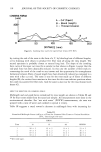
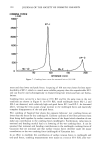
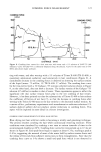
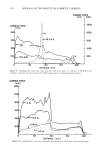
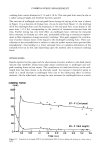
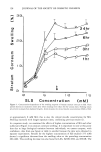
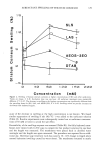
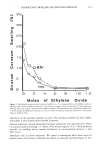
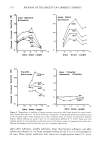
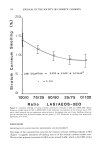
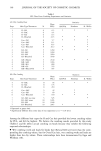
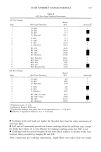
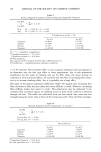
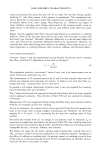
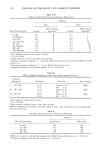
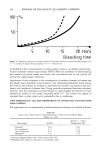
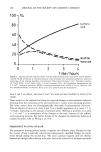
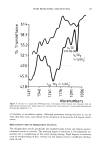
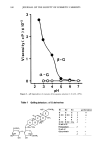
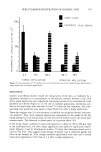
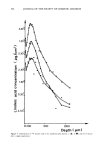
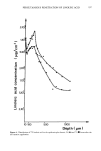
136 JOURNAL OF THE SOCIETY OF COSMETIC CHEMISTS THE C12 OR C14 MAXIMUM IN SWELLING For all the homologous surfactant series tested (except cationic surfactants which did not cause swelling), a maximum in swelling occurred for either the C•2 or C•4 homo- 1ogue. In vivo irritation also follows the same pattern for anionic surfactants (5,14). Our group (2) previously explained for similar results with alkyl sulfate homologues that this swelling maximum demonstrates the importance of hydrophobic interactions to the swelling mechanism. The hydrophobic bond energy increases with increasing chain length. However, at longer chain lengths, the larger molecules penetrate less efficiently into the matrix, and thus swelling is reduced for the longer chain alkyl sulfates. We also know that the submicellar concentrations of surfactant are lower for the higher alkyl chains due to the lower CMC. This would contribute to the lower relative amounts of swelling observed for the higher alkyl chain lengths. However, conversely, monomer levels would be higher for the shorter chain alkyl sulfates (since the CMC is relatively higher), yet swelling is depressed along with in vivo irritation for the shorter chain compared with the C•2 alkyl sulfate (5,14). This lends additional support for the importance of hydrophobic interactions in the swelling mechanism and probably for irritation. The importance of hydrophobic interactions to penetration of molecules through the epidermis has been clearly demonstrated (15,16). THE SWELLING MECHANISM Swelling is a two-step process: diffusion into the matrix followed by expansion against the elastic retractive forces of the substrate. Both steps are time-dependent. The swelling mechanism must involve a combination of ionic binding of the hydrophilic group as well as hydrophobic interactions of the alkyl chains with the substrate. We conclude this because nonionic surfactants don't promote swelling. We also conclude that the type of hydrophilic group is important to the swelling mechanism since, unlike anionic surfactants, cationic surfactants do not promote swelling and in fact cause shrinkage at longer incubation times (Figure 4). We speculate that cationic surfactants (at neutral pH) are attracted to and bind electrostatically to the excess of negative sites on the membrane (2, 17). This substitutes a hydrophobic cation for a small hydrophilic cation which converts a charged hydrophilic site into a hydrophobic site that repels water and may result in shrinking or tightening up of the structure. Anionic surfactants (at neutral pH), on the other hand, bind to hydrophobic sites by their hydrophobic tails, leaving the negative end group exposed. This type of binding creates additional anionic sites in the membrane, resulting in repulsive forces that separate the matrix, exposing more water-binding sites. This explanation is supported by our previous studies (2) of the effect of pH on surfac- tant-induced swelling. We demonstrated that at acidic pH anionic surfactants cause the least amount of swelling. At the lower pH, electrostatic binding of anionic surfactants would be enhanced to the new cationic sites produced. Increased ionic binding to the membrane would expose the hydrophobic tails which themselves associate and repel water, resulting in the reduced swelling at the lower pH compared to higher pH's. In the same manner, a cationic surfactant caused the least swelling at higher pH. This may be attributed again to enhanced ionic binding at higher pH for the cationic surfactant (which is known to be the case see for example reference 2), producing more association of hydrophobic tails, excluding water.

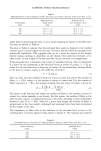
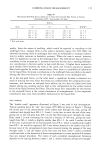
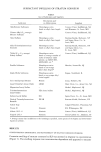
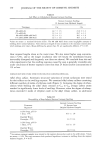
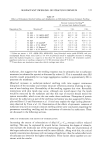
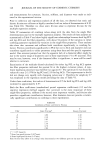
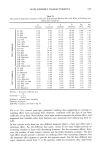
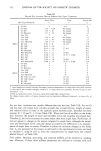
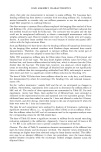
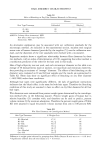
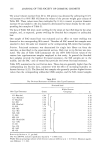
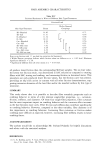
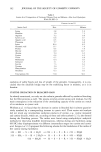
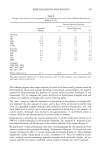
SURFACTANT SWELLING OF STRATUM CORNEUM 137 In general, then, for surfactants, we postulate that membrane shrinkage can occur due to electrostatic binding at some sites on the membrane resulting in water-repelling forces of the hydrophilic tails however, at other sites, membrane swelling can occur due to hydrophobic binding resulting in electrostatic repulsion by the negative end groups. The net effect will depend on both forces and on the structure of the surfactant. The effect of counter ions on surfactant-induced swelling may now be explained in this light. Both Mg 2+ and TEA + salts of equimolar amounts of lauryl sulfate elicited less swelling of the membrane than the corresponding Na + salt. The Mg 2+ salt is highly cationic and may crosslink the negative tails of the hydrophobically-bonded anionic surfactants, thus reducing the electrostatic repulsive forces between the hydrophilic tails. Alternatively, the reduced swelling for the Mg •+ salt of lauryl sulfate may, how- ever, be due in part to the reduced CMC. For TEA + we speculate that the large TEA + molecule may block the repulsive forces of the negative tails of the anionic surfactant. Still other mechanisms may explain the results. POSSIBLE EXPLANATIONS OF SURFACTANT INTERACTIONS REDUCING SWELLING The observation that stratum corneum swelling caused by LAS can be reduced by the addition of alkyl ethoxy sulfates and amphoterics clearly demonstrates an interaction of these components. Such interactions have been found by others (9-12) and may result from (a) competition for binding sites or binding surfaces, (b) a reduction in the CMC resulting in lower submicellar levels of free surfactant, or (c) some other association of the two surfactants, reducing either the surfactant available to interact with the mem- brane or the water-binding capability of the membrane. Faucher and Goddard (11) reported similar interactions between SLS and a nonionic surfactant (measured as a reduction in sorption of SLS to hair keratin). They suggested that this phenomenon was not due to competition for binding sites because the nonionic is sorbed very little by itself. Rather they felt that the more likely explanation was reduction in the overall monomer concentration of the mixed system compared to SLS alone. Similar explana- tions were postulated by Miyazawra eta/. (12), who explored the protein-denaturing potential of surfactants. ROLE OF SWELLING OF STRATUM CORNEUM IN THE IRRITATION MECHANISM What role does swelling play in the mechanisms of surfactant-induced irritation? Within classes of anionic and nonionic surfactants, the extent of swelling largely corre- sponds to the known irritancy of these surfactants (Table V). However, extent of swelling does not correctly predict the irritation potential of all surfactants. For ex- ample, cationic surfactants can be as irritating as some anionics, yet induce very little swelling. Swelling is thus not an important part of the mechanism of action of cationic surfactants. Clearly, swelling appears to be controlled by parameters such as binding strength, hydrophobic and hydrophilic interactions, molecular size, CMC, concentra- tion, and length of exposure time. Structure of the surfactant is important for swelling activity, i.e. alkyl chain length, degree of ethoxylation, nature of the polar head group, and counterion. Surfactant interactions also occur in mixtures resulting in modulation of the swelling response of the membrane these may be related to solution behavior of the two surfactants. Irritation is very complex and involves an additional cascade of events once the surfactant has penetrated the membrane. Thus chemical irritants may
Purchased for the exclusive use of nofirst nolast (unknown)
From: SCC Media Library & Resource Center (library.scconline.org)