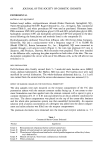
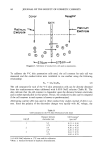
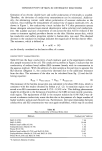
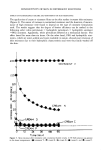
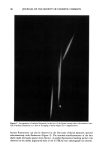
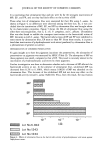
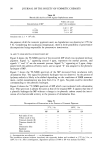
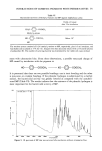
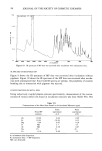
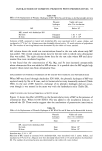
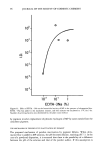
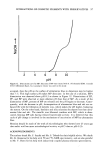
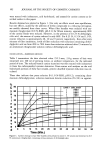
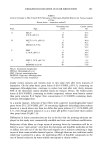
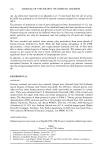
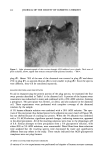
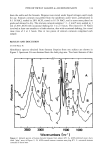
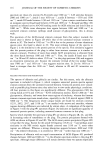
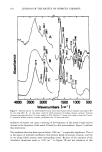
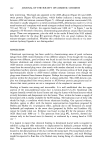
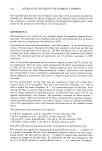
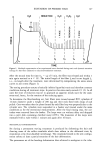
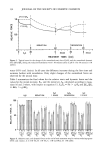
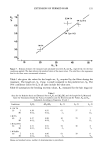
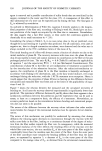
102 JOURNAL OF THE SOCIETY OF COSMETIC CHEMISTS were reacted with iodoacetate, acid hydrolyzed, and assayed for cystine content as de- scribed earlier in this paper. Results obtained are plotted in Figure 1. Not only are effects noted near equilibrium, but rate effects, caused by the addition of dithio compounds to a reducing mercaptan, are readily observed from these curves. When fiber bundles were reduced with am- monium thioglycolate (0.8 N-RSH, pH-9.2) for fifteen minutes, approximately 80% of the cystine bonds were reduced. However, in the presence of 0.125 N dithiodigly- colic acid, the amount of cystine reduced is only 60%. For 0.25 N, 0.5 N and 1.0 N, cystine reducton is approximately 40, 20 and 9 percent respectively. Even after sixty minutes of fiber immersion, levels of fiber reduction with solutions containing dithio- diglycolic acid are from 20% to 70% lower than reduction achieved after 15 minutes by an ammonium thioglycolate solution without dithiodiglycolic acid. EXCESS LOTION--IMMERSION METHOD Table I summarizes the data obtained when 152.5-mm, 2.0-g tresses of hair were immersed into 100 ml of perming lotion, at ambient temperature, for the indicated period of time. The reduced keratin cystine (cysteine) was then reacted with iodoacetate to form the carboxymethyl cysteine derivative. From amino acid analyses on the acid hydrolyzed portions of these hair strands, percent disulfide (cystine) reduction was cal- culated. These data indicate that perm solution B (1.0 N-RSH, pH-9.2), containing diam- monium dithiodiglycolate, achieves maximum keratin reduction (56.3%) in approxi- % C 90 y 8o s 70 t i 6o n 50 e 40 c I 3o e 2o a lO v e o d [ CUR•E # CO•lC. DTD(•A I 0.000 N f 2 0.125 N 3 0.250 N CURVE #1 CURVE #2 4 0.500 N 5 1.000 N ?? ou.w • • cu.w ,• • • • CURVE •5 • • 0 5 10 15 20 25 30 35 40 45 50 55 60 Time (Min.) Figure 1. Cystine cleavage in hair fiber bundles stress-relaxed in water (1.5% strain) and immersed in 0.8 N ammonium thioglycolate containing various amounts of dithiodiglycolate.

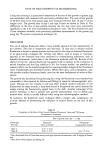
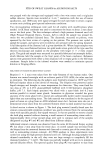
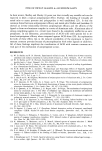
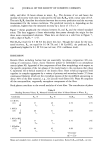
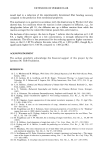
EXOGENOUS DISULFIDE IN HAIR REDUCTION 103 Table I Cysteine Cleavage in Hair Treated With Mercaptan or Mercaptan-Disulfide Mixtures for Various Lengths of Time (Excess lotion-- immersion methodS) Processing time Cystine cleaved Perm Type (min) (%) A NH4-T 5 76.5 (0.8 N, pH-9.3) 20 86.1 30 90.1 B NH4T (1.0 N, pH-9.2) 5 40.8 + 20 56.3 DTDGA (0.25 N) 30 53.8 40 54.3 C GMT 5 14.0 (1.18 N, pH-6.7) 20 38.4 30 58.4 40 71.9 GMT (1.29 N, pH-7.6) 5 9.3 + 20 21.8 DGDTDG (0.25 N) 40 31.8 NH4-T, Ammonium thioglycolate. DTDGA, Dithiodiglycolic acid. GMT, Glyceryl monothioglycolate. DGDTDG, Diglyceryl dithiodiglycolate. All processed at room temperature. mately twenty minutes and remains close to this value even after forty minutes of immersion. On the other hand, perm lotion A (0.8 N-RSH, pH-9.3), containing no exogenous dithiodiglycolate, continues to reduce hair and after only thirty minutes 90% of the theoretical cystine disulfide bonds are reduced. Hence, the weaker perm lotion A (0.8 N-RSH), containing no dithio compound, reduces more keratin cystine than perm solution B of higher thiol concentration (1.0 N-RSH) containing diam- monium dithiodiglycolate. In a similar manner, reduction of hair fibers with a glyceryl monothioglycolate based perm lotion D (1.29 N-RSH, pH-7.6) containing diglyceryl dithiodiglycolate reduces keratin at a much slower rate than the dithio-free perm solution C (1.18 N-RSH, pH 6.7), even though perm solution C is at a lower pH (pH-6.7) and lower thiol content than perm lotion D (pH-7.6). Differences in lotion concentrations are due to the fact that the perming solutions em- ployed in this study were commercially available and were used without modification. Reduction of hair fibers in a large excess of perming lotion by immersion will be re- ferred to as an "open system" since both the mercaptan and disulfide molecules are free to diffuse into and out of the hair fiber and migrate into a solution containing a large excess of these water-soluble chemical species. Although these are not conditions under which hair is permed in a salon, the moderating effect of disulfide compounds on the rate of keratin reduction by water-soluble mercaptans is clearly evident.
Purchased for the exclusive use of nofirst nolast (unknown)
From: SCC Media Library & Resource Center (library.scconline.org)