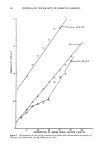
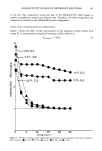
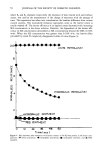
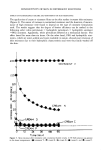
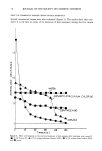
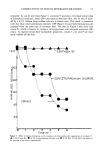
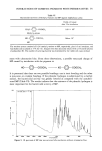
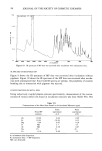
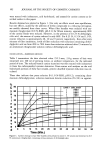
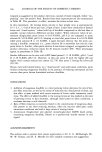
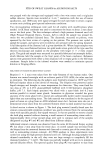
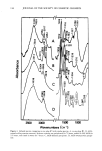
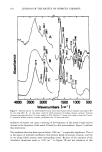
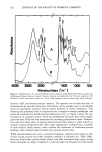
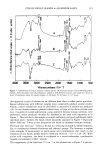
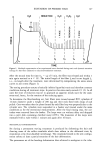
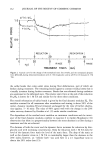
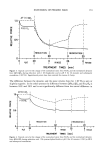
FTIR OF SWEAT GLANDS 8: ALUMINUM SALTS 119 spectrum to the in vivo plug #2, we have termed this the formation of an "in vitro plug." To determine the stability of this "in vitro plug," the sample (Figure 5B) was rinsed in distilled water an additional 5 hours and produced the spectrum in Figure 4B. The material that produced the intense plug-like spectrum disappeared, perhaps being sloughed off by the extended rinse (total of 7 hours). What remained was a good spec- tral match for ACH-treated stratum corneum. This indicated that not only was alu- minum penetration into heavily prehydrated stratum corneum deep but that the inter- action was strong and irreversible. This finding corroborates the results of earlier sorp- tion studies performed on guinea pig stratum corneum (8) and epidermal proteins (14). The similarity between the two spectra of plugs (Figures 5A and 5B) and the untreated stratum corneum (Figure 5C), in the region between 1200 and 1800 cm- •, is puzzling. It can be argued that both treated and untreated stratum corneum are present, espe- cially in the in vivo plug #2. This possibility would explain the intensity of the 1404 cm-• band and the frequency match of this as well as the amide II band at 1543 cm-• However, when the in vitro plug was rinsed an additional 5 hours, the resulting spec- trum (Figure 4B) continued to show changes associated with strong Al-stratum cor- neum interactions. The plug spectra outside this region clearly show strong Al-stratum corneum interactions. For example, in plug #2 spectrum, the band at 3117 cm-•, which appears to be a shift in the amide B band (associated to an N-H vibration), is usually found near 3070 cm-•. Habib et al. (15) have reported that the amide B ab- sorption at 3075 cm-• in untreated keratin shifted to 3125 cm-• when treated with a zinc reagent. The protein portion of both in vivo plugs resembled ACH-treated stratum corneum from the axilla even though their source was sweat ducts in the forearm. The kerati- nized cells in the forearm sweat ducts resemble those from axillary stratum corneum. To understand this phenomenon more clearly, forearm stratum corneum was examined in vitro. Interaction was expected with ACH since it is easier to inhibit sweating on the forearm than in the axilla. ACH-TREATED FOREARM STRATUM CORNEUM AND SPECTRAL SUBTRACTIONS The spectral changes which occurred when axillary stratum corneum was treated with ACH were readily discernible (compare Figures 5C and 4B). Similar treatments with a number of forearm stratum corneum samples produced no obvious changes (Figure 6), even in one sample that was prehydrated for 115 hours. This was surprising, since we knew that sweat inhibition was more readily achieved on the forearm than in the axilla. Since our biopsies came from the forearm, a closer examination of these spectra was needed. While these results did not add significantly to the characterization of the plug composition, they did add to our understanding of aluminum-protein interactions and are therefore included. First, the stratum corneum spectrum from the forearm (Figure 6A) was different from that from the axilla (Figure 5C). This was seen mainly in the 1300 cm-• region and at the amide I absorption near 1650 cm-•, which showed a significant difference in fre- quency and band shape these factors indicate compositional differences between forearm and axillary stratum corneum. Cursory inspection of Figure 6 might lead one to believe little interaction occurred

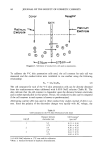
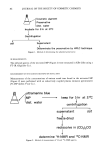
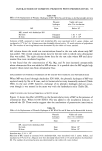
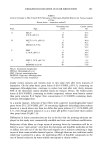
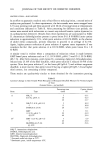
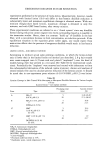
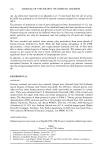
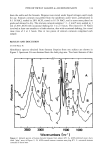
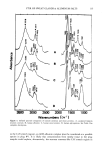
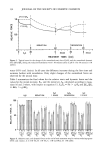
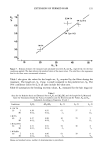
120 JOURNAL OF THE SOCIETY OF COSMETIC CHEMISTS I ' I ' ' I • I I A B 4000 3500 3000 1500 1000 5OO Wavenumbers {CM '1 ) Figure 6. Infrared spectra: A, antteated forearm stratum cornearn, prehydrated for 68 hours and dried. B, ACH-treated forearm stratum corneurn. Stratum corneum was prehydrated for 90 hours, soaked in 20% ACH for 2 hours, and rinsed in water for 3 hours. Peak frequencies are the same except where indicated. between ACH and forearm stratum corneum. The opposite was actually the case, as demonstrated by spectral subtraction. Fortunately, all six samples used in the forearm series of experiments produced spectra closely matched in overall absorbance. This showed good uniformity both in composition and in sample-to-sample pathlength, and produced conditions for reliable spectral subtractions (16, 17). Figure 7 shows the sub- tractions of an untreated control, which was prehydrated 68 hours, from three samples given the same ACH and rinse treatments but increasing prehydration times. Prehydra- tion time was varied since A1 sorption had previously been found to relate directly to stratum corneum prehydration (8). After using "appropriate" scaling factors, a number of new positive bands remain these indicate the formation of aluminum-protein bonding, while residual negative bands show protein reaction sites. While spectral subtraction can be a powerful technique, experience has taught us that certain criteria must be met before complete confidence is achieved (16). "Real" differ- ences are found when positive bands persist even after oversubtracting (using scaling factors obviously too large). Confidence is achieved when the frequencies of new bands
Purchased for the exclusive use of nofirst nolast (unknown)
From: SCC Media Library & Resource Center (library.scconline.org)