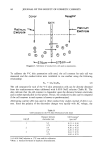
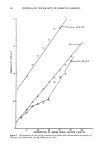
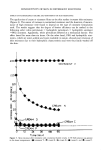
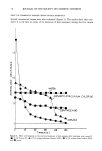
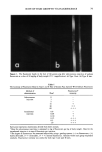
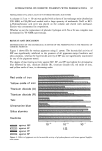
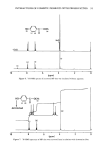
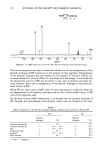
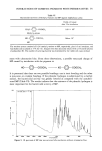
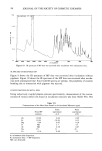
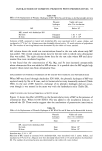
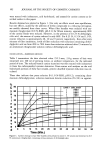
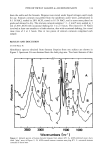
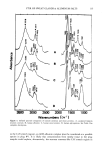
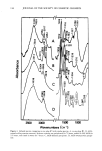
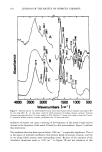
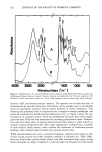
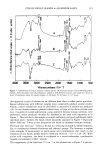
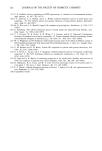
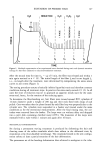
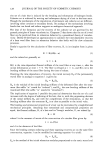
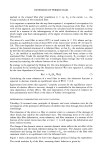
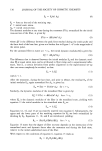
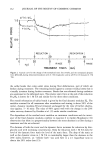
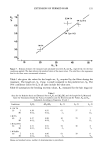
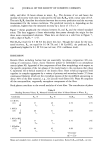
FTIR OF SWEAT GLANDS 8: ALUMINUM SALTS 117 the plug # 1 spectrum. Treated and untreated stratum corneum are similar in the C-H stretch region. IN VITRO ACH-TREATED AXILLARY STRATUM CORNEUM The best match for plug #1 spectrum is shown in Figure 4B. This spectrum was obtained from prehydrated axillary stratum corneum, was soaked in 20% ACH, then given a water rinse. This spectrum was essentially reproduced seven times using varying periods of treatment on axillary stratum corneum from two different subjects. Prehy- dration times ranged from 18 to 94 hours. Five samples were soaked in ACH for two hours, one for one hour, and another for 24 hours. Water rinses varied between 2 and 4.5 hours except the sample shown in Figure 4B, which was rinsed for a total of 7 hours. The ability to reproduce spectr,um 4B many times and from different subjects gave us confidence that this spectrum was representative of ACH-treated axillary stratum corneum. Untreated controls of axillary stratum corneum, also from different subjects, yielded spectra virtually identical to 5C, showing good sample-to-sample re- producibility even between subjects. ACH treatment of axillary stratum corneum produced changes between 1400 and 1600 cm-• similar to those produced by precipitating albumin with ACH. Compared to untreated axillary stratum corneum (Figure 5C), an intensity reversal was produced in the bands near 1400 and 1450 cm -•, and an amide II band at 1520 cm -• became resolved. A better match for plug # 1 was found, however, in the C-H stretch region compared to the albumin complex. Although not as evident in Figure 4B, additional features usually appeared in the ACH-treated biopsies of stratum corneum. These in- cluded intensity increases and band broadening at 1080 cm-• (A1-O-H bending vibra- tion), with a new band occurring at 1107 cm-•. Two additional weak bands were often found near 920 and 860 cm-•. All of these findings are evidence that the proteinaceous portion of plug #1 results from a chemical interaction with ACH and is not simply contamination from stratum corneum. IN VIVO PLUG #2 AND IN VITRO PLUG FORMATION The dark plug material from the second subject produced a unique spectrum, especially in the region below 1200 cm-• (Figure 5A). An excellent overall match was found for this spectrum by in vitro treatment of axillary stratum corneum with ACH (Figure 5B). While duplication of this in vitro spectrum was successful, both treatments included extended (72-hour) prehydration. A noteworthy difference between these spectra is found in the broad absorption in the OH stretch region of spectrum 5B centered at about 3300 cm-•, reflecting a higher state of hydration (probably as water of hydra- tion). Why this particular sample is the only one giving such a broad OH stretch region remains unexplained. Segnini et al. (11) investigated the infrared spectra of various metal-alanine coordination complexes in hydrated and dehydrated forms. They reported frequency shifts due to hydration on the order of 5 to 10 cm- • in nickel (II) complexes. These included bands at 852 cm -•, 920 cm-• (assigned to skeletal vibrations), 1030 cm-•, and 1405 cm-• (assigned to OCO symmetrical stretch). A similar dehydration effect was reported for bis-(glycino)-zinc (II) monohydrate and its anhydrous complex (12) and various other metal-amino acid complexes (13). Bendit (27) reported that

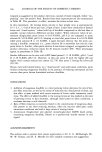
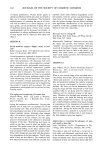
118 JOURNAL OF THE SOCIETY OF COSMETIC CHEMISTS A ß I . I. ß ///L . I ß I 4000 3500 1500 1000 Wavenumbem {cM ) Figure 5. Infrared spectra: A, ACH-inhibited sweat ducts from human forearm biopsies from subject #2 (in vivo plug #2). B, "in vitro plug" made by ACH-treatment of axillary stratum corneum. Stratum corneum was prehydrated for 72 hours, soaked in 20% ACH for 2.5 hours, and rinsed in water for 2 hours. C, untreated axillary stratum corneum, prehydrated for 70 hours and dried. hydration of keratin can cause a lowering of the frequency of the amide I band and an increase in the frequency of the amide II band by a few wavenumbers. Figure 5 confirms this observation. The similarity between these spectra below 1200 cm-• is especially significant. This is in the region of minimal interference from protein bands of stratum corneum, and the in vivo plugs likely contain some surrounding tissue. Because of the intensity of the Al-related vibrational mode at 1042 cm -• in Figure 5B and the similarity of this
Purchased for the exclusive use of nofirst nolast (unknown)
From: SCC Media Library & Resource Center (library.scconline.org)