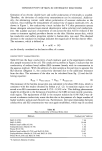
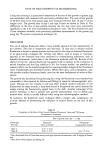
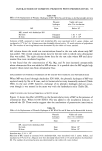
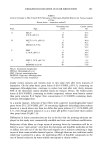
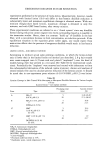
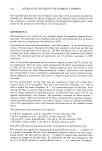
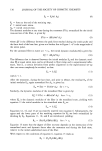
EXOGENOUS DISULFIDE IN HAIR REDUCTION 105 experiments performed in the presence of excess lotion. Quantitatively, however, results obtained with limited lotion (10.0 ml) differ in that keratin disulfide reduction is substantially lower and maximum equilibrium cleavage is obtained sooner. With am- monium thioglycolate based lotions, maximum cleavage is obtained in only five minutes, and with GMT-based lotions, after twenty minutes. These experimental conditions are referred to as a "closed system" since any disulfide formed during reduction cannot migrate into excess surrounding liquid as is possible in the immersion studies. Hence, there is a constant "build up" of disulfide in the hair fiber, with a concomitant decrease in thiol concentration, as reduction proceeds. If the equilibrium situation in the equations given earlier apply, one would expect from mass-action effects that the presence of exogenous disulfide would result in less keratin reduction. LIMITED LOTION--ROD IMPLANT METHOD Attempting to replicate actual salon perming conditions, in which the lotion-to-hair ratio is lower than in the limited lotion rod method just described, 2.0 g hair strands were water-wrapped onto 6.35-mm rods and placed ("implanted") onto the head of models having their hair permed in a test salon (See Table III for experimental condi- tions). Periodically the "implants" were removed and reacted with iodoacetate to form the carboxymethyl derivatives of the reduced cystine (cysteine). Amino acid analyses of treated strands were used to calculate percent reduction of the keratin cystine. It should be noted that in one experiment perm solution A (0.8 N-RSH, pH-9.2) was lotion- Table III Cysteine Cleavage in Hair Treated With Mercaptan or Mercaptan-Disulfide Mixtures for Various Lengths of Time (Limited lotion--rod implant method) Processing time Cystine cleaved Perm Type (min) (%) A NH4-T 5 13.8 (26.8) • (0.8 N, pH-9.3) 20 27.3 (48.4) • B NH4 T (1.0 N, pH-9.2) 5 10.8 + 20 21.3 DTDGA (0.25 N) C 2 GMT 5 19.4 (1.18 N, pH-6.7) 20 29.3 @ 53øc D 3 GMT (1.29 N, pH 7.6) 5 1.9 + 20 22.7 DGDTDG (0.25 N) @ 45øC NH4-T, Ammonium thioglycolate. DTDGA, Dithiodiglycolic acid. GMT, Glyceryl monothioglycolate. DGDTDG, Diglyceryl dithiodiglycolate. Lotion-wrapped. Processed under hair dryer at 53øC. Exothermic perm, initial temperature 45øC.

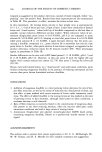
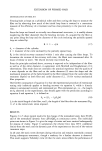
106 JOURNAL OF THE SOCIETY OF COSMETIC CHEMISTS wrapped as suggested in the product directions, instead of water-wrapped, before "im- planting" onto the model's head. Results from these experiments are also summarized in Table III. This procedure, in effect, increases the lotion-to-hair ratio. In this experiment, the waving lotion volume to hair weight ratio is approximately 0.7:1 (i. e., 1.4 ml of lotion per each 2.0 gm of hair). Under these conditions of limited lotion and "closed system," where build up of disulfide compounds in the hair fiber is possible, cystine reduction differences are also evident. When reduction values of am- monium thioglycolate perm lotion A (0.8 N-RSH, pH 9.2) are compared to perm solution B (1.0 N-RSH, pH 9.2), keeping in mind that perm lotion A is 0.8 N-RSH while perm solution B is 1.0 N-RSH, it again becomes obvious that the perm con- taining a disulfide compound (i.e., perm solution B) is somewhat less reactive than perm lotion A. Further, when perm solution A was lotion-wrapped, as suggested in the product directions, reduction values for 20 minutes reached 48%. These percentages appear in parentheses in Table III. Similar differences can be seen with GMT-based perms C (1.18 N-RSH, pH-6.7) and D (1.29 N-RSH, pH-7.6). However, in this case perm D with the higher pH and higher thiol content reduces less cystine (22.7%) than perm C having the lower pH (29.3%). Hence, even with limited lotion, in a "closed system" and under salon conditions, perm lotions containing exogenous disulfide in the presence of reducing mercaptans are less reactive than perm lotions formulated without disulfides. CONCLUSIONS 1. Addition of exogenous disulfide to a thiol perming lotion decreases the rate of ker- atin fiber reduction, as well as the extent of reduction (in a fixed period of time), and this effect is most marked with excess amounts of lotion under immersion condi- tions. The effects of added disulfide to the waving lotion are less marked as the ratio of perming lotion to hair decreases, although under practical salon conditions, a moderate decrease is still observed. 2. Rate of fiber reduction is inversely related to the concentration of exogenous disul- fide present in the thiol reducing medium, when the reaction takes place under immersion conditions and with a large excess of waving lotion. 3. Ammonium thioglycolate and glyceryl monothioglycolate (GMT) based perms, containing exogenous disulfide, behave in a qualitatively similar manner in this regard. ACKNOWLEDGEMENTS The authors wish to express their sincere appreciation to Dr. E. G. McDonough, Mr. W. W. Edman, and Dr. E. Menefee for their valuable comments and suggestions.
Purchased for the exclusive use of nofirst nolast (unknown)
From: SCC Media Library & Resource Center (library.scconline.org)