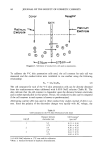
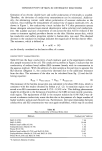
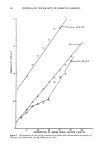
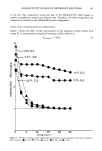
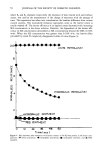
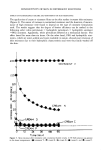
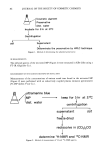
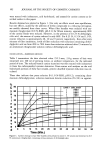
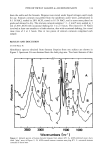
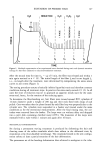
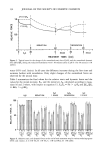
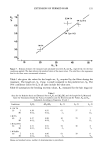
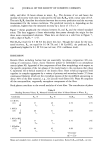
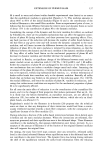
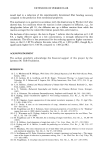
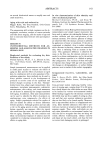
126 JOURNAL OF THE SOCIETY OF COSMETIC CHEMISTS The experimental procedure was developed on the basis of the procedures described by Tobolsky (4), Eriemann (5), and by de Jong (6), and combined with a method for the data evaluation to provide a feasible method for the detailed investigation and to some extent for the prediction of the efficacy of a waving system. EXPERIMENTAL All experiments were carried out on a standard sample of chemically untreated Euro- pean hair. All stress-strain and relaxation experiments were performed with an Instron tensile tester in a temperature controlled room (20øC). To perform the stress-strain measurements, a hair fiber (approx. 12 cm) was mounted as a loop of 50-mm length. The ends of the fiber were clamped in the lower jaw that was mounted on the base plate of the machine. The fiber was passed over a 2-mm diameter stainless steel hook connected to the load cell mounted in the crosshead of the Instron tester. The crosshead speed for all experiments was 10 mm/min, equivalent to 20% strain/min. Prior to the actual experiments the stress-strain diagram in water (20øC) of every hair was determined. After the stress-strain measurement the fibers were released in water at 50øC for one hour to restore their original properties and then stored at 65% RH/20øC for later use. Only fibers showing the "normal" stress-strain curve expected for a keratin fiber (3) were considered as undamaged and were used for further testing. Fibers exhibiting a pronounced yield point or a negative slope in the yield region were discarded. For the dynamic/static test the fiber loop was immersed in water and a small static strain of about 0.5% was applied. This strain lies within the "Hookean" (½ 2%) as well as within the linear viscoelastic (½ 1%) stress-strain region of the fiber. After leaving the fiber in water to relax for about 20 minutes to allow the stress level in the fiber to closely approach its equilibrium value, an additional strain pulse of 0.2% was applied intermittently every minute. The procedure continued for about another 5 minutes in water. Then the treatment of the fiber, consisting of the treatment sequence: reduction/rinse/reoxidation/rinse, was started. Figure 1 gives an idealized representa- tion of the experimental curves and illustrates the definitions of the variables as used below. The following setting treatments were applied: 0.3 M TA: thioglycolic acid, 0.3 M, pH 9, 20 rain reduction, 20øC. 1 M TA: thioglycolic acid, 1 M, pH 9, 20 rain reduction, 20øC. 1 M Cys-HCI: cystein hydrochloride, 1 M, pH 8, 40 min reduction, 20øC. 1 M Sulfite: sodium sulfite, 1 M, pH 6.4, 40 min reduction, 20øC. The pH of the solutions was adjusted either with ammonia or hydrochloric acid. The solutions were applied by immersing the strained fiber for time (t 2 - t•) (Figure 1) in a beaker containing 200 ml of the appropriate reductive solution that was contin- uously stirred. The first rinse for time (t 3 - t2) lasted 25 minutes and consisted of five consecutive changes of distilled water. For reoxidation the fiber was immersed in 200 ml of 2.3% H202 solution at neutral pH for time (t 4 -- t3) , which was 20 minutes.

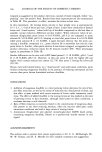
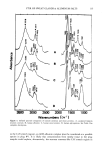
EXTENSION OF PERMED HAIR 127 H20 I REDUCTION H20 iH202 H20 I I ,Fo I TIME Figure 1. Idealized representation of an experimental curve obtained during static and dynamic extension testing of a hair fiber subjected to reduction/reoxidation treatment. After the second rinse for time (t 5 - t4) of 5 min, the fiber was released and within 1 min again strained to ß 1%. The initial length of the fiber 10 and its set length 11, i.e., its length after the treatment, were determined by extrapolating the stress strain curves to zero stress (Figure 1). The testing procedure ensures a basically infinite liquor/hair ratio and therefore constant conditions during all treatment steps. In practice this ratio rarely exceeds 2:1 (2). In all cases the time of reduction was set to approach an apparent steady state for the static stress and, hence, for the reaction of the reducing agent. To determine the fiber-bending set, hair fibers were wound around PVC cylinders of 12-mm diameter under a weight of 200 mg and their ends fixed with drops of nail polish. Care was taken that the plane formed by each fiber loop was perpendicular to the cylinder axis. The cylinders were suspended in a beaker and treated under the same conditions as for the extensional measurements. After the final rinsing step, the cyl- inders were removed from the beaker. The loops were cut without delay and dropped into a petri dish containing distilled water (20øC). The diameters of the loops were measured with a ruler within 1 minute and again after 16 hours. MECHANICAL CONSIDERATIONS Set during a permanent waving treatment is produced by deforming the hair and cleaving some of the sulfur crosslinks which then reform in the deformed state by reoxidation or by thiol-disulfide interchange. The crosslinks formed in the new configu- ration enforce at least a partial retention of the hair deformation. The permanent set of the bending deformation thus achieved is analogous to the cohe-
Purchased for the exclusive use of nofirst nolast (unknown)
From: SCC Media Library & Resource Center (library.scconline.org)