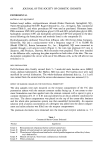
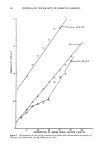
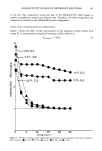
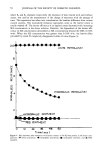
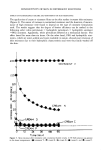
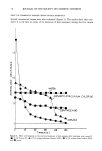
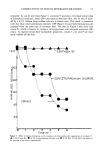
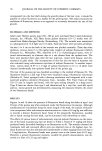
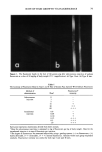
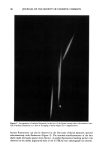
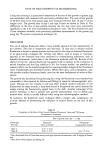
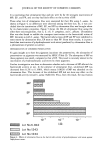
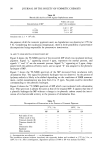
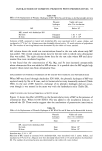
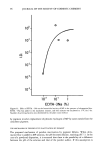
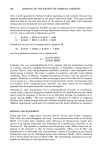
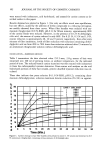
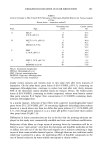
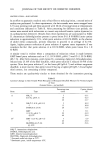
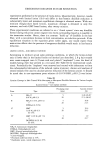
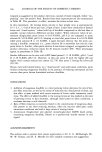
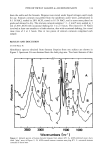
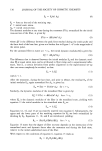
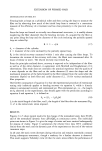
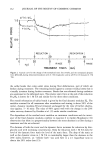
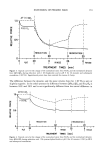
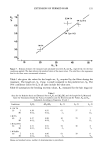
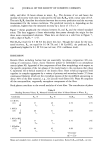
138 JOURNAL OF THE SOCIETY OF COSMETIC CHEMISTS agent is removed and a possible contribution of sulfur bonds that are reoxidized by the oxygen contained in the water used for the rinse (15). A consequence of this effect is that substantial set of a wave can be expected just by rinsing the hair. The final gain of Ero is achieved by reoxidation. As outlined in Determination of Fiber Set, equation 6 directly applies to the longitu- dinal properties of the fiber and, according to DeJong's work (6), should give an accu- rate prediction of the length set acquired by the fiber due to treatment. Nevertheless, the data suggest that a hair fiber cannot, at least under the conditions applied, be chemically set at small extensions (½ 2%). Considering the values in Table I, S L in no case comes close to the set predicted, even though the actual bending set is greater than predicted. For all conditions, even cases of negative set, that is a length contraction on release, were observed and the value zero is always included in the 95% confidence limits of the mean of S L. The initial bending set of a fiber will always contain a fraction of cohesive set due to the initial modulus of phase M. The recovery increases with time since the phase M mod- ulus decays rapidly in water and cannot maintain its contribution to the fiber set for any prolonged period of time. The ratio Ri/R•6 = 0.8 (Table II) confirms the applicability of equation 7 and the expectation •(oo) = 0.8 (see Mechanical Considerations). The contributions of phase M to the fiber set are (independent of treatment) accounted for by the introduction of the relaxation function. After the reduction/reoxidation se- quence, the contribution of phase M to the fiber modulus is basically unchanged in accordance with DeJong's (6) observations, and, as the data would indicate, even stays unchanged during the reduction, with the 1 M TA treatment as an exception. Hence it would appear that the properties of phase M have no bearing on the differences between anticipated and measured fiber recoveries and on the limits of the applicability of equa- tions 6 and 16. Figure 7 shows the relation between the measured and the calculated recoveries of bending set. In all cases the recovery observed experimentally is significantly lower than predicted. The systematic difference between R i and R o shows that there appears to be a satisfactory correlation between the prediction and the experiment that can be used to assess, at least on a comparative basis, the efficacy of a treatment. Nevertheless, an accurate prediction based on the interrelation between bending and extensional proper- ties does not seem to be possible. The nature of the difference between the recovery values indicates that other mecha- nisms besides the change of the extensional modulus must be operative for set determi- nation. The nature of this mechanism can possibly be understood by assuming that during diffusion the reducing agent decreases in concentration through the reaction with the sulfur cross-links in the fiber, leading to a continuous decrease of the degree of reduc- tion from the fiber surface towards the fiber core. In consequence, while the measured extensional modulus of the fiber reflects the resulting effect of the reaction over the whole fiber cross-section, the true modulus Ere of the outer parts of the fiber might be considerably lower than the modulus near the center of the fiber. Since the outer parts of the fiber contribute more towards the bending stiffness of the fiber than the inner parts, as expressed by equation 5, a decrease of Ere in the outer parts of the fiber compared to the average value of Ere , as obtained from the extensional measurements,

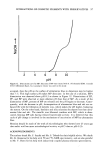
EXTENSION OF PERMED HAIR 139 would lead to a reduction of the experimentally determined fiber bending recovery compared to the prediction from extensional properties. This mechanism is in qualitative accordance with the observations by Wickett (22) who showed that, for conditions where the reaction is slow compared to diffusion, e.g., for thioglycolate below pH 10, the diffusion sets up a diffuse reaction front while the reaction averaged for the whole fiber follows pseudo first-order kinetics. On the basis of this concept, the data in Figure 7 indicate that the reduction in 0.3 M TA, a highly effective agent at a low concentration, is strongly influenced by this mechanism. The effect is less pronounced for the reducing agents at higher concentra- tions, so that 0.3 M TA achieves the same value of Ri as 1 M Cys-HCI, though R o is significantly higher for 0.3 M TA compared to 1 M Cys-HC1. ACKNOWLEDGEMENT The authors gratefully acknowledge the financial support of this project by the Lawrence M. Gelb Foundation. REFERENCES (3) (4) (5) (6) (7) (8) (9) (10) (11) (12) (13) (14) (15) (1) J. A. Maclaren and B. Milligan, WoolScience.' The ChemicalReactivity of the WoolFiber (Science Press, Sydney, 1981). (2) S. D. Gershon, M. A. Goldberg, and M. M. Rieger, "Permanent Waving," in Cosmetic Science and Technology, M. S. Balsam and E. Sagafin, Eds. (Wiley Interscience, New York, 1972), Vol. II, pp. 167-250. C. R. Robbins, Chemical and Physical Behaviour of Human Hair (Van Nostrand Reinhold Co., New York, London, 1979). A. V. Tobolsky, Mechanische Eigenschaften und Struktur von Polymeren (Berliner Union, Stuttgart, 1967). G. A. Eriemann, Die modernen Dauerwellsysteme, Parfiimerie und Kosmetik, 64, 541- 544 (1983). S. DeJong, Linear viscoelasticity applied to wool setting treatments, Text. Res. J., 55, 647-653 (1985). B. M. Chapman, Linear superposition of time-variant viscoelastic responses, J. Phys. D. Appl. Phys, 7, L185-L188 (1974). E. F. Denby, A note on the interconversion of creep, relaxation and recovery, Rheol. Acta. 14, 591-593 (1975). M. Feughelman and M. S. Robinson, Some mechanical properties of wool fibers in the "Hookean" region from zero to 100% relative humidity, Text. Res. J., 41, 469-474 (1971). F.-J. Wortmann and S. DeJong, Analysis of the humidity-time superposition for wool fibers, Text. Res. J., 55, 750-756 (1985). M. Feughelman and T. W. Mitchell, Set in bending of single wool fibers, Text. Res. J., 35, 88-89 (1965). C. R. Robbins, Load elongation of single hair coils, J. Soc. Cosm. Chem., 34, 227-239 (1983). S. DeJong and N. A. Michie, A model for predicting set in helices, Text. Res. J., 56, 219-227 (1986). H. Munakata, The stress relaxation and set of wool fibers with particular reference to their structure and mechanical properties, Text. Res. J., 34, 97-109 (1964). A. StriiBmann and H. Zahn, Alterations caused by cosmetic treatments on human hair--The impor- tance of the degree of reduction in permanent waving, Proc. 7, Into Wool Text. Res. Conf. Tokyo, IV, 173-182 (1985). (16) M. Feughelman, A two-phase structure for keratin fibers, Text. Res. J., 29, 223-228 (1959).
Purchased for the exclusive use of nofirst nolast (unknown)
From: SCC Media Library & Resource Center (library.scconline.org)