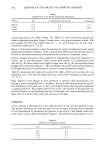
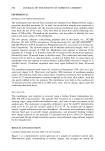
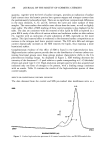
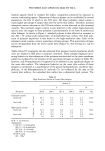
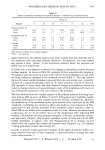
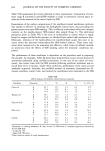
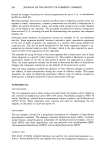
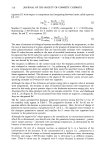
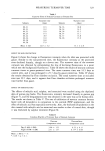
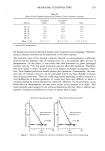
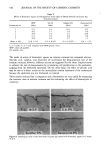
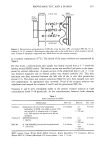
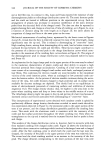
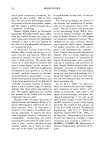
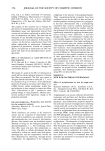
304 JOURNAL OF THE SOCIETY OF COSMETIC CHEMISTS Table VIII summarizes the results obtained in these experiments. Comparison of treat- ment stage B (untreated control/SDS washed) to stage A (untreated control) again re- veals the facile removal of the native lipids by SDS. Examination of the surface compositions of the emollient-treated membranes indicates that lanolin is effective in retaining the hydrophobic barrier layer, thus providing the greatest protection upon SDS washing. This is reflected as decreased sulfur and nitrogen contents on the lanolin-treated, SDS-washed skin sample (Stage C). The additional parameter given in Table VIII is the ratio of hydrocarbon to carbon which is singly bound to oxygen (alcohol/ether groups), as obtained from carbon high-resolution data. Obviously, retention of the hydrocarbon-rich emollient/lipid causes this ratio to in- crease versus the relatively hydrocarbon-free SDS-washed surfaces. These same indi- cators show mineral oil to be somewhat less effective, while castor oil affords virtually no protection from the effects of SDS washing under the treatment conditions em- ployed. The performance of these emollients is dependent on the procedure used in preparing the samples. As examples, Table IX shows data obtained from castor oil and mineral oil treatments performed using modified procedures. In the case of the castor oil treat- ments, the contact time with the SDS solution following emollient treatment was re- duced from 30 to 5 minutes. Under these conditions, performance of the castor oil was markedly improved. Similarly, the modified mineral oil treatment eliminated the 30- minute emollient contact time, and instead the membranes were immersed in the SDS Table VIII ESCA Analysis of Emollient-Treated Stratum Corneum Emollient Treatment C O N S C - C/C - O Castor oil A 81.7 12.7 2.2 0.4 5.8 B 72.8 15.5 8.1 1.5 4.1 C 73.4 15.7 8.5 1.6 3.8 Mineral oil • A 84.7 11.6 1.5 0.3 7.5 B 74.8 14.6 8.6 1.2 4.2 C 81.5 10.3 4.8 0.8 8.6 Glycerid acid 2 A 77.8 14.0 3.6 0.4 7.4 B 72.6 15.0 8.3 1.8 3.9 C 74.2 15.2 6.8 2.0 4.8 Oleic acid A 81.0 12.6 2.8 0.4 10.4 B 72.2 16.9 4.5 3.1 5.8 C 72.7 15.8 8.7 1.9 5.2 Lanolin A 84.2 11.7 2.2 0.4 8.9 B 70.4 16.2 9.5 1.7 4.1 C 86.2 9.2 1.0 0.6 10.4 Treatments: A, starting membrane B, after 30-min 1% SDS wash 30-min SDS wash. • Acroprime 350. 2 Agent GII, Westvaco. Values listed are results of single measurements. C, emollient application followed by

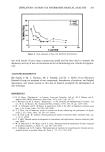
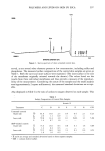
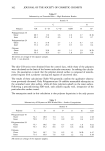
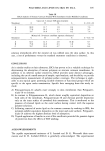
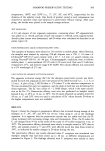
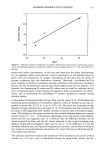
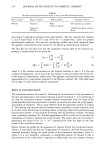
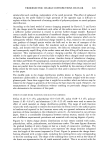
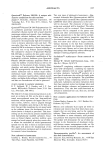
POLYMERS AND LIPIDS ON SKIN BY ESCA 305 Table IX ESCA Analysis of Stratum Corneum Treated With Emollients Under Modified Conditions Castor oil: 5-minute SDS post-treatment Treatment C O N S C - C/C - O A 80.0 13.7 1.8 0.4 7.6 B 77.8 14.2 4.3 0.8 5.5 C 79.7 14.8 1.3 0.2 7.4 Treatment Mineral oil: 30-minute emollient exposure eliminated C O N S C - C/C - O A 82.3 12.5 2.8 N.D. 9.7 B 75.8 14.8 6.3 1.8 5.4 C 78.7 12.8 4.7 1.4 6.4 solution immediately after the mineral oil was rubbed onto the skin surface. In this case, a loss of performance versus the standard treatment conditions is observed. CONCLUSIONS As in similar studies on hair substrates, ESCA has proven to be a valuable technique for determining the adsorption of various polymers on stratum corneum membranes. In addition to its inherent surface sensitivity, ESCA provides some distinct advantages, including the use of a small amount of sample, rapid analysis, and the ability to provide semiquantitative measurements of polymer-surface coverages. The technique is appli- cable to any topical agent possessing suitable elements or functional groups which are specific to the agent under examination. Specific facts emerging from this study in- clude: A) Polyquaternium-24 adsorbs more strongly to skin membranes than Polyquater- nium-10 or chitosan. B) In contrast to Polyquaternium-24, which shows roughly equivalent deposition on both sides of the membrane, Polyquaternium-10 and chitosan provide deposition only on the inner surface of unwashed skin membranes. This is attributed to the presence of retained lipids on the outer surface during contact with the aqueous polymer solutions. C) Following removal of native lipid on the stratum corneum by washing in SDS, the polymers exhibit equivalent deposition on the inner and outer surfaces. Polyquater- nium-24 achieves the highest absolute level of adsorption. D) Topical application of lanolin in a set of five emollients provided the greatest degree of protection from the effects of SDS washing. ACKNOWLEDGEMENTS The capable experimental assistance of E. Lesniak and D. G. Weternik (skin treat- ments) and D. H. Scofield (ESCA) is gratefully acknowledged. The experimental
Purchased for the exclusive use of nofirst nolast (unknown)
From: SCC Media Library & Resource Center (library.scconline.org)