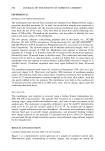
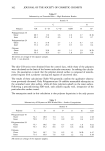
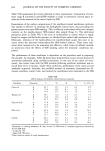
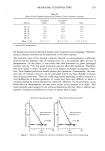
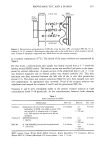
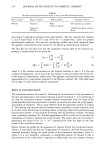
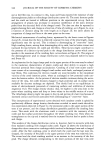
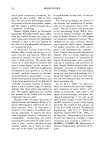
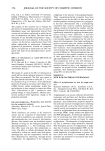
302 JOURNAL OF THE SOCIETY OF COSMETIC CHEMISTS Table IV Substantivity on Unwashed Skin--High-Resolution Results Atomic % C N Polymer CH C - O C = O COO N N + P olyquaternium- 10 Outer 68.5 9.6 3.6 2.6 2.7 N.D. Inner 60.4 15.6 4.6 1.0 2.0 0.7 Polyquaternium-24 Outer 53.1 17.8 3.7 1.5 0.7 0.4 Inner 53.4 23.4 3.7 0.3 1.0 0.4 Chitosan Outer 59.6 12.8 4.4 3.1 3.9 N.D. Inner 56.4 16.4 4.7 1.8 2.0 0.8 All entries are average of two separate samples. N.D. = not detected. The skin C/O ratios were obtained from the control data, while those of the polymers were calculated on the basis of the known molecular structures. In making this calcula- tion, the assumption is made that the polymer-treated surface is composed of interdis- persed regions with a polymer coating and regions of uncovered skin. The results of these calculations (Table VII) generally confirm the qualitative observa- tions previously discussed. Only Polyquaternium-24 exhibits measurable adsorption on the unwashed outer skin surface, while all three polymers adsorb on the inner surface. Following a preconditioning SDS wash, each adsorbs equally well, irrespective of the particular skin surface tested. The assumption made in this calculation is that polymer deposition is the only process Table V Substantivity of Polymers on SDS-Washed Skin--Surface Compositions Atomic % Polymer C O N P S Si C/O Polyquaternium- 10 Outer 74.2 18.8 5.4 0.1 1.2 0.2 3.95 Inner 70.8 17.4 7.4 0.9 1.0 0.4 4.07 Polyquaternium-24 Outer 74.7 18.6 4.8 0.3 0.6 1.0 4.02 Inner 70.3 19.2 8.6 0.7 0.6 N.D. 3.66 Chitosan Outer 74.6 16.7 7.0 0.2 1.5 N.D. 4.47 Inner 73.4 16.0 7.6 0.6 1.2 0.2 4.59 All entries are average of two separate samples.

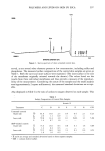
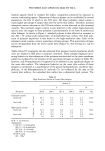
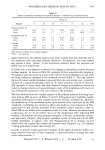
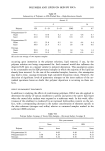
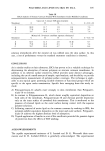
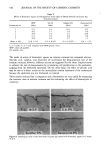
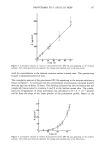
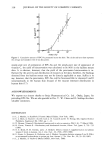
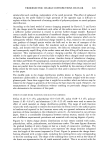
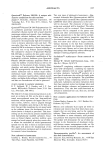
POLYMERS AND LIPIDS ON SKIN BY ESCA 303 Table VI Substantivity of Polymers on SDS-Washed Skin--High-Resolution Results Atomic % C N Polymer CH C - O C = O COO N N + Polyquaternium- 10 Outer 47.1 19.8 6.2 1.0 4.8 0.7 Inner 44.0 19.6 6.6 0.8 6.5 0.8 Polyquaternium-24 Outer 45.1 21.8 6.2 1.6 4.4 0.4 Inner 38.0 21.4 9.1 1.8 7.8 0.6 Chitosan Outer 50.8 15.4 6.6 1.8 5.6 1.4 Inner 49.4 14.9 7.2 1.8 6.6 0.9 All entries are average of two separate samples. occurring upon immersion in the polymer solutions, lipid removal, if any, by the polymer solution not being compensated for. Such removal would also influence the observed C/O ratio in a manner similar to polymer deposition. This assumption seems to be a reasonable one for SDS pretreated samples in which the majority of the lipid has already been removed. In the case of the unwashed samples, however, this assumption may lead to error, causing erroneously high calculated deposition values. However, the detection of significant levels of quaternary nitrogen on the inner surfaces of the un- washed specimens leaves no doubt that polymer deposition is occurring on these sur- faces. EFFECT OF EMOLLIENT TREATMENTS In addition to studying the effects of conditioning polymers, ESCA was also applied to determine the ability of various emollients to persist and protect the native lipid layer when the treated skin surfaces were exposed to a surfactant wash. In this work, effec- tiveness of the emollient is evidenced by an increased hydrocarbon content on the sur- face, with a corresponding decrease in the surface concentration of elements specific to the skin substrate (nitrogen and sulfur) relative to untreated samples washed in the surfactant (SDS) solution. Table VII Polymer Surface Coverage of Treated Skin Samples--Fractional Surface Coverage X Skin pretreatment None SDS Polymer Outer Inner Outer Inner Polyquaternium- 10 0 0.09 0.48 0.45 Polyquaternium-24 0.48 0.29 0.45 0.52 Chitosan 0.06 0.24 0.36 0.33
Purchased for the exclusive use of nofirst nolast (unknown)
From: SCC Media Library & Resource Center (library.scconline.org)