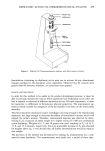
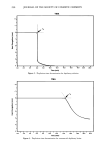
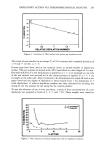
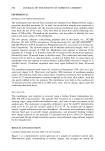
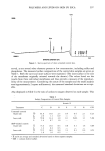
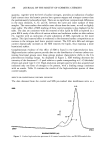
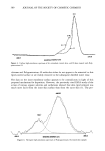
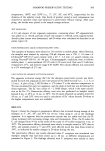
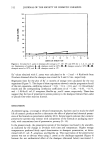
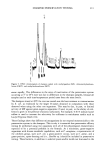
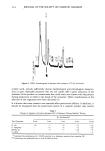
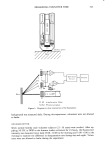
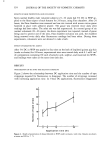
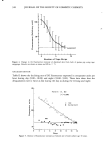
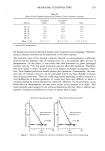
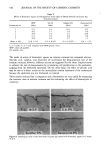
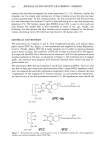
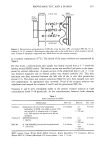
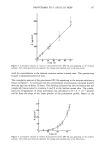
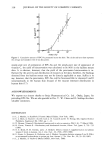
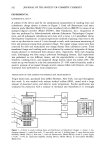
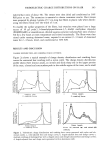
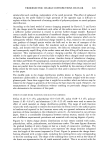
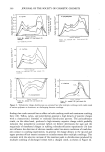
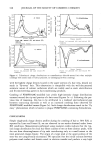
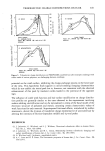
288 JOURNAL OF THE SOCIETY OF COSMETIC CHEMISTS Other researchers have taken this approach. Yablonsky and Williams (3) measured the "longitudinal swelling" of single hairs held under tension by a one-gram weight and immersed in a depilatory solution. This measurement was made by observing the posi- tion of the hair through a traveling microscope. The method, though shown to correlate well with in vivo testing, requires the constant attention of the analyst. T. J. Eliot's (4) "Depilometer" determined a depilation time by measuring the time at which a bundle of ten depilatory-treated hairs would break when stressed by a periodi- cally applied 50-g load. The method again correlated well with clinical tests. The procedure was automated through the use of a device developed and constructed in the author's laboratory. The need to test a large number of newly synthesized depilatory compounds in a variety of formulations required the development of a test method which could rapidly and precisely measure relative depilatory activity. Our approach uses the DuPont Model 943 Thermomechanical Analyzer to measure the time at which a hair bundle under constant stress, immersed in a depilatory formulation, begins to stretch. The data to be presented suggest that the method offers an objective and quantitative measurement of relative depilatory activity using commercially available equipment to automate the data collection. EXPERIMENTAL EQUIPMENT A DuPont © Model 943 Thermomechanical Analyzer interfaced to the Model 1090 Thermal Analyzer with dual floppy disc drives was used. This device, with fiber probe accessory, was designed to measure elongations and contractions of fibers under con- stant tension when exposed to thermal stress (5-8). The device works by measuring the position of the metallic shaft assembly in a magnetic field (Figure 1). The Thermal Analyzer was programmed to observe the stretching and/or breaking of a hair fiber bundle attached to the fiber tension probe accessory, immersed in a test formulation under isothermal conditions (22 -+ IøC). METHOD A hair bundle was prepared by clamping five strands of DeMeo European dark brown hair between two partially cleaved lead balls (split shot) positioned approximately 15 mm apart. A multi-strand bundle was chosen to randomize differences in depilation time due to damaged cuticle or differences in hair shaft thickness. The hair bundle was attached to the lower probe assembly and the sample holder assembly (Figure 1). A five-gram weight was placed on the weight tray to apply tension, and the instrument was electronically zeroed. The hair bundle was immersed in 20 ml of test sample, held in a 20-ml beaker, and the probe position was plotted versus time (Figures 2, 3). Depilation time (Td) was defined as that time at which stretching of the hair bundle began. This time was determined by measuring the time at the intersection of the lines extended from the baseline and from the straight portion of the plot after elongation begins. The determination of Td for each sample was repeated using at least three hair bundles. The average T• was reported to the nearest 0.1 minute. Controls consisting of

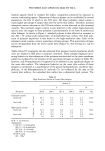
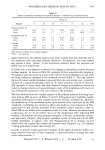
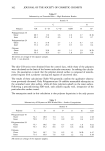
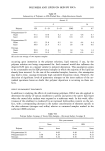
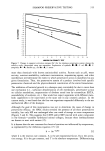
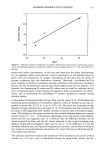
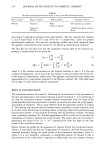
DEPILATORY ACTION VIA THERMOMECHANICAL ANALYSIS 289 WEIGHT TRAY UPPER SHAFT TRANSDUCER SAMPLE HOLDER LOWER PROBE HAIR STRANDS Figure 1. DuPont 943 Thermomechanical Analyzer with fiber tension accessory. formulations containing no depilatory active were run to account for any dimensional changes unrelated to the depilatory active ingredient. Observed Ta's for controls were greater than 60 minutes therefore, no corrections were applied. RESULTS AND DISCUSSION In order for this method to be useful in the product development process, it must be able to precisely measure the time at which significant hair weakening occurs when the hair is exposed to solutions of different depilatory actives. Of equal importance, it must be insensitive to differences in formulation physical properties. The instrumental pa- rameter which controls the elongation of the hair bundle is the force on the lower probe assembly. This force should be minimized to give a breakage time long enough to be reproducibly measured, but large enough to overcome the eftkcts of formulation viscosity which will impede the probe's motion. Therefore, instrumental response was observed by deter- mining T a as a function of added weight for a highly viscous (37,500 cps) commercial cream depilatory. Weights of 2, 5, and 10 grams were used, resulting in Ta's of 34.2, 15.8, and 15.2 minutes, respectively. Since no appreciable decrease in Ta was observed for weights above 5g, it was decided that all further determinations would be made at that weight. The precision of the method was determined by making T a measurements for a com- mercial cream depilatory. The measurements were made over a period of three days.
Purchased for the exclusive use of nofirst nolast (unknown)
From: SCC Media Library & Resource Center (library.scconline.org)