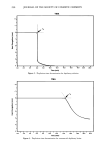
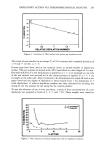
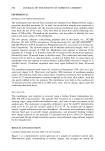
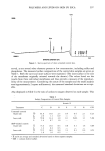
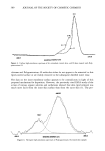
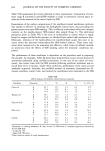
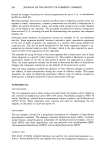
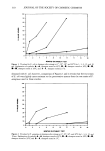
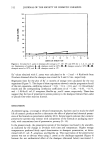
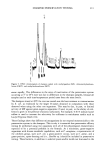
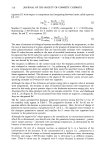
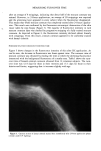
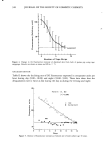
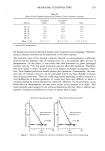
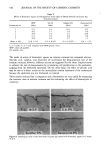
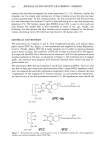
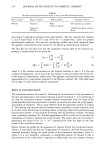
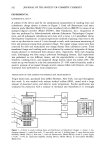
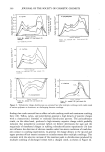
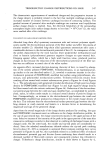
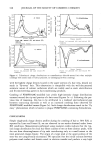
290 JOURNAL OF THE SOCIETY OF COSMETIC CHEMISTS TMA • o ! 0.0 2.0 4.• i i 6.0 8. 10.0 I 0 Time (min) Figure 2. Depilation time determination for depilatory solution. 1•,.0 '•8.0 •8.0 2(•.0 22•0 TMA -2 -1 xxx\x/ Td i ß i i i i ß ß i i i 0.0 21.0 4."0 I 6.10 8.• 10.•) 12:0 1•1.0 16.0 8.0 0.0 2•.0 Time (min) Figure 3. Depilation time determination for commercial depilatory lotion.

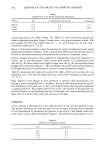
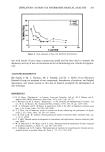
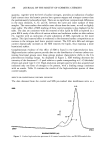
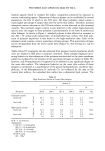
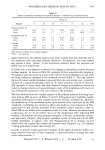
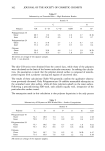
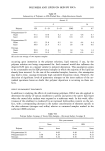
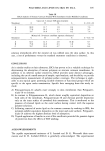
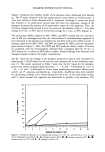
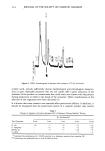
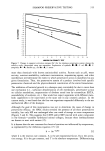
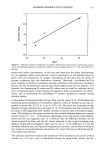
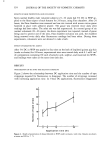
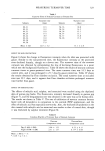
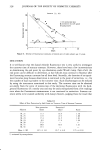
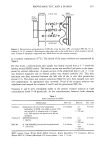
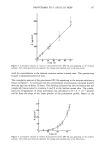
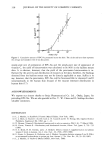
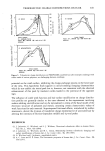
DEPILATORY ACTION VIA THERMOMECHANICAL ANALYSIS 291 o REL:+51VE DEPIL/•TION NUMI•I'SER Figure 4. Correlation of TMA method with guinea pig depilation study. This series of runs resulted in an average Ta of 16.6 minutes and a standard deviation of 1.73 (rsd = 10.4%, n = 7). Guinea pigs have been used at our research center as animal models in depilatory studies. The test animals are shaved with a # 10 razor blade to a hair length of 1.6 min. One-half milliliter of a test formulation is applied to a 5 X 4 cm rectangle on one side of the test animal, and one-half ml of the control product is applied to a 5 X 4 cm rectangle on the other side. After 10 minutes, the formulations are wiped off with a wet paper towel and the degree of depilation is rated visually from 1 (no depilation) to 5 (total depilation). A relative depilation number was then calculated by dividing the rating for the test product by the rating for the control product. To test the relevance of our in vitro procedure, a series of four concentrations of a test depilatory was prepared at levels of 3, 4, 5, and 7.5%. These samples were tested on % ACTIVE *'--'• test compound []--IH thioglycolate 2O Figure 5. Dose responses of sodium thioglycolate and test depilatory solutions.
Purchased for the exclusive use of nofirst nolast (unknown)
From: SCC Media Library & Resource Center (library.scconline.org)