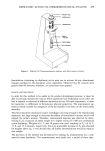
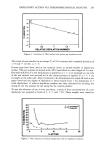
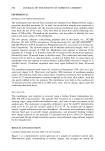
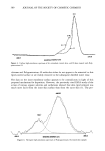
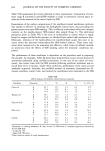
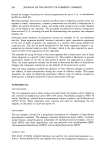
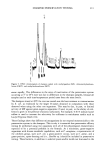
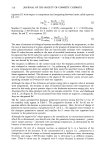
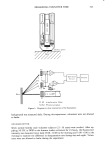
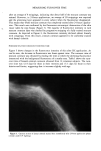
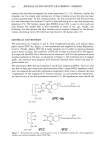
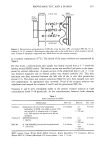
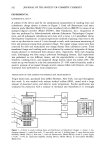
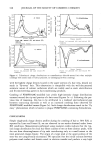
342 JOURNAL OF THE SOCIETY OF COSMETIC CHEMISTS EXPERIMENTAL EXPERIMENTAL SET-UP A scheme of the device used for the simultaneous measurement of combing force and triboelectric charge density is shown in Figure 1. Load cell (Sensotronic) and static detector probe (Keithley Model 2501) were interfaced with an IBM PC by means of an analog-to-digital converter (Model DT2801, Data Translation, Inc.). Acquisition of data was performed by Labtechnotebook software (Laboratory Technologies Corpora- tion), and all subsequent calculations were done with a Lotus 1-2-3 spreadsheet (Lotus Development Corporation). A typical experiment consisted of passing a hair tress in the root-to-tip direction at a rate of 1 cm/s through a comb, with continuous monitoring of force and potential arising from generated charge. The signal voltage values were then corrected for drift and recalculated into charge density from calibration curves. Total transferred charge and combing work were obtained by numerical integration of charge density-distance or mechanical force-distance plots, respectively. After each charging cycle, discharging was done using a polonium discharging element. Each experiment was performed on two different tresses, and the reproducibility in terms of charge densities, combing forces, and integrated charge density values was within 20%. The entire set-up was housed in a dry box maintained at 25-30% relative humidity under a positive pressure of air passed through several columns filled with Drierite. All mea- surements were performed at room temperature. PREPARATION OF HAiR SAMPLES FOR TRIBOELECTRIC MEASUREMENTS Virgin brown hair, purchased from deMeo Brothers, New York, was used throughout this work. It was washed with sodium dodecyl sulfate (SDS), rinsed with a large amount of deionized water, and dried at room temperature. Further purification was conducted by extraction with a mixture of methanol and chloroform (1:1) overnight • 'tlllrr,tqllll I lllllllllll IIIIillllll Computer Figure 1. A device to study combing forces and distribution of triboelectric charges. 1, motor 2, dis- charging element 3, comb (four teeth, 1.5-mm thick, per cm) 4, holding frame 5, static detector probe (Keithley, Model 2503) 6, hair tress 7, load cell (Sensotronics, Model 60036) A and C, power supply (+ 10V, q-15V) B, operational amplifier (Analog Devices, Model 2B31J) D, electrometer (Keithley, Model 616).

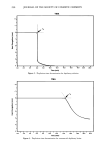
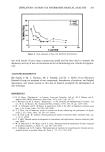
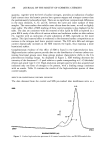
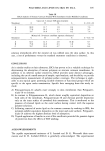
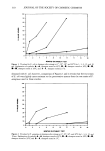
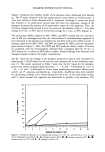
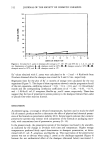
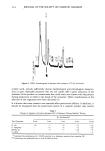
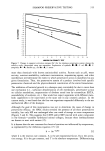
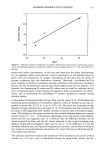
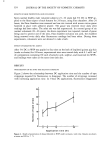
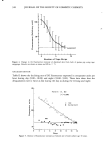
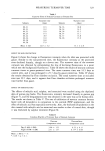
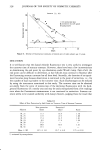
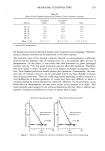
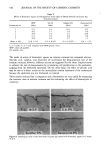
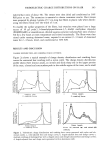
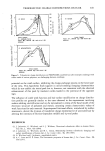
TRIBOELECTRIC CHARGE DISTRIBUTIONS ON HAIR 343 (solvent/hair ratio of about 50). The tresses were then dried and conditioned at 30% RH prior to use. The extraction is essential to obtain consistent results. Hair tresses were prepared by gluing 2 grams of 17-cm-long hair fibers to plastic tabs while distrib- uting the fibers evenly over the width of 3 cm. To modify the surface properties of the fibers, hair swatches were placed into a large excess of 10 g/l poly(1,1-dimethylpiperidinium-3,5,-diallyl methylene chloride) (PDMPDAMC) or stearalkonium chloride aqueous solution (solution/hair ratio of about 50) for a few hours at room temperature and stirred occasionally. The fibers were then rinsed under running deionized water, exposed to an excess (2-3 liters) of deionized water for 2-4 hours, dried, and conditioned at 30% RH. RESULTS AND DISCUSSION CHARGE DISTRIBUTION AND COMBING FORCE PATTERNS Figure 2a shows a typical example of charge density distribution and combing force curves for untreated hair combing with a nylon comb. The charge density distribution profile shows three distinct peaks, an intense and fairly sharp one in the upper portion of the tress, a broad and structureless peak in the middle region of the trees, and a small o • • 0 Combing time 0 -combing force 86a 0 Tress length 0-combing force Tress length O-combing force tSa 0 Tress length First (O),second (•) and third (•) combing Figure 2. Triboelectric charge distributions and combing force curves generated with nylon and alu- minum combs. a, time-adjusted force and charge curves b, length-adjusted force and charge curves c, multiple combings of discharged hair with a charged nylon comb (length-adjusted force and charge curves) d, length-adjusted force and charge curves generated with an aluminum comb.
Purchased for the exclusive use of nofirst nolast (unknown)
From: SCC Media Library & Resource Center (library.scconline.org)