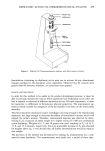
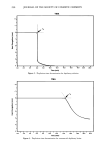
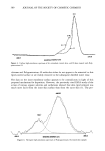
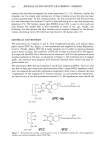
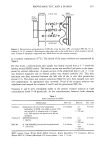
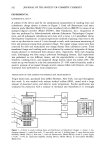
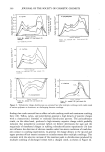
j. Soc. Cosmet. Chem., 38, 341-350 (September/October 1987) Triboelectric charge distributions generated during combing of hair tresses G. WIS-SUREL, J. JACHOWICZ, and M. GARCIA, Clairol Inc., 2 Blachley Road, Stamford, CT 06922. Received February I2, I987. Synopsis Triboelectric charge distributions generated by combing of hair tresses were correlated with combing force curves by an experimental set-up comprising a load cell and a static detector probe interfaced with a computer. The charge-density distribution profiles showed three distinct peaks corresponding to the upper, middle, and tip-end sections of a hair tress. The upper section peak was usually the most pronounced, and a hypothesis of its existence is discussed. The comb-work function and hair-surface modification effects were explained qualitatively in terms of the band model of the electronic structure of polymers and metals. Hair-surface modifications by a cationic surfactant or a cationic polymer were demonstrated to affect both the magnitude and the distribution of comb-generated static charges along the length of a hair tress. INTRODUCTION Triboelectric charging of hair in the rubbing mode with metals and polymers has been the subject of two reports (1,2). In experiments detailed in these articles, hair fibers were subjected to tangential rubbing, and charge density was measured as a function of time (or the number of rubs) in a selected and small area of contact between the fibers and the probe. In each contact event, the fibers underwent similar elongation and stress since the distance between the rubbing element and the plane formed by the fibers was constant. The charge generation, under these simplified conditions of rubbing, was demonstrated to be controlled by the work function of the contact probe (1), direction of rubbing (1), hair surface modification with polymers (2), surfactants (2), and oils, as well as the mechanical and/or electrostatic history of a tress (3). There is, however, very little information on the relationship between these data and real-life combing electrifi- cation. Therefore, we have investigated the process of triboelectric charging of hair tresses during combing. It was expected that combing triboelectrification is a more complex phenomenon than rubbing since such parameters as fiber elongation and stress, as well as the magnitude of frictional forces between the comb and fiber, vary during the movement of a comb from the upper part of a tress towards the fiber tips. To correlate mechanical combing data and charge distribution (charge density as a function of time or the position along the length of a fiber tress), we have constructed a special apparatus which allows for the measurements of these two quantities simultaneously, 341
Purchased for the exclusive use of nofirst nolast (unknown)
From: SCC Media Library & Resource Center (library.scconline.org)