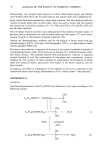
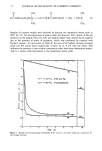
12 JOURNAL OF THE SOCIETY OF COSMETIC CHEMISTS positively elucitated. It is likely, however, that they derive from skin surface lipids through oxidative processes that may either involve the microbiological activity of the resident flora or be of a strictly physicochemical nature. For one particular class of compounds identified--?-lactones--which feature an asym- metric carbon atom in their structure, it was observed that both enantiomers were present as a racemic composition. Thus, for this class of compounds, a microbiological origin seems unlikely. Peroxidized species have been detected in human skin surface lipids by other authors and are suspected to be involved in cutaneous pathogenesis (34). Our results show that other oxidized species which seem to be the breakdown products of the first-formed hydroperoxides are present in the skin surface lipid mixtures and should also be consid- ered in that respect. The methodology which has been developed could be of diagnostic value to assess the state of oxidation of these volatile species prevailing on the human skin. REFERENCES (1) P. Bore, N. Goetz, P. Gataud, and L. Tourenq, Evolution in the composition of human skin surface lipids during their accumulation on scalp and hair, Int. J. Cosmet. Sci., 4, 39-52 (1982). (2) N. Goetz, G. Kaba, and P. Bore, Capillary gas chromatographic analysis of human skin surface lipids after microsampling on ground-glass platelets, J. Chromatogr., 223, 19-28 (1982). (3) N. Goetz, H. Burgaud, C. Berrebi, and P. Bore, Analysis of the lipid content of single hair bulbs. Comparison with the content of the sebaceous gland and with surface lipids,J. Soc. Cosmet. Chem., 35, 411-422 (1984). (4) A.J. Nunez, L. F. Gonzalez, and J. Janak, Pre-concentration of headspace volatiles for trace organic analysis by gas chromatography, J. Chromatogr., 300, 127-162 (1984). (5) J. Gregoire, F. Maillet, R. Gillard, and J. Auger, Improvements of headspace and analysis: Their applications, especially to residual sterilisation gases and by-products in medical and surgical mate- rials, 13th International Symposium on Chromatography, June 30-July, 1980, Cannes, France. (6) A.M. Samoun and J. Gregoire, Dynamic headspace analysis with Girdel D.C.I. gas chromatograph, 3 3rd Pittsburgh Conference on Analytical Chemistry and Applied Spectroscopy, March 8- 13, 1982, Atlantic City, N.J. (7) K. Grob and G. Grob, A new, generally applicable procedure for the preparation of glass capillary columns, J. Chromatogr., 125, 471-485 (1976). (8) K. Grob, G. Grob, and K. Grob, Jr., The barium carbonate procedure for the prepartion of glass capillary columns further informations and developments, Chromatographia, 10, 181-187 (1977). (9) K. Grob, Jr., G. Grob, and K. Grob, Preparation of apolar glass capillary columns by the barium carbonate procedure, J. High Resol. Chromatogr. Chromatogr. Commun., 1, 149-155 (1978). (10) K. Grob and G. Grob, Splitless injection on capillary columns, Part I. The basic technique steroid analysis as an example, J. Chromatogr. Sci., 7, 584-586 (1969). (11) K. Grob and K. Grob, Jr., Splitless injection and the solvent effect, J. High Resol. Chromatogr. Chromatogr. Commun., 1, 57-64 (1978). (12) K. Grob and G. Grob, Deactivation of glass capillaries by persilylation. Part 3: Extending the wetta- bility by bonding phenyl groups to the glass surface, J. High Resol. Chromatogr. Chromatogr. Commun., 3, 197-198 (1980). (13) K. Grob, G. Grob, and K. Grob, Jr., Deactivation of glass capillary columns by silylation. Part 1: Principles and basic techniques,J. High Resol. Chromatogr. Chromatogr. Commun., 2, 31-35 (1979). (14) K. Grob, G. Grob, and K. Grob, Jr., Deactivation of glass capillaries by persilylation. Part 2: Practical recommendations,J. High Resol. Chromatogr. Chromatogr. Commun., 2, 677-678 (1979). (15) V. Schurig and W. Burkle, Extending the scope of enantiomer resolution by complexation gas chro- matography, J. Am. Chem. Sot., 104, 7573-7580 (1982). (16) V. Schurig, Homogene Belegung yon Glas- und Quartzkapillarsiiulen mit Metallkoordinationsver-

VOLATILE COMPOUNDS FROM HAIR AND SCALP 13 (22) (23) (24) (25) (26) (27) (28) bindungen zur selectiven gaschromatographischen Trennung von Struktur-, Stereo- sowie optischen Isomeren. Ger. Offen. DE 3,247,714, Oct. 27, 1983. (17) V. Schurig, U. Leyer, and R. Weber, The use of glass and fused silica open tubular columns for the separation of structural, configurational and optical isomers by selective complexation GC: sec-al- cohols and ketones, J. High Resol. Chromatogr. Chromatogr. Commun., 8, 459-464 (1985). (18) K. Warner and E. N. Frankel, Flavor stability of soybean oil based on induction periods for the formation of volatile compounds by gas chromatography, JAOCS, 62, 100-103 (1985). (19) J. M. Snyder, E. N. Frankel, and E. Selke, Capillary gas chromatographic analyses of headspace volatiles from vegetable oils,JAOCS, 62, 1675-1679 (1985). (20) H. P. Dupuy, G. J. Flick, Jr., M. E. Bailey, A. J. St. Angelo, M. G. Legendre, and G. Sumtell, JAOCS, 62, 1690-1693 (1985). (21) W. A. May, R. J. Peterson, and S.S. Chang, Chemical reactions involved in the deep-fat frying of foods: IX. Identification of the volatile decomposition products of triolein, JAOCS, 60, 990-995 (1983). M. G. Heydanek and R. J. McGorrin, Gas chromatography-mass spectroscopy identification of vol- atiles from rancid oat groats, J. Agric. Food Chem., 29, 1093-1095 (1981). J. A. Thompson, W. A. May, M. M. Paulose, R. J. Peterson, and S. S. Chang, Chemical reactions involved in the deep-fat frying of foods. VII. Identification of volatile decomposition products of trilinolein, JAOCS, 55, 897-901 (1978). E. Selke, W. K. Rohwedder, and H. J. Dutton, Volatile components from triolein heated in air, JAOCS, 54, 62-67 (1977). E. Selke, W. K. Rohwedder, and H. J. Dutton, Volatile components from tristearin heated in air, JAOCS, 52, 232-235 (1975). H. Cheng and S. S. Chang, A study of odor stability of commerical stearic acid through isolation and identification of its volatile odoriferous compounds, JAOCS, 51, 189-191 (1974). D. Saint-Leger, A. Bague, E. Cohen, and M. Chivot, A possible role for squalene in the pathogenesis of acne. I. In vitro study of squalene oxidation, Brit. J. Dermatol., 114, 535-542 (1986). J. N. Labows, K.J. McGinley, G. F. Webster, and J. J. Leyden, Headspace analysis of volatile metabolites of Pseudomonas aeruginosa and related species by gas chromatography-mass spectrometry, J. Clin. Microbiol., 12, 521-526 (1980). (29) J. M. Zechman and J. N. Labows, Jr., Volatiles of Pseudomonas aeruginosa and related species by automated headspace concentration-gas chromatography, Can. J. Microbiol., 31, 232- 237 ( 1985). (30) R. Aly, H. I. Maibach, and J. M. Madden, Infrequent and transient nature of colonization of Pseudo- monas aeruginosa on normal human skin, J. Soc. Cosmet. Chem., 33, 225-228 (1982). (31) L. Larsson, P. A. Mardh, and G. Odham, Detection of alcohols and volatile fatty acids by head-space gas chromatography in identification of anaerobic bacteria, J. Clin. Microbiol., 7, 23- 27 (1978). (32) A. Morin and G. Paquette, Rapid temperature programmed gas liquid chromatography of volatile fatty acids (C•-C7) for the identification of anaerobic bacteria, Experientia, 36, 1380-1381 (1980). (33) J. N. Labows, K.J. McGinley, J.J. Leyden, and G. F. Webster, Characteristic •/-lactone odor production of the genus Pityrosporum, Appl. Environ. Microbial, 38, 412-415 (1979). (34) D. Saint-Leger, A. Bague, E. Lefebvre, E. Cohen, and M. Chivot, A possible role for squatene in the pathogenesis of acne. II. In vivo study of squalene oxides in skin surface and intracomedonal lipids of acne patients, Brit. J. Dermatol., 114, 543-552 (1986).
Purchased for the exclusive use of nofirst nolast (unknown)
From: SCC Media Library & Resource Center (library.scconline.org)