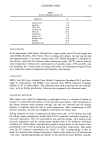
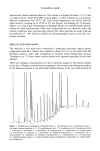
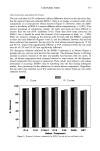
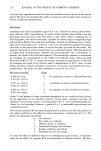
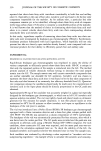
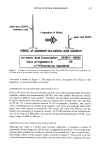
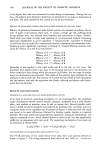
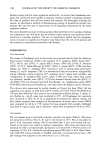
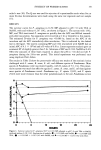
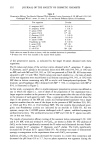
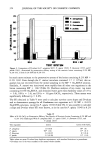
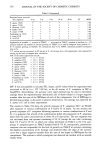
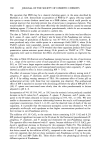
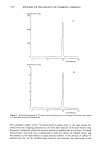
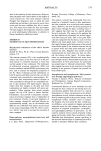
SYNERGY OF PRESERVATIVES 3 51 tailed t test (10). The Q test was used for rejection of a questionable result when five or more D-value determinations were made using the same test organism and test sample (11). RESULTS The survivor curves for P. aeruginosa in 0.2% MP adjusted to pH 7.0 with TEA or NaOH, with and without 0.2% 1342, are shown in Figure 1. The system with 1342, MP, and TEA inactivated P. aeruginosa so quickly that the APC was 600/ml immedi- ately after inoculation. No organisms were recovered at 2 hr or thereafter in this system. The estimated D-value for P. aeruginosa was 0.006 hr, based on the APC of the inoculum and the APC immediately after inoculation. This is indicated by the dashed line in the figure. The system containing MP and 1342 neutralized with NaOH had an initial APC of 4.3 x 10⁵/ml and a D-value of 0.9 hr. Linear regression analysis gave an estimated ST of slightly greater than 5 hr. Solutions of MP and 0.16% NaOH or 0.6% TEA (the amounts of these bases required to adjust the pH to 7.0) did not kill P. aeruginosa during the 24-hr test period. This initial experiment was performed once using duplicate Petri dishes. The results in Table II show the preservative efficacy test results of the nonionic lotion challenged with S. aureus, B. cereus, E. coli, and different species of Pseudomonas. Most species of Pseudomonas were inactivated rapidly, with D-values of • 1.1 hr. The preser- vative system was much less effective against S. aureus, B. cereus, and E. coli than against most species of Pseudomonas tested. Pseudomonas sp., P. cepacia 13945, and P. cepacia 25416 were more resistant than the other pseudomonads to the anti-Pseudomonas action :::) 8 uJ g 1 0 0 5 10 15 20 25 HOUFI8 Figure 1. Survivor curves for P. aeruginosa 9027 in 0.2% MP adjusted to pH 7.0 with TEA or NaOH, with and without 0.2% 1342. Explanation of symbols: ß = 0.2% MP with NaOH, ß = 0.2% MP with TEA, ß = 0.2% MP + 0.2% 1342 with NaOH, and ß = 0.2% MP + 0.2% 1342 with TEA.

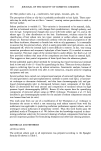
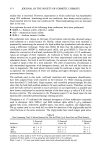
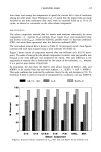
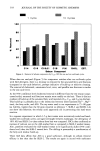
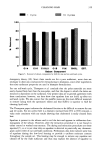
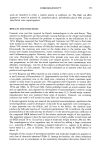
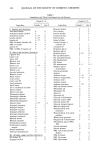
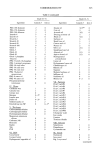
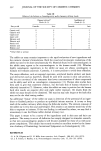
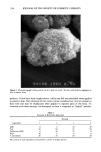
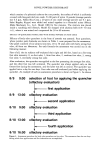
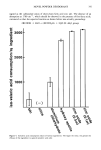
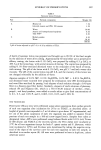
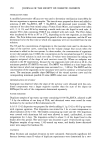
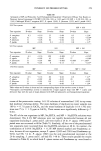
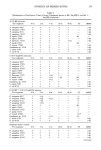
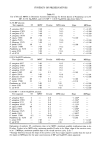
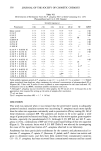
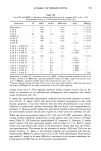
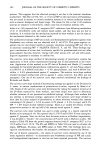
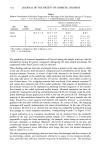
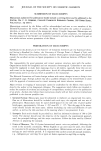
352 JOURNAL OF THE SOCIETY OF COSMETIC CHEMISTS Table II Preservative Efficacy Test Results Obtained With Nonionic Lotion Containing 0.2% MP and 0.2% 1342 Challenged With S. aureus, B. cereus, E. coli, and Several Different Species of Pseudomonas Test organism D-value P. aeruginosa 9027 0.9 (0.3) P. aeruginosa 10145 1.1 (0.1) P. cepacia 13945 24* (4) P. cepacia 25416 11' (0) P. fluorescens 13525 1.1 (0.9) P. putida 12633 1.0 (0.6) P. stutzeri 17588 0.5 (0) Pseudomonas sp. 9230 9.3 (0.9) S. aureus 6538 26* (0) B. cereus 11778 7.2 (0.4) E. coli 8739 78* (28) Table values are mean D-values in hours, with the standard deviations in parentheses. * D-values over 10 hr were rounded to the nearest whole number. of the preservative system, as indicated by the larger D-values obtained with these organisms. The D-values and slopes of the survivor curves obtained with P. aeruginosa, P. cepacia, ?. fluorescens, and ?. putida in the nonionic lotion with MP with 934, 941, or 1342 and no MP and with MP and 934, 941, or 1342 are presented in Table III. All lotions were adjusted to pH 7.0 with TEA. The D-values were much smaller (i.e., the rates of death of the test organisms were much faster) in all lotions containing 934, 941, or 1342 with MP than in lotions containing only MP or acrylic acid homopolymer/copolymer. The dramatic anti-?seudomonas effect obtained with MP + 934, in comparison with MP or 934, is illustrated in Figure 2. In this work, a synergistic effect in multicomponent preservative systems was defined as one in which the slope (i.e., rate of death of the population of test organisms) was a larger negative number in the presence of two or more agents than the sum of the slopes in the presence of each agent by itself. Thus, a synergistic effect was obtained when the slope in the presence of the MP and acrylic acid homopolymer/copolymer was a larger negative number than the sum of the slopes in the presence of MP (without 934, 941, or 1342) and 934, 941, or 1342 (without MP). The test systems that produced syner- gistic anti-?seudomonas activity are indicated by an asterisk in Table III. All test systems, except the 1342/MP system challenged with ?. cepacia, exhibited synergistic antibacterial activity. The antibacterial action of MP and 1342 for ?. cepacia was addi- tive in this test lotion. The results of preservative efficacy testing of the nonionic lotion containing 0.2% 1342 and 0.2% MP, with and without 0.1% CaCI2, are shown in Table IV. The addition of CaCI 2 to the lotion significantly increased the D-values and eliminated the anti-?seudo- toohas synergy for P. aeruginosa, P. fluorescens, and P. putida. The CaCI 2 significantly decreased the D-values for P. cepacia (Table IV). No attempt was made to demonstrate synergy or antagonism in the experiments done with CaCI 2 test systems. Addition of CaCI 2 to the lotion decreased the viscosity to a water-thin consistency and decreased the pH from 6.8 to 5.7, but no phase separation was apparent during the
Purchased for the exclusive use of nofirst nolast (unknown)
From: SCC Media Library & Resource Center (library.scconline.org)