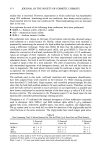
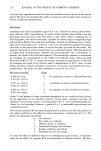
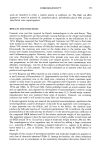
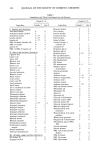
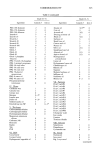
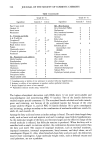
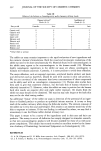
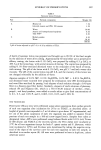
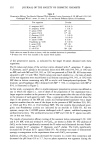
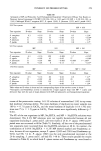
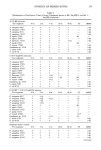
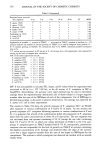
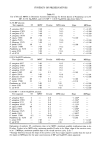
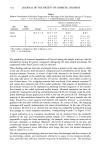
SYNERGY OF PRESERVATIVES 359 Table VIII Use of STs and MPSTs to Determine Antimicrobial Synergy for P. aeruginosa 9027 in 0 to 1.0% Phenoxyethanol and 0 to 0.10% Nipastat (data from Table VII) Preservative ST MPST D-value MPD-value Slope MPSlope Saline control -- 48 6.6 -- - 0.151 0.1% P -- 48 6.6 -- -0.151 0.5% P -- 48 6.6 -- -0.151 1.0% P 48 -- 6.6 -- -0.151 -- 0.005% N -- 48 6.6 -- -0.151 0.01% N -- 48 6.6 -- -0.151 0.05% N -- 48 -- 6.6 -- - 0.151 0.10% N 2 -- 0.3 -- -3.615 -- 0.1% P + 0.005% N -- 48 -- 6.6 -- -0.151 0.1% P + 0.01% N -- 48 -- 6.6 -- -0.151 0.1% P + 0.05% N 2 -- 0.3 -- -3.615' -- 0.1% P + 0.10% N 0.1 -- -0.01 -- -72.304* -- 0.5% P + 0.005% N -- 48 -- 6.6 -- -0.151 0.5% P + 0.01% N 24 -- 3.3 -- -0.301 -- 0.5% P + 0.05% N 2 -- 0.3 -- -3.615' 0.5% P + 0.10% N 0.1 -- 0.01 -- -72.304* 1.0% P + 0.005% N 4 -- 0.6 -- - 1.808' 1.0% P + 0.01% N 4 -- 0.6 -- -1.808' 1.0% P + 0.05% N 4 -- 0.6 -- - 1.808' 1.0% P + 0.10% N 2 -- 0.3 -- -- -3.615 Explanation of symbols: ST, sterilization time in hr MPST, minimum possible sterilization time in hr D-value, D-value in hr MPD-value, minimum possible D-value in hr Slope, slope of the survivor curve, in hr- 2 MPSlope, maximum possible slope of the virtual survivor curve, in hr- x * Synergy observed, because the slope of the survivor curve was a larger negative number than the sum of the slopes (or MPSlopes) for the same concentrations of P and N taken separately. corneal ulcers (16,17). This organism produces several virulence factors that are be- lieved to contribute to its multifactorial pathogenicity and complicate the clinical course of infections (18-23). P. cepacia has considerable physiological versatility and has broad resistance to antibi- otics (24,25). P. cepacia 13945 was selected for detailed investigation in this work because, generally, it was more resistant than the other pseudomonads in our culture collection to preservative systems containing MP and acrylic acid homopolymer/co- polymers. P. fluorescens and P. putida were selected for detailed studies here because they are nutritionally versatile and are able to grow on a wide variety of substrates (24,26). When the lotion was prepared using 0.2% 1342 and 0.2% MP, preservative efficacy testing revealed significant antibacterial activity against most test cultures of Pseudo- monas (Table II). All fluorescent pseudomonads [P. aeruginosa, P. fluorescens, P. putida and P. stutzeri (24)] were inactivated rapidly, with D-values • 1.1 hr. Both P. cepacia strains were inactivated more slowly in the preservative system than were the fluores- cent pseudomonads. The reasons for the resistance of strains 13945 and 25416 are not known however, P. cepacia is nutritionally versatile and accumulates poly-beta-hy- droxybutyrate (PHB) as a carbon reserve (24,27,28). These physiological characteristics may enable P. cepacia to be more difficult to inactivate in test systems containing che- lating agents and MP than are the fluorescent pseudomonads.

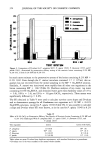
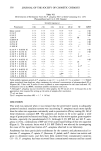
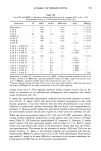
360 JOURNAL OF THE SOCIETY OF COSMETIC CHEMISTS We speculate that PHB may be a classical chelating agent, in the sense described by Marshall et al. (29). Intracellular accumulation of PHB by P. cepacia (24) may enable this species to retain divalent metal ions as a PHB chelate, which could provide an internal reservoir that may help prevent loss of metal ions to exogenous chelators. This would enable P. cepacia to resist more effectively the destabilization caused by external chelating agents (7) than do the fluorescent pseudomonads, which do not accumulate PHB (24). Definitive studies are needed to confirm this. The data in Table II show that the preservative system in this lotion was less effective for S. aureus, B. cereus, and E. coli than it was for many of the Pseudomonas test cultures. The percentage of sporulation of Bacillus sp. was 30-50% at 24 hr (8) however, B. cereus produced only a few visible spores in a microscopic field (1000 X ) when 24-hr TSALT cultures were suspended, stained, and examined microscopically. Experience with Bacillus sp. and B. cereus 11778 revealed that these organisms produce few (if any) preservative system-resistant spores during 24-hr growth on TSALT at 37øC. These organisms were used to determine the effects of preservative systems on vegetative ba- cilli. The data in Table III illustrate anti-Pseudomonas synergy because the rate of inactivation (i.e., slope of the survivor curve) of each population of test organisms in MP + 934, 941, or 1342 was a larger negative number than the sum of the rates (slopes) of inacti- vation in MP and each acrylic acid homopolymer/copolymer taken separately. P. cepacia showed an additive effect in lotion containing MP + 1342. The effect of nonionic lotion pH on the results of preservative efficacy testing with P. aeruginosa, P. cepacia, P. fluorescens, and P. putid• was determined in lotions adjusted to pH 6-9 by adding varying amounts of TEA. No consistent effect of lotion pH on antibacterial activity with these four test organisms was observed. The antibacterial effect of MP is reported to increase with decreasing pH below the pKa of MP (pH 8.17) (30). P. cepacia was inactivated more slowly than the other pseudomonads in lotions adjusted to pH 6-9. Incorporation of •0.1% 934, 941, or 1342 into the nonionic lotion produced a marked decrease in the D-values for P. aeruginosa, P. cepacia, P. fluorescens, and P. putida, com- pared to the D-values obtained in lotions containing no 934, 941, or 1342. We were unable to demonstrate a consistent relationship between the acrylic acid homopolymer/ copolymer concentration, from 0.1-0.4%, and the observed rates of death of the test organisms. It is possible that the maximum synergistic action was obtained at •0.1% polyacrylic acid/acrylic acid copolymer so that higher concentrations produced no fur- ther increase in anti-Pseudomonas activity. The addition of 0.1% CaCi 2 to the nonionic lotion containing 0.2% 1342 and 0.2% MP produced significant increases in the D-values for the fluorescent pseudomonads (P. aeruginosa, P. fluorescens, and P. putida) and eliminated the anti-Pseudomonas synergy. The opposite effect was observed with P. cepacia, because addition of 0.1% CaCi 2 pro- duced a significant decrease in D-values for this organism (Table IV). The inhibitory effects of CaCI 2 on P. cepacia may have been due primarily to the decrease in the pH of this lotion caused by the addition of CaC12, compared to the control. P. cepacia was the only test organism that did not show synergistic anti-Pseudomonas activity in the pres- ence of 1342 and MP (Table III). These results reflect the physiological diversity of different species of Pseudomonas.
Purchased for the exclusive use of nofirst nolast (unknown)
From: SCC Media Library & Resource Center (library.scconline.org)