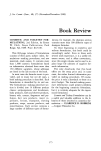
j. Soc. Cosmet. Chem., 40, 375 (November/December 1989) Book Review COSMETIC AND TOILETRY FOR- MULATIONS, 2nd Edition, by Ernest W. Flick. Noyes Publications, Park Ridge, NJ, 1989. Price: $125.00. This 964-page volume of formulations consists of three parts: subject index, for- mulations-making procedures, and raw materials-trade names. It contains more than 1,800 cosmetic formulations based on information obtained from more than 150 different suppliers, whose addresses are listed in the last section of the book. In most cases the formula source is pro- vided, and in many but not all cases, a brief making procedure is described. Each formulation is identified by its end use. The formulations-making procedure sec- tion is divided into 14 different product classes: antiperspirants and deodorants, baby products, bath and shower products, beauty aids, creams, fragrances and per- fumes, hair care products, insect re- pellants, lotions, shampoos, shaving products, soaps, suncare products, and miscellaneous. Each section contains a large number of different types of formu- lations for example, the shampoo section contains more than 100 different types of shampoo formulas. To those beginning in cosmetics and toiletry formulation, this book could be exceedingly useful. Even to those with several years experience, it is a useful ref- erence source, and it offers convenience, since this single volume can be used to re- place large file cabinets of supplier for- mula information. The only drawbacks that this book offers are the steep price and, in some cases, the rather limited information pro- vided on making procedures. Of course, the price is only a drawback to those on a strict budget. The limited making proce- dure information could present problems for the beginning cosmetics formulator, but it is certainly adequate for the experi- enced formulator. Cosmetic and Toiletry Formulations can be a useful and valuable addition to the li- braries of those involved in cosmetics for- mulation.-- CLARENCE R. ROBBINS --Colgate Palmolive Co. 375

j. Soc. Cosmet. Chem., 40, 377-379 (November/December 1989) Abstracts The Annual Scientific Meeting and Seminars of the Society of Cosmetic Chemists are important venues for informing the participants about the state of the art and recent technical advances in the field of Cosmetic Science. To provide broader dissemination of that information, the Publi- cations Committee has decided to publish abstracts of the technical presentations made at these Meetings and Seminars in the Journal.--The Editor. Society of Cosmetic Chemists Annual Seminar May 10-11, 1990 San Francisco Hilton on Hilton Square San Francisco Program arranged by the Society's Committee on Scientific Affairs Anne Wolven-Garrett (A.M. Wolven, Inc.), Chair, 1990 SESSION A INTERACTION BETWEEN RAW MATERIAL SUPPLIERS AND FORMULATORS Optimizing the formulator-supplier relation- ship Peter J. Kaufmann, Almay, Inc., 1501 Williams- boro St., Oxford, NC 27565 The relationship between the cosmetic chemist and the raw material supplier, will be examined empha- sizing ways to optimize the productivity of both. Current trends in the cosmetic and related indus- tries will be examined, forming the basis for sug- gestions on improving the partnership between chemists and raw material suppliers in the develop- ment of new personal care products. Technical interactions between supplier and customer Duane G. Krzysik, Dow Corning Corporation, 2200 W. Salzburg Rd., Midland, MI 48686 It is the purpose of this paper to touch on current interactions between suppliers of specialty chem- icals and their customers, mainly product develop- ment chemists. We will then discuss some of the apparent difficulties of this relationship and suggest possible alternatives that will help make both the supplier and the customer more successful. Gaining and maintaining a competitive edge will be a key factor to success in the 1990s. Competition will be tough not only for the supplier but also for the customer. Consumers at every level are be- coming more educated, and with that education comes increased expectations. To meet these expectations, significant advance- ments will be made in cosmetic science as well as in related fields such as dermatology. This will require more complex interactions and development be- tween suppliers and customers. It is this interac- tion, however, that will be a key factor in new product development, commercialization, and, ul- timately, market success. A Realistic toxicological profile for new cos- metic ingredients Howard I. Maibach, M.D., Department of Derma- tology, University of California Medical Center, San Francisco When exciting new cosmetic ingredients are being introduced into the consumer skin and hair care market, both the supplier and the cosmetic manu- facturer want to be sure that consumers using their new product can realize the benefits of the product with minimal risk. Early evaluation of individual ingredients based on experience and testing, where required, will prevent unexpected and expensive problems late in the product development process. New materials can be evaluated first by comparing chemical structure with known classes of irritants and sensitizers. These comparisons will help the cosmetic product developer and the supplier to de- termine together whether minimal or extensive tox- icological testing is desirable. Once the final proto- 377
Purchased for the exclusive use of nofirst nolast (unknown)
From: SCC Media Library & Resource Center (library.scconline.org)