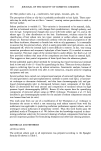
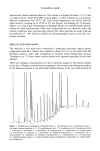
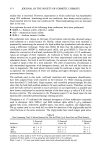
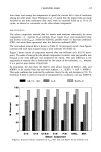
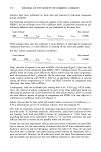
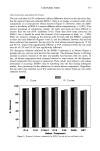
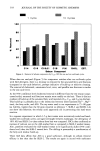
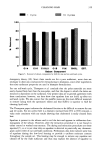
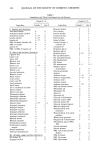
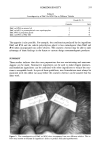
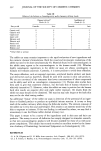
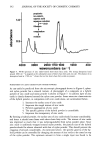
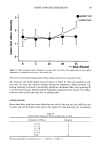
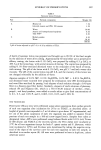
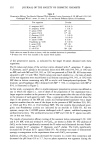
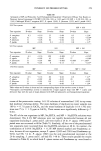
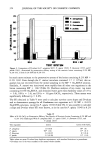
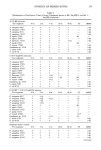
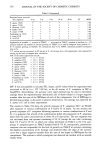
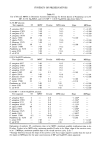
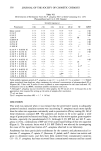
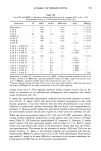
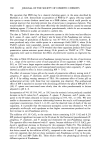
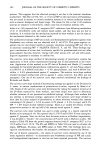
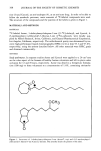
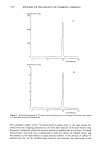
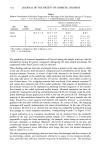
372 JOURNAL OF THE SOCIETY OF COSMETIC CHEMISTS Table I Relative Contribution of Individual Compounds as a Percentage of the Total Eluted Amount of •4C-Azone (A n = 3) or •4C-Cyoctol (C n = 4) Derived Radioactivity (mean -+ SD) Relative contribution (%) in tape extracts at hour Test Peak compound number • Dosage 1 (A + C) 20 (A) or 23 (C) 44 (A) or 45 (C) Azone Cyoctol 1 95.4 --- 1.8 94.0 & 3.8 N.D. 2 N.D. 2 1 1.4 -+ 0.9 9.7 & 5.0 17.5 -+ 3.9 2 4.0 _+ 2.6 12.2 _+ 4.2 15.7 -+ 1.7 3 4.0 -+ 3.1 8.3 -+ 7.0 5.9 -+ 1.6 4 93.9 -+ 1.4 78.3 -+ 16.8 49.5 -+ 19.7 35.4 -+ 13.4 5 6.6 _+ 7.6 9.2 -+ 5.8 14.2 _+ 10.0 The numbers correspond to those in Figures 2 and 3. N.D. = not determined. The possibility of chemical degradation of Cyoctol during the sample work-up could be excluded by having the parent compound undergoing the same sample processing. No compounds other than Cyoctol could be detected. These findings indicate that only unchanged Azone is present in the tape extracts, while in the case of Cyoctol, both the parent compound and its metabolites can be found. The stratum corneum, however, is a layer of dead cells, assumed to be devoid of metabolic activity, as opposed to the underlying viable epidermis and dermis where skin metabo- lism may take place (1). Bioconversion of Cyoctol, therefore, conceivably occurred in one of these layers. Yet, stripping removes only two thirds of the stratum corneum (7) and cannot have removed part of the viable epidermis. The presence of metabolites in the stratum corneum can be explained by assuming outward migration of the metabo- lites formed in the viable epidermis and/or dermis. Outward migration has been de- scribed for compounds following oral administration (8,9), but recently could be estab- lished following dermal application as well in the case of Cyoctol (6,10). Although the majority of the metabolites formed in the viable epidermis will move inwards into the body, favored by a more aqueous environment and systemic removal, a concentration gradient will also exist towards the stratum corneum. As a result of that, the stripping technique will usually underestimate the extent of metabolism. In the case of Cyoctol, for instance, De Zeeuw et al. showed that this drug was completely metabolized during skin passage to a more nonpolar metabolite, corresponding to peak 5 in Figure ! (10). A good indication as to cutaneous metabolism can be obtained from the metabolic profiles of the ipsi- and contralateral plasma samples (11). However, it is sometimes impossible to apply the latter methodology, for example, when dosing on areas such as the back, abdomen, or forehead. Moreover, the levels of radioactivity in the ipsi- and contralateral plasma samples have to be relatively high to obtain reliable metabolic profiles. This presents severe difficulties with drugs that have low dermal absorption such as Azone (5,12,13). The skin stripping methodology does not have these disadvantages and thus seems to be an interesting, simple, and noninvasive alternative to assess in vivo cutaneous metabo- lism, provided that sufficient outward migration of metabolites occurs. The technique

SKIN STRIPPING TO DETERMINE METABOLISM 373 should be considered as a potential method to determine whether metabolism can take place rather than providing quantitative information on the extent of cutaneous metab- olism. ACKNOWLEDGMENTS This study was supported in part by Nelson Research and Chantal Pharmaceutical Cor- poration. REFERENCES (1) R. H. Guy, J. Hadgraft, and D. A. W. Bucks, Transdermal drug delivery and cutaneous metabo- lism, Xenobiotica, 17, 325-343 (1987). (2) R. J. Martin, S. P. Denyet, and J. Hadgraft, Skin metabolism of topically applied compounds, Int. J. Pharm., 39, 23-32 (1987). (3) R. B. Stoughton and W. O. McClure, Azone©: A new non-toxic enhancer of cutaneous penetration, Drug Devel. Ind. Pharm., 9, 725-744 (1983). (4) L. C. Ford, H. A. Hammill, R. J. DeLange, D. A. Bruckner, F. Suzuki-Chavez, K. L. Mickus, and T. B. Lebherz, Determination of estrogen and androgen receptors in Trichomonas vaginalis and the effects ofantihormones, Am. J. Obstet. Gynecol., 156, 1119-1121 (1987). (5) J. W. Wiechers, B. F. H. Drenth, J. H. G. Jonkman, and R. A. de Zeeuw, Percutaneous absorp- tion, metabolic profiling and excretion of the penetration enhancer Azone © after multiple dosing of an Azone-containing triamcinolone acetonide cream (TAZ) in humans, J. Pharm. Sci., 79, 111-115 (1990). (6) J. W. Wiechers, R. E. Herder, B. F. H. Drenth, and R. A. de Zeeuw, Percutaneous absorption, disposition, and excretion of x4C-labeled Cyoctol in humans after a single derreal application, Int. J. Pharm. (in press). (7) M. T. Hojyo-Tomoka and A.M. Kligman, Does cellophane tape stripping remove the horny layer? Arch. Dermatol., 106, 767-768 (1972). (8) C. C. Peck, D. P. Conner, B.J. Bolden, R. G. Almirez, T. E. Kingsley, L. D. Mell, M. G. Murphy, V. E. Hill, L. M. Rowland, D. Ezra, T. E. Kwiatkowski, C. R. Bradley, and M. Abdel- Rahim, Outward transcutaneous chemical migration: Implications for diagnostics and dosimetry, Skin Pharmacol., 1, 14-23 (1988). (9) C. C. Peck, D. P. Conner, B.J. Bolden, R. G. Almirez, L. M. Rowland, T. E. Kwiatkowski, B. A. McKelvin, and C. R. Bradley, "Outward Transdermal Migration ofTheophylline," in Pharma- cology and the Skin, B. Shroot and H. Schaefer, Eds. (Karger, Basel, 1987), Vol. 1, pp. 201-208. (10) R. A. de Zeeuw, R. E. Herder, J. W. Wiechers, and B. F. H. Drenth, Metabolic conversion of Cyoctol during skin passage in humans, Pharm. Res. (in press). (11) A. Yacobi, R. A. Baughman, D. B. Cosulich, and G. Nicolau, Method for determination of first- pass metabolism in human skin, J. Pharm. Sci., 73, 1499-1500 (1984). (12) J. W. Wiechers, B. F. H. Drenth, J. H. G. Jonkman, and R. A. de Zeeuw, Percutaneous absorp- tion and elimination of the penetration enhancer Azone in humans, Pharm. Res., 4, 519-523 (1987). (13) J. W. Wiechers, B. F. H. Drenth, J. H. G. Jonkman, and R. A. de Zeeuw, Percutaneous absorp- tion, metabolism, and elimination of the penetration enhancer Azone in humans after prolonged application under occlusion, Int. J. Pharm., 47, 43-49 (1988).
Purchased for the exclusive use of nofirst nolast (unknown)
From: SCC Media Library & Resource Center (library.scconline.org)