j. Soc. Cosmet. Chem., 41, 1-22 (January/February 1990) Multiple-phase oil-in-water emulsions GILLIAN M. ECCLESTON, Department of Pharmacy, University of Strathclyde, Glasgow GI IXW, Scotland, U.K. Received November 8, 1989. Presented at the Annual Meeting of the Society of Cosmetic Chemists, New York, December 1989. Synopsis Cosmetic oil-in-water emulsions such as lotions and creams are complex multiple-phase systems. In their preparation, combinations of fatty amphiphiles (glyceryl monoesters or fatty alcohols) and ionic or nonionic surfactants are widely used. The mixed emulsifier combinations interact in the aqueous continuous phases to form lameliar or crystalline structures. These both stabilise and sometimes control the consistencies of emulsions between wide limits. There is, however, confusion as to the type of lameliar phase that forms in a specific emulsion. The majority of the literature fails to distinguish between the lamellar liquid crystalline state and the equally important lamellar gel state. Although liquid crystalline phases form in many emul- sions at the high temperatures of manufacture, these often convert to gel phases when the emulsion cools so that the properties of this phase dominate the emulsion. In this article the structures and swelling properties of the different lameliar phases that occur in emulsions are discussed, as well as the formation of other crystalline phases. Attention is given to the conditions over which each type of phase forms and, in particular, the relevance of the gel-liquid crystalline transition temperature to emulsions. It will be shown how the behaviour of many complex emulsions during manu- facture, storage, and use can be related to the component phases. INTRODUCTION Most of the literature published about emulsions is based on attempts to apply classical theories of colloid stability to well characterised "model" systems. These are invariably dilute, monodispersed, two-phase oil-and-water emulsions stabilised by a single surfac- tant emulsifier. The surfactant forms a monomolecular film at the oil-water interface where it introduces additional repulsive (e.g., electrostatic, steric, or hydrational) forces that provide an energy barrier to droplet coalescence. Cosmetic and pharmaceutical emulsions such as lotions and creams are rarely such simple two-phase preparations. They are more likely to be complex polydispersed systems containing several surfactant and amphiphilic emulsifiers and to be composed of additional phases to oil-and-water. The additional phases generally form in aqueous systems when the emulsifier, in excess of that required to form a monomolecular film, interacts with continuous-phase water. Thus investigation into the phase behaviour of emulsifiers and their mixtures in water provides valuable information about the micro- structures of emulsions prepared with them.

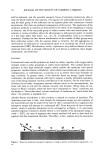
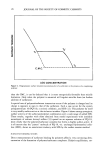
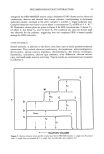
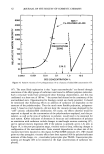
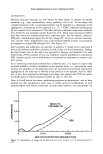
2 JOURNAL OF THE SOCIETY OF COSMETIC CHEMISTS There is now substantial evidence that the formation of specific lamellar phases that are capable of incorporating large quantities of water is an essential requirement for the stability of many commercial emulsions. Such phases can also impart the required rheo- logical properties (for example, ranging from mobile lotions to thick semisolid creams) to some products (1-3). However, there is much confusion as to the type of lameliar phase that forms in a specific emulsion. Most of the literature concentrates on the formation of liquid crystalline phases and fails to identify the equally important gel phases, even though each phase imparts totally different properties to emulsions con- taining them. It is not always appreciated that the lameliar liquid crystalline state is rarely dominant in cosmetic emulsions containing long-chain alcohols, acids, or mon- oglycerides as co-emulsifiers. The commercial literature contains many articles that incorrectly discuss the presence of bilayer liquid crystalline phases in emulsions that are actually composed mainly of gel phases. In this paper, the microstructures and properties of multiple-phase oil-in-water emul- sions of cosmetic use (in particular dermatological) will be described. Particular atten- tion will be given to the various lameliar liquid crystalline and gel phases as well as to other crystalline phases that occur in such emulsions. It will be shown how the behav- iour of many real emulsions during manufacture, storage, and use (i.e., after applica- tion to the skin) can be related to their component phases. STRUCTURE OF LAMELLAR LIQUID CRYSTALLINE AND GEL PHASES Lamellar phases in which surfactant molecules are arranged in bilayers separated by layers of water are formed in water by a range of surface-active materials under specific conditions. The hydrocarbon chains of the bilayers can exist in a number of physical states (4,5), the most relevant to emulsions being the so-called ordered, or gel, and disordered, or liquid crystalline, states (Figure 1). In the gel state the hydrocarbon chains are packed in a hexagonal subcell with rotational motion about the long axes, whereas in the liquid crystalline state they are disordered and liquid-like. The order- disorder transition, Tc, is essentially the melting of the hydrocarbon chains without any loss of long-range stacked bilayer structure. The transition occurs at a characteristic temperature, influenced primarily by the characteristics of the hydrophobic portion of the surfactant. Transition temperatures increase with increasing acyl chain length and decrease when unsaturated or branched chains are present. Such bilayer states are of interest in several scientific areas, and consequently a con- fusing number of different nomenclatures are used to describe them. The lameliar liquid crystalline phases that occur above the phase transition temperature have been called neat, G, or L= phase. Bilayer gel phases that occur below the transition tempera- ture are also referred to as c•-crystalline gel or L• phase (4), and the transition tempera- ture as the chain melting temperature, CMT, or the penetration temperature, Tpen (1). The designation L, i.e., lameliar, with the subscript c•- for the disordered liquid crys- talline phase and the subscript [3- for the more rigid gel phase, is not entirely satisfac- tory. Confusion can arise because identical Greek letters c•- and [3- are used to describe crystalline polymorphs of some amphiphilic emulsifiers, including the fatty alcohols. In this paper the ordered and disordered states will be described simply as gel and liquid crystalline phases. Several other types of gel phase have been reported in the general
Purchased for the exclusive use of nofirst nolast (unknown)
From: SCC Media Library & Resource Center (library.scconline.org)