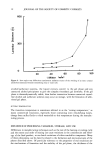
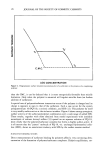
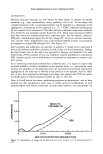
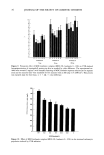
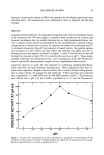
DNA REPAIR IN SKIN 87 frequency of pyrimidine dimers in DNA was measured by the alkaline agarose gel assay described above. All measurements were performed at least in duplicate and the data averaged. RESULTS Liposome-mediated delivery of encapsulated drugs proceeds either by membrane fusion or by endocytosis (8). We have sought to maximize these interactions by constructing liposome membranes that (a) resemble keratinocytes in high phosphatidylcholine con- tent to enhance fusion and (b) are destabilized by the low pH found in internal cellular compartments to release their contents. To measure the ability of recombinant endo V to withstand release into the pH 5 environment of coated vesicles, the purified enzyme was incubated at acidic pH for one hour before the substrate was added and the re- maining activity was assayed. As shown in Figure 1, endo V lost function as the pH declined but retained at least 25% of its activity after one hour at pH 5. These results probably understate the remaining activity, since incubation at acidic pH followed by assay at neutral pH showed greater enzyme activity (unpublished observations). Liposomes sensitive to acidic pH were prepared by combining phosphatidylethanol- amine with oleic acid and cholesteryl hemisuccinate. These components form lipid bi- layers when negatively charged at neutral pH but fail to stack in bilayers when proton- ated in acidic pH (6). To measure the pH sensitivity, T4N5 liposomes were prepared that encapsulated 12.5 mM ANTS and 45 mM DPX instead of endo V. The liposomes were diluted into a pH 5 or pH 8 buffer, incubated at 37 C, and the fluorescence 100' 80' 60' 4.0' 20' 0 I I I I I I I 5 5.4 5.8 6.2 6.6 7 7.4 7.8 pH Figure 1. Activity of T4 endonuclease V at acidic pH relative to optimal pH. T4 endonuclease V was incubated at various pH for one hour. UV-DNA substrate was added and the remaining activity assayed. Results are plotted relative to activity at optimal pH of 6.6.

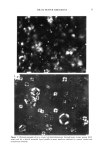
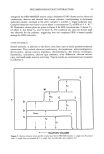
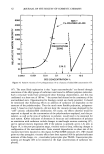
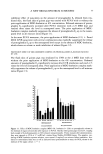
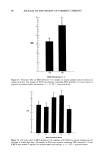
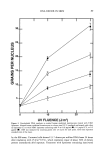
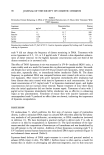
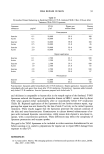
88 JOURNAL OF THE SOCIETY OF COSMETIC CHEMISTS compared over a 30-minute period with the maximum fluorescence measured in lipo- somes dissolved with Triton X-100 (Figure 2). Incubation of the liposomes at pH 8 did not change their fluorescence (closed circles), indicating no release of contents. Incuba- tion of the liposomes at pH 5 (open circles) increased their fluorescence over time, demonstrating release of their contents and their pH sensitivity. DNA repair was measured in normal human epidermal keratinocytes treated with T4N5 liposomes containing endo V by UDS (Figure 3). Unirradiated cells treated with liposomes showed no increase in UDS compared to unirradiated and untreated cells. Untreated cells irradiated with either 10 or 25 J/m 2 of UV-C showed increased grains over nuclei, representing normal DNA repair. Treatment with 0.02, 0.05, 1.0, and 2.0 Ixg/ml of endo V in liposomes enhanced UDS at both 10 and 25 J/m 2. The increase compared to untreated cells at each dose and for each T4N5 liposome concentration was statistically significant (p 0.00 ! by the Student t-test). Increasing concentrations of T4N5 liposomes produced increasing DNA repair responses. Liposome encapsulation is essential to enhancing repair incubation of cells with purified endo V or M. luteus UV-DNA endonuclease alone produces no effect (9,10). Repair of pyrimidine dimer photoproducts was measured in normal human keratino- cytes (Table I). Cells were irradiated with UV-C and treated with active and inactive T4N5 liposomes. Inactive liposomes were prepared with endo V that had been boiled for one hour to denature the enzyme, as confirmed by activity assays of the boiled endo V. DNA was extracted 24 hours after treatment, and dimer frequency was determined I-- LU U.I 120 __ 8O 6O 4O 20 -- 4 8 12 16 20 24 MINUTES Figure 2. pH Sensitivity of T4N5 liposomes. Liposomes with the composition of T4N5 liposomes but encapsulating ANTS/DPX were prepared and incubated either at pH 8 (O) or pH 5 (O). Duplicate aliquots were removed during incubation and their fluorescence measured. Results are plotted relative to fluorescence of liposomes dissolved with 1% Triton X-100.
Purchased for the exclusive use of nofirst nolast (unknown)
From: SCC Media Library & Resource Center (library.scconline.org)