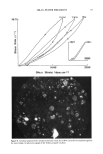
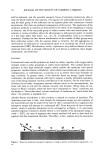
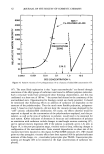
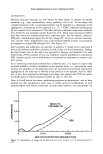
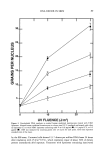
POLYMER/SURFACTANT INTERACTION 41 3000 20O0 1OOO I 10-2 2x10⁻² SDS CONCENTRATION (tool/I} Figure 13. Reduced viscosity of PEO as a function of SDS concentration: (O) M = 2 X 10⁶, Cp = 6 X 10 -•g/1 (O) M = 106 ,Cp = 6 X 10 -2g/1 ([•)M = 2 X 10⁵ ,Cp = 5 X 10 -•g/1 (I) M = 7 X 10 4, Cp = 5 X 10- • g/1 (46). Even larger increases can be seen with certain oppositely charged polyelectrolyte/ionic surfactant pairs, as illustrated in Figure 14. In this case involving the cationic cellu- losic, PQ-10, relatively low levels of added SDS lead to substantial viscosity increases (as large as 200 fold), or even gel formation, in the immediate preprecipitation zone

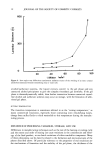
42 JOURNAL OF THE SOCIETY OF COSMETIC CHEMISTS 2000- lOOO- - 125 - 100- 7õ- 25 • I I I I I ! 1% _- I • c.•.c. ! - o.•1 O.Ol o.1 1.o lO.O SDS CONCENTRATION % Figure 14. Relative viscosity of 1% polyquaternium 10 as a function of added SDS concentration (47). (47). The most likely explanation is that "super macromolecules" are formed through association of the alkyl groups of surfactant ions bound to different polymer molecules. Such a structure would have pronounced shear thinning characteristics, and this was confirmed: at a shear rate of 100 sec-• the system had thinned to the consistency of the uncrosslinked state. Opportunities for rheology control are clearly provided. It should be mentioned that thickening effects on addition of surfactant are dependent on the structure of the polyelectrolyte. Thus the much more flexible polycation, polyquater- nium 5, based on vinyl chemistry, did not show the viscosity increase displayed by the "stiff" cationic cellulosic/SDS combination. Of course, the effects observed would be expected to depend on the concentration of the polyelectrolyte employed, and this pa- rameter, as well as the ratio of surfactant to polymer, would need to be examined for each system. [Other indicators of alteration in structure and conformation of polyions on association with surfactant include changes in small-angle neutron scattering (47), and in optical rotatory dispersion (48) if the polyion is optically active.] As seen in Figure 14, in the post-precipitation range, viscosity tends to drop, reflecting changes in configuration of the macromolecules. Some unusual dependencies on shear rate of the viscosity have been reported in this region for PQ-10/SDS mixtures (47). [We should point out that synergistic viscosity effects have been reported (49) for polyion/surfactant mixtures of like charge, viz., cross-linked polyacrylate plus TEALS. Coacervation phe- nomena are thought (49) to be involved at the high concentrations of surfactant em- ployed].
Purchased for the exclusive use of nofirst nolast (unknown)
From: SCC Media Library & Resource Center (library.scconline.org)