j. Soc. Cosmet. Chem., 41, 23-49 (January/February 1990) Polymer/surfactant interaction E. D. GODDARD, Specialty Chemicals Division, Union Carbide Corporation, Tarrytown, NY 10591. Received November 21, 1989. Presented at the Annual Meeting of the Sodety of Cosmetic Chemists, New York, December 1989. Synopsis Water-soluble polymers and surfactants are common ingredients of cosmetic formulations that are known to influence each other's properties. This article reviews some of the methods that have been used to study polymer/surfactant pairs, lists the factors which influence their properties and interaction, and analyzes the factors responsible for this interaction. In addition, some opportunities afforded by the changes in proper- ties occasioned by these interactions are outlined. INTRODUCTION In cosmetic formulation and technology, use is made of a wide variety of surfactants and also of a number of different water-soluble polymers. It is, in fact, the case in many systems, e.g. shampoos, lotions, creams, dentifrices, and so on, that both of these species are present in the same system. In recent years a great deal of scientific study has been carried out on the properties of such mixtures in model systems (1-3). The present article seeks to summarize the high points of these studies, to identify features of these investigations relevant to cosmetic systems and, furthermore, to draw attention to opportunities for exploiting certain properties of these binary mixtures. It should be pointed out that interaction and complex formation between natural polymers (proteins) and "surfactants" (lipiris) were recognized a long time ago (4). This article will, how- ever, not deal with lipoproteins but will be concerned largely with synthetic polymers and synthetic surfactants. However, it should be recognized that many of the principles and properties described will be directly applicable to protein/surfactant pairs also. Before discussing mixed systems, it is appropriate to briefly describe the properties of each of these components when in aqueous solution, namely the properties of surfactant solutions and of polymer solutions. Such a discussion, in a general sense, will aid the understanding of what interaction can be expected when the two species are present in the same solution. SURFACTANTS A surfactant is the classical case of an amphipathic molecular structure. In aqueous solution the ionic headgroup, or the polar headgroup (e.g., polyoxyethylene group), 23

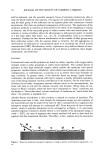
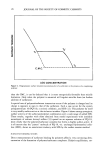
24 JOURNAL OF THE SOCIETY OF COSMETIC CHEMISTS will be hydrated, and the powerful energetic forces of solvation involved are able to carry the whole molecule into solution, even against the unfavorable process of transfer- ring the alkyl group of the surfactant into an aqueous phase that constitutes a hostile environment. But there are profound consequences of this action. The migrations of the surfactant molecule in solution are dominated by the desire of the headgroup to remain in solution, and of the non-polar group to reduce contact with this hostile phase. Ad- sorption at various interfaces allows the alkyl groups to self-associate and/or to transfer to a less polar phase than water, e.g., air, oil, or hydrophobic solid as an adsorbed monolayer. Perhaps the best known manifestation of the transfer of alkyl groups away from molecular contact with the aqueous phase is, however, the self aggregation or micellization of surfactants at concentrations equal to or exceeding the critical micelie concentration (CMC). Micellization, in fact, represents a very delicate balance of inter- molecular forces that is strongly influenced by such factors as surfactant chain length, temperature, and added salt. POLYMERS Conventional water-soluble polymers are based on carbon, together with oxygen and/or nitrogen atoms in polar groupings to confer water solubility. The cardinal feature of polymers is their high molecular weight, which endows the molecules with special properties. Another feature is flexibility, which allows macromolecules to adopt various configurations, or conformations, in solution so as to achieve their most favorable en- ergy condition. In general terms, if the solvation forces are strong ("good solvent" conditions), the polymer molecule will tend to expand, a readily observable manifesta- tion of this being maximal viscosity contribution to the solution. On the other hand, if solvation forces barely compensate internal cohesion forces in the macromolecule, the latter will tend to coil and the solution viscosity will decrease. [These ideas are em- braced in Flory's concepts, where the latter state corresponds to "theta" conditions and the former to "better than theta" solvent conditions. If conditions are "much worse than theta," the polymer is insoluble (5).] Another feature of polymers is their tendency to adsorb at a variety of interfaces. The important point here is that, even though the adsorption energy per each segment of the macromolecule may be small (of the order of lkT), cumulatively for n segments this adsorption energy will amount to a substantial nkT. From the point of view of mecha- nistics, events in polymer adsorption can be envisaged as in Figure 1 if a previously adsorbed segment of polymer desorbs [which is very feasible if the adsorption energy is weak ('" lkT)], the mass of segments that remain attached will tend to draw back the segment that has temporarily desorbed. This effect, in fact, explains why the adsorption b c d e Figure 1. Depiction of polymer adsorption: Segment a, trying to desorb, is held back by segments b, c, d, etc.
Purchased for the exclusive use of nofirst nolast (unknown)
From: SCC Media Library & Resource Center (library.scconline.org)