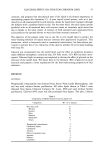
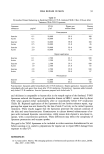
DNA REPAIR IN SKIN 91 Table II Pyrimidine Dimers Remaining in Epidermal DNA of UV-B-Irradiated SKH-1 Mice 6 Hours After Treatment With T4N5 Liposomes Liposome UV-B Dimers per Percent treatment •g/ml J/m 2 million bases control Posttreatment Inactive 0.1 10,000 92.9 100 Active 0.1 10,000 55.9 60 Inactive 0.5 10,000 90.8 100 Active 0.5 10,000 23.8 26 Inactive 2.0 10,000 93.0 100 Active 2.0 10,000 72.9 78 Repeat application Inactive 0.1 2,500 43.7 100 Active 0.1 2,500 22.0 50 Inactive 1.0 2,500 36.4 100 Active 1.0 2,500 23.8 65 Inactive 2.0 2,500 39.8 100 Active 2.0 2,500 26.8 67 Pretreatment Inactive 2.0 10,000 79.0 100 Active 2.0 10,000 63.6 80 Posttreatment: liposomes added immediately after UV-B irradiation. Repeat application: liposomes added immediately after and again three hours after UV-B irradiation. Pretreatment: liposomes added immedi- ately before UV-B irradiation. Inactive liposomes prepared with boiled endo V. and thickness is comparable to human skin in the temple region of the forehead. T4N5 liposomes reduced the frequency of pyrimidine dimers in SKH-1 mouse skin by about 50% when applied either immediately after or immediately before UV irradiation (Table II). Repeated application of the liposomes did not further enhance repair, sug- gesting that repair was not limited by the loss of endo V activity in the initial liposome treatment. These results suggest that the liposomes penetrate the stratum corneum of the skin and enter keratinocytes. Keratinocytes in culture showed enhancement of re- pair with increased liposome concentration, while mouse skin showed a non-linear re- sponse, with a concentration optimum. These differences may reflect the complexity of liposome penetration and enzyme uptake. Our goal is for T4N5 liposomes to be included in either sunscreen formulations for use before sunning or in cosmetic preparations for regular use to repair DNA damage from exposure to solar UV. REFERENCES (1) A. Glass and R. Hoover, The emerging epidemic ofmelanoma and squamous cell skin cancer,JAMA, 262, 2097-2100 (1989).

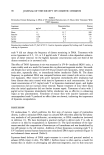
92 JOURNAL OF THE SOCIETY OF COSMETIC CHEMISTS (2) K. Kraemer, M. M. Lee, and J. Scotto, Xeroderma pigmentosum: Cutaneous, ocular and neurologic abnormalities in 830 published cases, Arch. Dermatol., 123, 241-250 (1987). (3) H. Honigsmann, W. Brenner, A. Tanew, and B. Ortel, UV-induced unscheduled DNA synthesis in human skin: Dose response, correlation with erythema, time course and split dose exposure in vivo. J. Photochem. Photobiol., 1, 33-43 (1987). (4) D. Yarosh, Topical application of liposomes, J. Photochem. Photobiol., 6 (in press). (5) J. Ceccoli, N. Rosales, J. Tsimis, and D. Yarosh, Encapsulation of the UV-DNA repair enzyme T4 endonuclease V in liposomes and delivery to human cells,J. Invest. Dermatol., 93, 190-194 (1989). (6) H. Ellens, J. Bentz, and J. Szoka, pH-induced destabilization of phosphatidylethanolamine-con- taining liposomes: Role of bilayer contact, Biochem., 23, 1532-1538 (1984). (7) S. Freeman, A. Blackett, D. Monteleone, R. Setlow, B. Sutherland, and J. Sutherland, Quantitation of radiation-, chemical-, or enzyme-induced single strand breaks in nonradioactive DNA by alkaline gel electrophoresis: Application to pyrimidine dimers, Anal. Blochem., 158, 119-129 (1986). (8) R. Straubinger, K. Hong, D. Friend, and D. Papahadjopoulos, Endocytosis of liposomes and intra- cellular fate of encapsulated molecules: Encounter with a low pH compartment after internalization in coated vesicles, Cell, 32, 1069-1079 (1983). (9) K. Tanaka, M. Sekiguchi, and Y. Okada, Restoration of ultraviolet-induced unscheduled DNA syn- thesis of xeroderma pigmentosum cells by the concomitant treatment of bacteriophage T4 endonu- clease V and HVJ (Sendai virus). Proc. Natl. Acad. Sci., 72, 4071-4075 (1975). (10) D. Yarosh and R. Setlow, Permeabilization of ultraviolet-irradiated Chinese hamster cells with poly- ethylene glycol and introduction of ultraviolet endonuclease from Micrococcus luteus, Molec. Cell. Biol., 1, 237-244 (1981). (11) J. H. J. Hoeijmakers, Characterization of genes and proteins involved in excision repair of human cells, J. Cell Sci. (Suppl.), 6, 111-125 (1987).
Purchased for the exclusive use of nofirst nolast (unknown)
From: SCC Media Library & Resource Center (library.scconline.org)