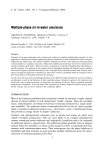
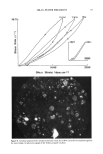
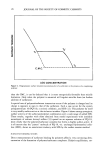
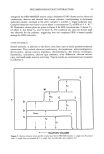
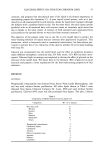
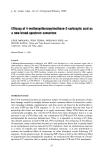
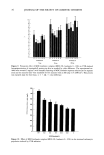
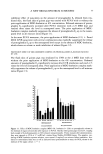
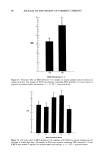
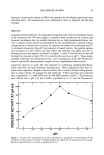
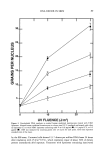
OIL-IN-WATER EMULSIONS 13 z 200 160 120 40 I i i I 20 40 60 8O 100 • WATER (W/W) Figure 7a. Low angle x-ray diffraction (synchrotron radiation source) of the swelling of a nonionic cetearyl alcohol/ceteth 20 emulsifying wax in water (20). •i(-7' "-Z-Z-7 '-Z-Z-Z-Z-Z%Z-Z-Z-' .... -Z-Z-Z-' 50A Interlamellar distance Bilayer L I I 120-170 A Figure 7b. Schematic diagram of the gel phase formed from cetearyl alcohol and nonionic polyoxyethylene surfactant (ceteth 20).

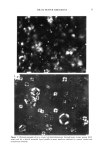
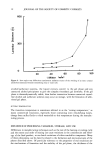
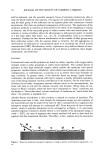
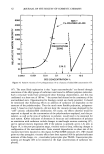
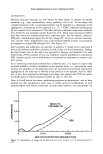
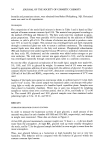
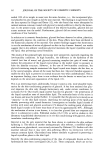
14 JOURNAL OF THE SOCIETY OF COSMETIC CHEMISTS interlamellar water layers, and the relative amounts of the crystalline, gel, and water phases. CONSISTENCY CHANGES ON STORAGE Emulsions prepared with fatty alcohols and ionic surfactants reach their final consis- tencies within hours of manufacture. This is because interaction to form both liquid crystals above the transition temperature and gel phase below the transition tempera- ture is rapid. Phase equilibrium is reached soon after preparation so that there are relatively minor microstructural changes on extended storage. In contrast, systems pre- pared with fatty alcohols and nonionic surfactants often gel up considerably on extended storage (Figure 8a), and this may result in a cosmetically unacceptable product. Structural build-up occurs in nonionic emulsions because significant amounts of gel phase form below the transition temperature on storage after manufacture (23). A very complex phase situation is envisaged during the preparation of such emulsions because hydration of the polyoxyethylene (POE) chains is limited at high temperature but in- creases progressively as the emulsion cools. Above the transition temperature, large masses of molten surfactant and alcohol are present in addition to liquid crystals. In these, the hydrocarbon chains of the surfactant are dispersed among those of the alcohol, and clusters of POE groups are present both at the surfaces and within the masses. As systems cool, the POE groups become more soluble and, if hydration forces are strong enough, lamellar liquid crystals separate. When the transition temperature is reached, the liquid crystals transform to gel phase and the unreacted emulsifier precipitates as crystalline masses. The partially interacted masses of alcohol and surfactant are often visible microscopically in freshly prepared formulations (Figure 8b). On storage, aqueous surfactant continues to penetrate the crystalline mases, which disappear as ad- ditional gel phase forms. As this involves the incorporation of significant quantities of water, there are marked consistency increases. The structure builds up relatively slowly because the crystalline nature of the hydrocarbon chains limits both the rate of penetra- tion by water and the subsequent rearrangement into swollen bilayers. PROCESSING VARIABLES It is well known that processing variables affect the structure and properties of emul- sions. However, these effects are not dramatic with fatty alcohols combined with ionic surfactants. Differences in consistencies of oil-in-water creams prepared with cetearyl alcohol and an ionic surfactant (cetrimonium bromide) were shown to be due to varia- tions in size of the crystalline hydrates rather than to variations in the gel phase struc- ture (24). In contrast, preparation techniques, in particular cooling rates and mixing procedures, have a marked effect on initial and final consistencies of emulsions prepared with fatty alcohols and nonionic surfactants. For example, "shock" cooling and limited mixing produces initially very mobile systems, whereas slow cooling with adequate mixing produces semisolid emulsions (25). These variations in rheological properties are also related to the mechanisms by which nonionic gel phases form. Little gel phase is present initially in the system after shock cooling. Mixing time, when the emulsifiers are in the molten state, influences the distribution of surfactant within the molten masses and bilayers and the relative lamellar order within the system.
Purchased for the exclusive use of nofirst nolast (unknown)
From: SCC Media Library & Resource Center (library.scconline.org)