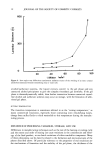
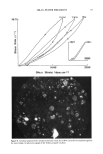
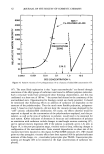
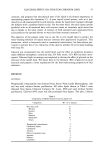
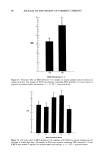
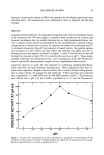
POLYMER/SURFACTANT INTERACTION 43 SOLUBILIZATION Micellar surfactant solutions are well known for their ability to dissolve oil-soluble materials, e.g., dyes, hydrocarbons, esters, perfumes, and so on. To the extent that complex formation with a nonionized polymer can be regarded as a depression of the aggregation concentration of the surfactant (i.e., T• • CMC), enhanced solubilization by the complex can be anticipated. This effect has been confirmed using water-insoluble dyes (8,50,51) and sparingly soluble fluorescers (52). Much more pronounced effects have been found for polyelectrolyte/ionic surfactant pairs. For the cationic cellulosic/ SDS pair, a solubilization region for the dye, orange OT, occurs at very low concentra- tion, and the "main" solubilization zone is also widened (shifted to lower concentration) as compared to simple SDS solutions (47). (See Figure 15.) Since polymers and surfactants can associate in solution, it would not be surprising if they could influence each other's solubility as well as that of a third component. Perhaps the best known case of this effect was reported by Isemura and Imanishi (53), who showed that a PVAc polymer of very low solubility could be solubilized in solutions of SDS. Another specific case of solubilization of polymers by surfactants is treated in the next section. In an interacting nonionized polymer/ionic surfactant pair, it is logical to expect that increased solubility could be manifested in the opposite sense, i.e., the polymer could increase the solubility of the surfactant since the monomer concentration required for aggregation of the surfactant is lowered in the presence of the polymer. Such an effect has, in fact, been reported by Schwuger and Lange, who showed that PVP can reduce the Krafft point of sodium hexadecyl sulfate by close to 10øC (9). Note: It is well known that many conditioning polymers are polycationic, and we have pointed out that precipitation zones exist at certain ratios in combinations of such polyelectrolytes with anionic surfactants. In most cases, however, such precipitates can 3.0 SDS/O.1% m• 2.0 1.O S O O.010 0.020 SDS CONCENTRATION (MOLES/LITER) Figure 15. $olubilizarion ooe o•angc OT by SDS a]onc aria in •hc p•cscncc o• 0. [% polyq•cmi• •0 (47).

44 JOURNAL OF THE SOCIETY OF COSMETIC CHEMISTS be solubilized in the presence of excess surfactant or prevented by co-presence of a nonionic surfactant (54). CLOUD POINT ELEVATION OF POLYMERS Most uncharged polymers owe their solubility to the presence of polar groups, such as ether, hydroxyl, amide, and carboxyl, which will hydrate in the presence of water. This hydration, especially of the ether group, can diminish progressively with temperature, and the critical balance governing solubility can be upset at a specific temperature ("cloud point") at which the polymer comes out of solution. If the polymer can acquire charges, e.g., by ionization of acidic or basic groups or by the adsorption of a charged species such as a surfactant, enhanced solubility or elevation of the cloud point can be expected. There is much evidence in the literature to illustrate these effects. Although PEO itself is not amenable to such studies (its cloud point exceeds 100øC), related polymers pro- vide such information: PPO, by dint of possessing hydrophobic methyl groups, has much lower water solubility than PEO: PPOs of MW 1025 and 2000 have cloud points of about 40øC and 20øC, respectively. Pletnev and Trapeznikov (55) showed that SDS and NaDDBS can raise these values to above 90øC. (In one sense, standard nonionic surfactants can be regarded as PEO polymers: that one can raise their cloud point by addition of ionic surfactants is a fact already well known to formulators.) There are several references to increases of the cloud point of PVOH polymers by addition of anionic surfactants, and similar elevation is well known for MeC. The behavior of the latter polymer has recently been examined in great detail by Lindman (56) and co- workers and is somewhat complex. For example, while confirming the activity of SDS in raising the cloudpoint, they have found that in the presence of salt, first additions of SDS can actually reduce the solubility of MeC. Similar behavior has been found recently by Xie et al. for the PPO/SDS system (57). REDUCTION OF MONOMER CONCENTRATION The fact that, in the presence of polymer, aggregates of surfactant can form at concen- trations lower than the CMC means that the maximum monomer concentration of sur- factant is reduced. For nonionized polymer/ionic surfactant combinations, the region involved would be in the T•, T 2 concentration range. For polyelectrolyte/ionized sur- factant pairs this effect would be maximal in the preprecipitation binding zone. Because of the strong bonding forces involved in the latter case, the reduction in monomer concentration would tend to be much higher. Although the picture concerning the irritation to skin caused by exposure to surfac- rants, in particular anionic surfactants, is not completely clear, much evidence exists that suggests that lowered monomer concentration of the surfactant can correspond to lowered irritation (58). Coupled with this, there is evidence (59,60) that addition of selected polymers to solutions of anionic surfactants can reduce the irritation caused by the latter. The implication is that formulations of lowered irritation potential could be more reliably created on this basis if a knowledge of the binding characteristics of the particular polymer/surfactant combination chosen were established. On the other hand, a definite possibility always exists that any observed reduction of irritation occasioned by the presence of a polymer may involve more than one mechanism (61).
Purchased for the exclusive use of nofirst nolast (unknown)
From: SCC Media Library & Resource Center (library.scconline.org)