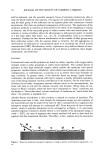
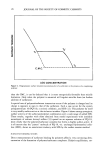
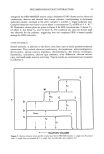
POLYMER/SURFACTANT INTERACTION 39 of regular ionic surfactant (spherical) micelies, a major resisting force is the crowding together of ionized head groups at the periphery of the micelie and the development of a high electrostatic potential that can be offset only partially by counterion binding. Futhermore, in the well-accepted spherical, or Hartley, micelle, there is a considerable distance, on a molecular scale, between the headgroups at the periphery, if only for geometrical reasons of packing. Some of this space will accommodate conterions, but most will comprise areas of the hydrocarbon chains exposed to water--an obviously unfavorable situation. Early NMR data indicated that the first few carbons (measured from the headgroup) of micellized molecules of SDS remain in contact with water. One can easily imagine a "1oopy" configuration of water-soluble polymer, associating with a miceliar array of surfactants, which allows ion-dipole association of the hydrophilic groups of the polymer and the ionic headgroup of the surfactant and, in addition, allows contact between the hydrophobic segments of the polymer and the "exposed" hydrocarbon areas of the micelie--in effect resulting in screening of the electrical charges and diminution of the extent of these exposed areas. Consequences of the above would include several features already observed, such as 1. A more favorable free energy of association, as manifested in a lowered "CMC" (i.e., T• CMC). 2. Increased ionic dissociation of the aggregates. 3. An altered environment in the CH 2 groups of the surfactant near the head group, as seen in •3C-NMR results. 4. Increased associating tendency as the polymer becomes more hydrophobic. A major point of difference from the above systems exists when the polymer and surfac- rant are oppositely charged as we have pointed out, in this case there are discrete binding sites for the surfactant ions and binding is reinforced by alkyl chain association, and this can also be considered a special case of surfactant aggregation. There are, in fact, strong analogies between the process of surfactant adsorption, leading to complex formulation of the surfactant with the polyelectrolyte, and adsorption, leading to hemi- micelle formation, of ionic surfactants on the surface of oppositely charged solids, such as minerals. In both cases an ion-exchange process is involved in which the counterion of the polyelectrolyte (or charged surface) is replaced by the surfactant ion and binding commences at a concentration orders of magnitude below the CMC of the surfactant. A differentiating factor in the case of the polyelectrolyte is the molecular flexibility of the charge-bearing substrate, meaning that its properties, such as conformation, can be substantially altered by the adsorption process and actually reinforce it. One of the models for binding, developed by Satake and Yang (42), is, in fact, based on the Zimm-Bragg theory for coil-helix transitions of polymers as adapted to the cooperative bonding process. Precisely the same relationships as those obtained by Satake were derived by Shirahama (43,44), who employed a statistical mechanical treatment of the binding process. Lastly, Delville (45) has presented a model to describe the process, based on two additive effects, one due to Poisson-Boltzmann condensation of the sur- factant ion and the other a contribution due to cooperative bonding. At high surfactant concentration, in the post-precipitation or resolubilization zone, "string of beads" structures have been invoked in which the beads are surfactant clusters and the polyion is the string. Possible structures are depicted in Figure 12, which links the surface and bulk behavior with compositional changes in the system (3).

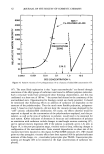
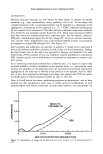
40 JOURNAL OF THE SOCIETY OF COSMETIC CHEMISTS SOLUTION . WITH POLYMER \ ! WITHOUT POLYMER PRECIPITATION I ZONE CO N C E NTRATION SU R FACTANT Figure 12. Conditions in the bulk and surface of solutions containing a polycation (fixed concentration) and anionic surfactant. Full line is the hypothetical ST-concentration curve of the surfactant alone dotted line is that of mixture with polycation. Simple gegencations are depicted only in surface zone (3). SOME PROPERTIES AND OPPORTUNITIES RELEVANT TO COSMETIC SCIENCE There are many changes in solution and surface properties that occur as a result of polymer/surfactant association. Some which would appear relevant to cosmetic science follow. VISCOSITY It is known that polyelectrolytes tend to adopt a linear configuration in aqueous solu- tion unless the ionic strength of the solution is high. This configuration favors an increase in viscosity of the solution. When an unionized polymer binds an ionic surfactant, the polymer will acquire a charge, and hence, on the basis of the "polyelectrolyte effect," an increase in viscosity would be anticipated. This area has been investigated by a number of authors, and in Figure 13 we present data of Francois et al. on the effect of adding SDS to a series of PEO polymers (46). A sudden increase in viscosity occurs at a certain concentration (T•) of surfactant, independent of polymer molecular weight, and this increase can be as high as five-fold, which is consistent with a polymer charging effect.
Purchased for the exclusive use of nofirst nolast (unknown)
From: SCC Media Library & Resource Center (library.scconline.org)