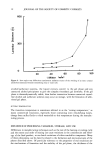
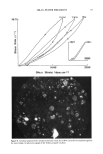
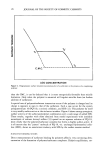
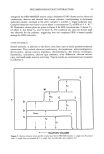
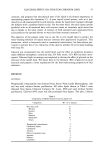
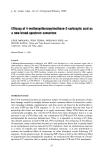
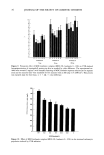
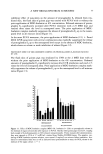
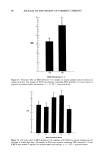
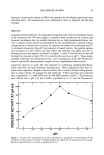
POLYMER/SURFACTANT INTERACTION 33 vestigated the PEO 6000/SDS system using a Sephadex G100 column and an electrical conductivity detector and showed that elution volumes, corresponding to decreasing molecular volume, increased in the order: complex micelles single surfactant ions. Complex formation was found to occur above a concentration (T•) of SDS of 4 X 10⁻³ M. Illustrative elution plots are given in Figure 9 for SDS concentrations (1) below T•, (2) above T• but below T2, and (3) above T 2. For condition (2), only one elution peak was observed for the polymer, suggesting that the complexed SDS is shared equally among the PEO molecules. OTHER TECHNIQUES Several methods, in addition to the above, have been used to study polymer/surfactant interactions. They include electrical conductivity, electrophoresis, ultracentrifugation, electro-optics, optical rotatory dispersion, photochemistry, fast kinetics techniques, fluorescence, calorimetry, electron spin resonance, x-ray diffraction, electron micros- copy, and small-angle neutron scattering. Typical results are summarized and reviewed in reference 3. S If • M c 2 -- ELUTION VOLUME Figure 9. Elution volumes versus specific conductance (K) for PEO-SDS systems: 1, single ions (S) present only 2, single ions and complex (C) 3, single ions, micelles (M), and complex (23).

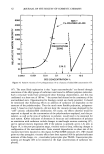
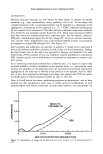
34 JOURNAL OF THE SOCIETY OF COSMETIC CHEMISTS FACTORS INFLUENCING COMPLEX FORMATION SURFACTANT STRUCTURE It has frequently been reported that interaction between uncharged water-soluble polymers and surfactants is much more facile with anionic surfactants than with cationic surfactants and, in turn, very much stronger than with nonionic surfactants. A pro- nounced influence of the particular counterion present in the cationic surfactant on its reactivity with a polymer has been found by Saito (24). This author (25) also reported that modification of the structure of an alkylsulfate by insertion of ethyleneoxide groups considerably weakened its interaction with a polymer (PVP). Branching of a surfactant molecule is also expected to weaken the interaction. CHAIN LENGTH In a homologous series of alkylsulfates, the initial binding concentration, T•, decreases with increasing chain length (8,10,26). A linear relation between log Tx and n, the number of carbons in the alkyl chain, viz. lnT• = n•o/kT + constant exists as has been found between log CMC and n. For PVP/SDS mixtures, Arai et al. (10) found a value for •o of - 1.1 kT. This corresponds to the free energy change per CH 2 group on transferring the surfactant from the unassociated state in water to the complex, and is comparable to the value for the analogous transfer of the surfactant molecule to a micelle. Goddard et al. (27) studied the solubility diagrams of a homologous series of alkyl sodium sulfates in mixture with the cationic cellulosic polymer, PQ-10. In each case it was found that, in the limit, the slope of the points of maximum insolubility in the plot of log polymer versus log surfactant concentration changed from 45 ø to 90 ø (i.e., be- came independent of polymer concentration if the latter were reduced below a certain value). Mathematically, the result could be expressed as Ceexp (mo/kT) = constant where Ce is the polymer concentration-independent surfactant concentration corre- sponding to maximum precipitation. A value of •o of - 1.1 kT was derived, suggesting that the environment of surfactant molecules in the complex resembles that of micelles in this case also. EFFECT OF SALT In the case of unionized polymer/charged surfactant systems, addition of salt depresses the T• values, i.e., promotes the formation of complexes. Murata and Arai, for ex- ample, found the log-log plot of T• against sodium ion concentration for the PVP/SDS association to be linear, with a slope exactly the same as that of the CMC/sodium ion concentration plot for this surfactant (11). Addition of salt also increased the binding ratio of surfactant to polymer, i.e., extended the T•, T 2 range. For example, in the case of PVP/SDS, addition of 0.1 M NaC1 increased the ratio to 0.9 mol SDS per base mol PVP from the 0.3/1 ratio observed in water. A similar effect occurs with PEO/SDS (28).
Purchased for the exclusive use of nofirst nolast (unknown)
From: SCC Media Library & Resource Center (library.scconline.org)