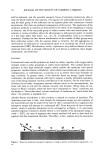
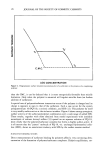
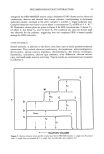
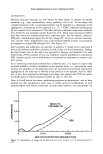
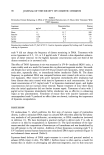
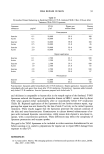
OIL-IN-WATER EMULSIONS 9 Table II Composition of Emulsions and Corresponding Ternary Systems Emulsion Ternary system Liquid paraffin 100 -- g Water 300 300 g Fatty amphiphile (cetearyl alcohol) Varied 7-57 Varied 7-57 g Surfactant (ionic or nonionic) Varied 0.8-6.4 Varied 0.8-6.4 g cably that complex crystalline gel phases are a major component of emulsions stabilised by combinations of fatty alcohols and ionic or nonionic surfactants (19-21). Figure 4 shows a schematic diagram of a typical o/w emulsion stabilised in this manner. At least four phases can be identified: 1. Dispersed oil phase 2. Crystalline gel phase composed of bilayers of surfactant and amphiphile separated by "thick" layers of water 3. Crystalline hydrates of amphiphile 4. Pockets of bulk "free water" The oil droplets are surrounded by multilayers of gel phase that become more randomly oriented as they progress further into the continuous phase. The gel phase can exist in equilibrium with crystalline regions and pockets of bulk water. The oil droplets are Surface of Oil Droplet Interlamellar Water GEL PHASE Figure 4. Schematic diagram of a typical multiple-phase oil-in-water cream to illustrate the composition of the viscoelastic continuous phase (redrawn from ref. 19).

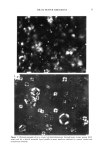
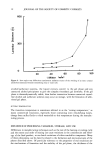
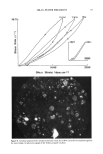
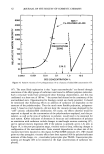
10 JOURNAL OF THE SOCIETY OF COSMETIC CHEMISTS essentially immobilised in the structured continuous phase, and both flocculation and coalescence on storage are inhibited. These emulsions are more stable than those con- taining liquid crystals described above because of the large amounts of incorporated water and the substantial mechanical strength of the crystalline chains. It is interesting to note that in these multiple-phase emulsions the forces of repulsion (electrostatic or hydrational) between the bilayers, rather than similar forces on the surface of the oil droplets, are responsible for preventing the close approach of droplets. These crystalline and swollen gel phases can be identified microscopically. In model mixed emulsifier/water ternary systems, crystalline masses of alcohol appear to form a focus for various bilayer structures (vesicles) of heterogeneous composition, size and complexity. In emulsions, the gel phase bilayers are focused as a rigid matrix around oil droplets (Figure 5). More detailed analysis of the viscoelastic phases has been obtained from x-ray investi- gations of both emulsions and emulsifier/water systems using a synchrotron radiation source (20). The progressive swelling properties in water (0-94%) of a series of emulsi- fying waxes composed of cetearyl alcohol combined with either ionic (cetrimonium bromide) or nonionic (ceteth 20) surfactants are shown in Figures 6 and 7a. They dem- onstrate that different swelling mechanisms are involved in gel phase formation with each type of surfactant. Cetrimide emulsifying wax exhibits the phenomenal swelling observed with some charged lipids (14) the lameliar spacing that incorporoates the interlamellar water in- creases from 75• at 28% water to approximately 500A at 93% water (model contin- uous phase). The hydrocarbon bilayer distance (-50•) does not change markedly as the water content increases (Figure 6). In contrast, there is comparatively limited incorpo- ration of water between the bilayers of the alcohol in the presence of nonionic surfac- tant. The water thicknesses of gel phase vary from approximately 75• at 10% w/w water to approximately ! 10• for 84% water (Figure 7). Both types of system show phase separation at high water concentrations. The x-ray data confirmed that swollen gel phase of similar bilayer thicknesses was present in significant amounts in emulsions containing these mixtures. The infinite swelling with ionic surfactants is essentially electrostatic in nature. Charged groups at the surface of the bilayers significantly increase the forces of repulsion between the bilayers. In the presence of nonionic surfactant, the swelling is due to hydration of the polyoxyethylene chains of the interpositioned surfactant that are orientated and ex- tended into the interlamellar water layer (Figure 7b). Stabilisation of the nonionic gel phase is essentially by steric repulsions (22). FORMATION OF THE GEL NETWORK PHASE Emulsions are manufactured by mixing the molten components and then cooling to the storage temperature. At the high temperatures of manufacture, the emulsion formed by homogenisation is stabilised by an adsorbed monomolecular film at the oil droplet/ water interface. During the cooling process, fatty amphiphile becomes progressively less soluble in the oil and diffuses from this phase into the aqueous miceliar environment to form either spherical mixed micelies or lameliar liquid crystals that will further stabilise the emulsion. A small portion of the oil is also solubilised. When the temperature falls below the transition temperature, which is between 40 ø and 50øC for most fatty
Purchased for the exclusive use of nofirst nolast (unknown)
From: SCC Media Library & Resource Center (library.scconline.org)