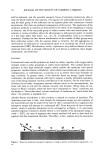
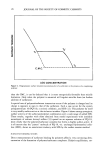
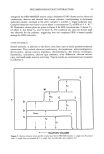
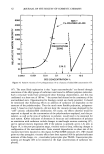
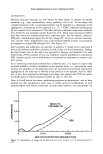
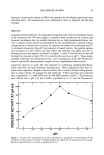
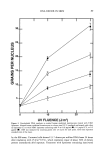
OIL-IN-WATER EMULSIONS 3 // WAT E R Below Above -- T½ • Tc WATER GEL LIQUID CRYSTAL Figure l. The order-disorder transition, T o and the lameliar gel and liquid crystalline phases that form spontaneously when a natural surfactant (polar lipid) is dispersed in water. literature about surfactants (for example, the tilted L•' gel phases or inderdigited monolayer phases (4-6)), but these have not been reported in emulsions. Both the gel and liquid crystalline states formed by bi-alkyl lipids (Figure 1) are well known to biological scientists, as they represent the fundamental structure of most animal cell membranes and are also an important structural element in the barrier function of the stratum corneum (7). Many polar lipids such as the lecithins are natural surfactants with a hydrophobic portion composed of two hydrocarbon chains of different lengths and degrees of unsaturation. In cell membranes these are finely balanced to give the required levels of order and disorder, and the transition temperature is close to physiological temperature. Small changes of temperature, pressure, or other biological stimuli can locally fluidise or crystallise the membrane to make it more or less perme- able. In the skin the long hydrocarbon chains and high transition temperatures of the stratum corneum lipids imply that the normal organisation of this barrier is the gel state. There is less information about these states in the emulsion literature, although both natural and synthetic emulsifiers often form liquid crystalline and gel phases in water

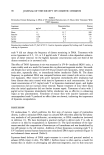
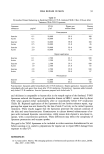
4 JOURNAL OF THE SOCIETY OF COSMETIC CHEMISTS over the range of temperatures relevant to the manufacture and storage of emulsions. The rest of this paper will describe the importance of these phases in emulsion tech- nology. EMULSIFIERS USED IN MULTIPHASE EMULSIONS Most commercial emulsions contain mixtures of emulsifiers formed from combinations of fatty amphiphiles and surfactants. Mixtures of sparingly soluble long-chain alcohols or glyceryl esters, such as glyceryl stearate (G.M.S.) with more soluble ionic or nonionic surfactants, are well known in cosmetic science. The emulsifier components are either added separately during the manufacture of the emulsion by dispersing the surfactant in water and the amphiphile in the oil with the aid of gentle heat, or, alternatively, they are added combined as a previously blended emulsifying wax. A selection of commonly used surfactants, amphiphiles, and emulsifying waxes is included in Table I. The surfactants, which alone are capable of stabilising simple oil-in-water emulsions, are generally referred to as the primary emulsifier, and the fatty amphiphiles, which are too lipophilic to promote oil-in-water emulsions, as the secondary, auxiliary, or co- emulsifier. It will be shown that this terminology is misleading, for the fatty amphi- phile is usually the dominant or primary emulsifier in such mixtures. INTERACTION OF EMULSIFIERS IN WATER EMULSIFIER COMPONENTS Surfactants. Polar lipids such as the soybean lecithins are sometimes used in preference to synthetic surfactants in dermatological emulsions, as they are considered less harmful to the skin. Lecithins from this source are usually composed of homologue admixtures of unsaturated C•6-C18 acids and may have gel-liquid crystalline transition tempera- tures as low as -22 ø (8). This means that although theoretically they can form gel phases, liquid crystals are present in most of the aqueous solutions studied. Table I Selection of Commonly Used Amphiphiles, Surfactants, and Emulsifying Waxes Amphiphiles Surfactants Cetearyl alcohol Triethanolamine stearate Cetyl alcohol Sodium lauryl sulphate Stearyl alcohol Cetrimonium bromide Glycerol stearate Ceteth 20 Stearic acid Lecithin Cholesterol PEG-20 stearate Emulsifying Waxes Components Emulsifying wax U.S.N.F. Cationic emulsifying wax B.P.C. Glyceryl stearate, S.E. Cetomacrogol emulsifying wax B.P.C. Cetearyl alcohol, polysorbate Cetearyl alcohol, cetrimonium bromide Glyceryl stearate, soap Cetearyl alcohol, ceteth 20
Purchased for the exclusive use of nofirst nolast (unknown)
From: SCC Media Library & Resource Center (library.scconline.org)