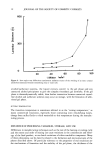
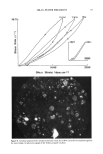
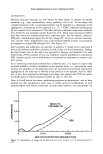
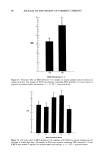
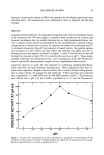
POLYMER/SURFACTANT INTERACTION 29 10.0 5.0 2.5 O/ - 0 n I• 2 I I I 0 0.5 1.0 1.5 2.0 2.5 CONCENTRATION OF "OUTSIDE" SOLUTION (SDS mM) Figure 5. Binding isotherm of PEO-SDS system in 0.1 M NaC1 solid line from Hill equation (14). mol PVP, in good agreement with the values obtained for SDS/PVP and SDS/PEO in salt-free solution obtained previously. Others who have used the specific ion electrode include Birch et al., who investigated the PVP/SDS and PVOH/SDS systems (17). Turning now to oppositely charged pairs, we refer to the extensive studies of Kwak and co-workers, who used membrane electrodes specific for cationic surfactants in studies of their interaction with a series of polyanions (3,18,19, and references contained therein). Typical data of Kwak et al. are given in Figure 7. Important aspects are: 1. The binding curves are steep, indicative of cooperative binding. 2. Binding occurs at very low surfactant concentrations, which are relatively higher for straight-chain alkyltrimethylammonium surfactants than for alkylpyridinium sur- factants, showing a lower affinity in the former case. 3. As the alkyl group is lengthened, the concentration for binding is reduced. Considerable differences in binding characteristics in a series of polyanions were found by Kwak, reflecting the effect of differences in polymer structure, polymer chain flexi- bility, and charge density. For the dodecyltrimethylammonium ion the strength of binding followed the sequence: polystyrene sulfonate dextran sulfate polyacrylate DNA alginate pectate NaCMC.

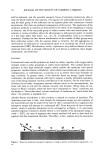
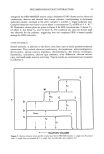
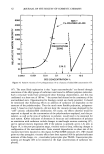
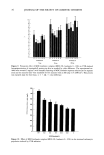
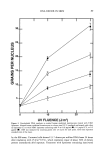
30 JOURNAL OF THE SOCIETY OF COSMETIC CHEMISTS 200- 180 - 160- ._. 140- tu 120 - 100- 80- ß . C. M.C.apparent z 3 2 I 0 -LOG [DS-] Figure 6. Emf, concentration plots of SDecS in the presence of PVP: (¸) 1.2% PVP ([•) 0.5% PVP (I) 0.25% PVP (O) 0% PVP. Each upper curve is raised progressively by 10 mV. For c.m.c. designations, see text (16). PRECIPITATION IN OPPOSITELY CHARGED PAIRS The studies of Kwak and other investigators were confined to relatively low levels of added surfactant, since binding in these systems is so energetic, i.e., occurs in most cases at concentrations a fraction of the CMC of the surfactant. When, however, the charged surfactant and oppositely charged polymer approach equivalence, on a charge basis, precipitation reactions occur since the charge-neutralized complex has limited solubility. An interesting feature is that the precipitated complex can be solubilized if excess surfactant is added to the system. These effects are illustrated in the "solubility diagram" for the cationic cellulosic, polyquaternium 10/triethanolamine lauryl sulfate combination. See Figure 8 (12). The 45 ø slope of the log/log plot, representing condi- tions of maximum precipitation, signifies a constant composition of the insoluble com- plex. It should be noted that resolubilization in such pairs depends on the specifics of both polyion and surfactant, and in some cases the resolubilization areas are only partial or even absent. For example, it has been found that if the charge density of the polyion is too high, resolubilization cannot be achieved. NUCLEAR MAGNETIC RESONANCE Early work by Muller and Johnson (20) on "F 3 SDS" (SDS in which the terminal CH 3
Purchased for the exclusive use of nofirst nolast (unknown)
From: SCC Media Library & Resource Center (library.scconline.org)