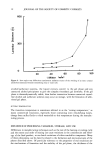
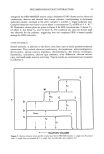
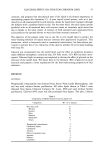
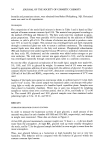
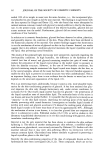
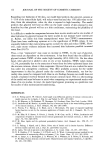
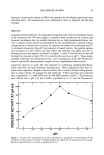
POLYMER/SURFACTANT INTERACTION 37 More complete models have been proposed recently by Nagarajan (35) and by Gilanyi and Wolfram (36). Nagarajan, for example, sets up a mass balance equation for the total surfactant in the system that includes surfactant in single ion form, in clusters of size gb in the polymer/surfactant complexes, and in micelles of size gf. Binding (Kb) and micellization (Kf) constants are also assigned. Depending on the relative values of K• and Kf, one can then either encounter complex formation followed by micellization or only micellization, and the steepness of the binding curve will be determined by the degree of cooperativity or g•. With this model, Nagarajan was able to account quantita- tively for observed binding data, while confirming the essential similarity of the pro- cesses of complex formation and of micelle formation. The picture that emerges is that these two processes are essentially competitive. If K• Kf complex formation will oc- cur until the binding process is complete, after which, on further increase of surfactant, regular micelles will form. [This would lead to phase diagrams of the type developed by Sasaki et al. (23) and other workers (28,35). See Figure 10]. Another factor supporting the similarity of the two processes comes from the fast kinetics measurements of Wyn- Jones (37-39). A surprising result is that the kinetics of aggregate formation are at least as fast as those of micellization, itself a very fast process with relaxation times in E E 2O 0•8 •12 0 I..- z I,U z o D (MICELLE) C B A (SINGLE ION) 4 8 12 16 20 24 CONCENTRATION OF SDS/mmol din-3 Figure 10. Phase diagram of PEO (0.5%)-SDS system. The concentration of the different species, viz., single ion, micelle, and polymer/surfactant complex, at any SDS concentration is obtained from the inter- cepts of a vertical line raised at that concentration (23).

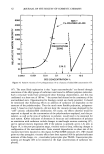
38 JOURNAL OF THE SOCIETY OF COSMETIC CHEMISTS the microsecond to millisecond range. A further point of interest is that the activation energy for surfactant clustering in complex formation is as little as one third that in- volved in micelle formulation of the same surfactant (39). A simple model providing explanation of all these phenomena is seen in the picture of the surfactant/(unionized) polymer complex put forward by Nagarajan (35), Shirahama (40), Landoll (41), and Cabane (22). (See Figure 11.) It is noted first that in formation WATER (a) / // ©/ ©/ CHARGE REPULSION (b) Figure 11. Schematic diagram of (a) charged surfactant micelle and (b) polymer/surfactant complex (35).
Purchased for the exclusive use of nofirst nolast (unknown)
From: SCC Media Library & Resource Center (library.scconline.org)