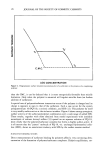
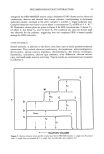
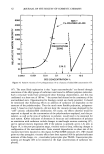
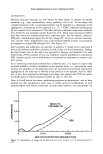
POLYMER/SURFACTANT INTERACTION 35 A very different effect of salt occurs if the polymer is a polyion and the surfactant bears an opposite charge to it. In this case, while the addition of salt increases the steepness, i.e., the "cooperativity" observed in the binding isotherm, it substantially reduces the affinity of binding, as evidenced by a steady increase in the concentration at which binding commences (29). This result clearly points to the importance of electrostatic attraction between the polyion and the oppositely charged surfactant as being a primary driving force for the association. That electrical screening by the salt is the operating mechanism in weakening attraction is verified inasmuch as the effect is magnified if the salt contains divalent ions, as opposed to monovalent ions, bearing a charge opposite in sign to that of the polyion (30). THE POLYMER A minimum molecular weight of polymer is apparently required to ensure "complete" interaction with the surfactant, and this value is 4000 for PEO and PVP. Below values of ca. 1500, the interaction tendencies with these polymers are restricted. Until quite recently, the list of unionized polymers showing the ability to form com- plexes with ionic surfactant was quite small. The "traditional" list included PEO, PVP, and PVOH. The lack of reactivity in this respect of other polymers, such as HEC, was thought to be due to a lack of macromolecular flexibility, but even the more flexible polysaccharide dextran shows little tendency to interact with SDS or DDBS. Likewise, the relative inactivity of polyacrylamide, PAAm, remained a puzzle. It was recognized that reactivity can be induced in a polymeric structure by introducing hydrophobic sites in the macromolecule. Examples are MeC versus HEC, low-molecular-weight polyal- kyleneoxides in which PO replaces EO, and PVOH specimens prepared from, but still containing residual amounts of, PVAc. In fact, the reactivity of polymers seems to correlate with a kind of "hydrophobicity index": For anionic surfactants, Breuer and Robb (1) listed polymers in the following order of increasing reactivity: PVOH ( PEO ( MeC ( PVAc • PPO -- PVP and for cationic surfactants: PVP ( PEO ( PVOH ( MeC ( PVAc ( PPO Recently, the notion of the importance of hydrophobicity in the polymer in promoting reactivity with surfactants has had strong reinforcement. Lindman and co-workers have shown that hydroxypropyl and ethylhydroxyethyl cellulose (31), and of course MeC (32), all display pronounced association tendencies towards SDS, and "reactivity" can be induced in PAAm by methyl (or other alkyl substitution) of the nitrogen amide group of this polymer (33). These results support the earlier data of Murai et al. on the reaction of SDS with a series of model polypeptides (34). It should be mentioned that very recent work on so-called "associative polymers" (alkyl-substituted water-soluble polymers) is clearly indicating that these structures have pronounced interaction ten- dencies with added surfactant. See below. Turning now to ionized polymers, we point out first the position of PVP in the above two polymer sequence series. This polymer is known to be weakly cationic its slight residual positive charge promotes interaction with anionic surfactants and does the re- verse with cationic surfactants. These effects are magnified when the polymer carries

36 JOURNAL OF THE SOCIETY OF COSMETIC CHEMISTS formal positive or negative charges. If the charges on the polyion and the surfactant have the same sign, then strong forces of electrostatic repulsion are involved and little to no association can be expected. Examples are NaCMC or ionized polyacrylic acid in the presence of anionic surfactants. The position is reversed in the opposite case, and in fact the polyion now presents well-defined electrostatic binding sites for the oppositely charged surfactant ions. The process is strongly reinforced by alkyl chain association of the adsorbing surfactant molecules. Examples are the interaction of alkyl sulfate surfac- tants with cationic-cellulosic or -vinyl polymers. Several properties of the polyion influence the reaction with oppositely charged surfac- tants. This is evident in the binding sequence of Kwak referred to earlier, and involves charge density, hydrophobicity, macromolecule flexibility, and other factors. The reader is referred to Kwak's papers for more detailed information. It should again be mentioned that the ability of excess surfactant to resolubilize the insoluble polymer/sur- factant complex formed under "stoichiometric conditions" also depends on the charge density and structure of the polyion. INTERACTION MODELS For both types of polymer/surfactant systems, viz., polymers charged or uncharged, theories developed to account for the formation of polymer/surfactant complexes have postulated structures with the surfactant molecules in the form of aggregates or clusters. Much information, including NMR data (referred to above) and solubilization data (referred to below), points to individual surfactant molecules experiencing an envi- ronment in the complexes similar to that which they encounter in regular surfactant micelies. In explaining their data for the SDS/PEO system, Smith and Muller (21) postulated that each macromolecule consists of a number of effective segments of mass (Ms) and total concentration (P) that act independently of each other and are able to bind n surfactant anions (D-), in a single step according to P +nD- • PDn n- with the equilibrium constant being given by K = [PDn n- ]/[P][D-]n K is obtained from the half saturation concentration, viz., K = [D- ]•/2-n The data indicated the cluster size, n, to be about 15 (which is much smaller than in regular micelies) and Ms to be 1830, which explains the experimental finding that PEO of MW 1500 is relatively ineffective for surfactant binding while higher molecular weight PEOs are effective. The free energy of binding is given by AGø= RTlnK •/n and the value obtained, viz., - 5.07 Kcal mole- •, is close to that of micelie formation. Shirahama (14) introduced a similar model to account for his binding data of SDS on PEO in the sense that cluster formation of the bound surfactant molecules (with n = 20 molecules) was invoked and the degree of binding, 0, was expressed by a modified Langmuir isotherm of the form 0 = KCn/(1 + cn).
Purchased for the exclusive use of nofirst nolast (unknown)
From: SCC Media Library & Resource Center (library.scconline.org)