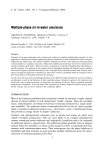
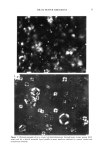
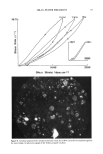
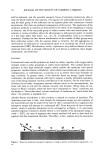
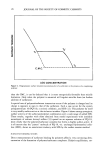
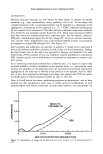
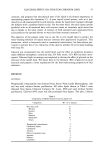
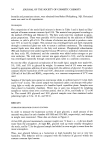
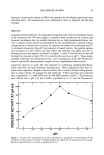
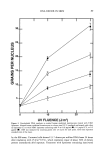
40 JOURNAL OF THE SOCIETY OF COSMETIC CHEMISTS SOLUTION . WITH POLYMER \ ! WITHOUT POLYMER PRECIPITATION I ZONE CO N C E NTRATION SU R FACTANT Figure 12. Conditions in the bulk and surface of solutions containing a polycation (fixed concentration) and anionic surfactant. Full line is the hypothetical ST-concentration curve of the surfactant alone dotted line is that of mixture with polycation. Simple gegencations are depicted only in surface zone (3). SOME PROPERTIES AND OPPORTUNITIES RELEVANT TO COSMETIC SCIENCE There are many changes in solution and surface properties that occur as a result of polymer/surfactant association. Some which would appear relevant to cosmetic science follow. VISCOSITY It is known that polyelectrolytes tend to adopt a linear configuration in aqueous solu- tion unless the ionic strength of the solution is high. This configuration favors an increase in viscosity of the solution. When an unionized polymer binds an ionic surfactant, the polymer will acquire a charge, and hence, on the basis of the "polyelectrolyte effect," an increase in viscosity would be anticipated. This area has been investigated by a number of authors, and in Figure 13 we present data of Francois et al. on the effect of adding SDS to a series of PEO polymers (46). A sudden increase in viscosity occurs at a certain concentration (T•) of surfactant, independent of polymer molecular weight, and this increase can be as high as five-fold, which is consistent with a polymer charging effect.

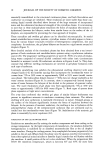
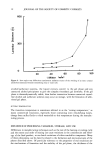
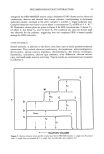
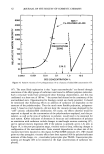
POLYMER/SURFACTANT INTERACTION 41 3000 20O0 1OOO I 10-2 2x10⁻² SDS CONCENTRATION (tool/I} Figure 13. Reduced viscosity of PEO as a function of SDS concentration: (O) M = 2 X 10⁶, Cp = 6 X 10 -•g/1 (O) M = 106 ,Cp = 6 X 10 -2g/1 ([•)M = 2 X 10⁵ ,Cp = 5 X 10 -•g/1 (I) M = 7 X 10 4, Cp = 5 X 10- • g/1 (46). Even larger increases can be seen with certain oppositely charged polyelectrolyte/ionic surfactant pairs, as illustrated in Figure 14. In this case involving the cationic cellu- losic, PQ-10, relatively low levels of added SDS lead to substantial viscosity increases (as large as 200 fold), or even gel formation, in the immediate preprecipitation zone
Purchased for the exclusive use of nofirst nolast (unknown)
From: SCC Media Library & Resource Center (library.scconline.org)