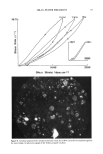
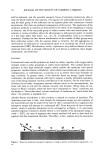
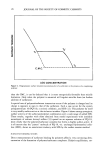
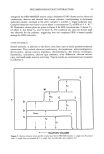
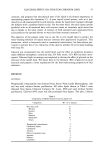
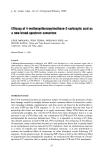
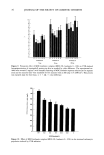
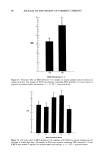
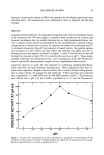
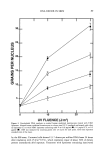
80 JOURNAL OF THE SOCIETY OF COSMETIC CHEMISTS PF 3 2 1 0 4% 8% MDC/Boehmite (1/1) Figure 15. Preventive effect of MDC-boehmite (1/1) complex on natural sunlight-induced erythema of human back skin. The samples of W/O-type emulsion containing MDC-boehmite (1/1) were treated (2 mg/cm 2) ten minutes before sun exposure. n = 14. PF = protection factor. PF 0-8 2-6 4 -4 6-2 8-0 MDC-Boehmlte/P-MCX% Figure 16. Preventive effect of MDC-boehmite (1/1) combined with P-MCX on natural sunlight-induced erythema of human back skin. The samples of W/O-type emulsion containing MDC-boehmite (1/1) and P-MCX were treated (2 mg/cm 2) ten minutes before sun exposure. n = 5. PF = protection factor.

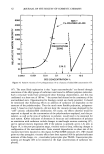
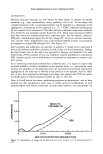
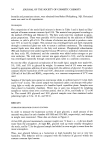
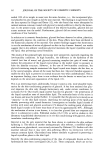
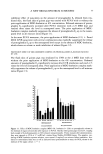
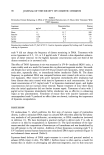
A NEW BROAD-SPECTRUM SUNSCREEN 81 PF 0-8 4-4 6-2 8-0 MDC-Boehmite/P-MCX% Figure 17. Preventive effect of MDC-boehmite (1/1) combined with P-MCX on delayed pigmentation induced by natural sunlight on human back skin. The samples of W/O-type emulsion containing MDC- boehmite (1/1) and P-MCX were treated (2 mg/cm 2) ten minutes before sun exposure. n = 6. PF = protection factor. jects. In several combinations with Parsol MCX, they demonstrate an SPF near 2, while Parsol MCX alone had no effect (Figure 18). DISCUSSION 4-Methoxydibenzoylmethane-2-carboxylic acid (MDC) was developed as a new sun- screen agent. It is characterized by varying UVA and UVB absorption spectra with cationic metal compounds such as boehmite, and such complexation induces an increase in the molecular absorbance coefficient in the UVA range and a decrease in the UVB range. In accordance with changes in the molecular absorbance coefficient (MAC), the MDC-boehmite complex is found to provide a high and dose-dependent protection against both PUVA- and UVB-induced erythema. An increase in MAC by 10,000 in the UVA range induces an increase in SPF by about 3.8, while a decrease in MAC by 4,000 at UVB range is associated with a decrease in SPF by about 1.2, although the appearance of a minimum value at the 6/6 ratio of MDC-boehmite does not exactly correspond to the changes in the MAC. Since prostaglandins have frequently been implicated as inflammatory mediators in ery- thema induced by UVB irradiation as well as that induced by PUVA (8-13), the
Purchased for the exclusive use of nofirst nolast (unknown)
From: SCC Media Library & Resource Center (library.scconline.org)