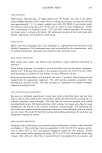
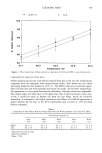
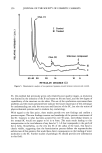
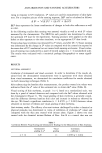
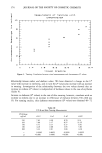
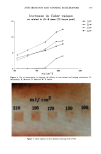
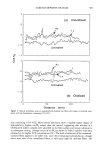
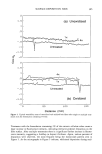
338 JOURNAL OF THE SOCIETY OF COSMETIC CHEMISTS the drying was completed at room temperature. Conditioning in the humidity room followed. EXTRACTION OF SEBUM FROM HAIR The extraction process (using hexane) and the subsequent analysis of the sebum residues removed from the hair has been described previously (1). WOOL SWATCH EXPERIMENTS A wool swatch screening test was used to evaluate total sebum removal by SLES-2 and ALS over the temperature range of 21 to 43øC. Essentially this test assesses sebum removal by monitoring (using a reflectance technique) the amount of lipid-soluble dye (Sudan IV, Aldrich) remaining on sebum/dye-soiled swatches after washing. The soil is applied to the wool using a 1% sebum/chloroform solution (0.005 g dye/g sebum), and the soiled swatches are washed in 1 liter of 0.1% surfactant solution (five swatches per wash load). After rinsing, the swatches are dried and the amount of dye remaining is assessed by reflectance. RESULTS AND DISCUSSION Results are presented for two sets of soil/wash conditions: 1. Sebum/dye-impregnated wool swatches washed at various temperatures in 0.1% surfactant -- essentially one soil/wash cycle 2. Hair soiled at 0.03-0.04 g soil/g hair and washed with 0.01% surfactant solution --ten soil/wash cycles The low detergent concentration for the hair experiments was used to facilitate analysis of the sebum residues on the hair. If higher concentrations are employed, the recovery and subsequent analysis of the lipid residue is not feasible because excessive amounts of surfactant relative to the amount of hair and soil would be involved. It has been pre- viously shown that similar results could be produced on hair after ten soil/wash cycles using either 0.01% or 10% solutions (1) of these same two surfactants. WOOLSWATCH DATA The percent total sebum removed by SLES-2 and ALS for wash temperatures between 21øC and 43øC are shown in Figure 1. (Values represent averages for between n = 5 and n = 15). Sebum removal increases linearly with temperature, and at all tempera- tures SLES-2 is a more effective detergent than ALS. However, the slopes of the curves are essentially the same, suggesting similar mechanisms for lipid soil removal. Thus the behavior of these two surfactants with respect to oily soil is that predicted by surfactant theory (4).

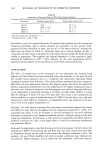
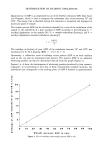
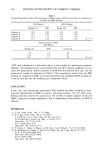
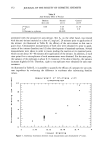
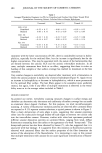
CLEANING HAIR 339 + SLES-2 A ALS lOO o E 90 70 60 i .50 • I 21.1 26.7 32.2 37.8 43.3 Temperature (C) Figure 1. Wool swatch data: Sebum removal vs temperature for ALS and SLES-2, one soil/wash cycle. COMPARISON OF HAIR AND WOOL DATA Table I presents data for the total sebum removed from hair at the two test temperatures compared with the analogous wool swatch/sebum values. Also shown are the values previously found for hair washed at 43øC (1). The SLES-2 data are in excellent agree- ment for both hair and wool (standard deviations are small). At the lower temperature, the agreeement is not as good (between the substrates), although values are comparable. One might expect the hair value to be higher than that of wool (as found), since intu- itively it should be easier to remove soil from the hair fibers, which are relatively untangled, as compared to the highly interwoven wool fibers. For ALS the agreement is again excellent for the hair in the 43øC experiments and is lower at 21øC for both keratin substrates. Table I Comparison of Total Sebum Removal Values From Hair and Wool Substrates (2 iøC and 43øC Data) Total sebum removed (%) Hair • Hair 2 Wool Hair Wool (43) (43) (43) (21) (21) SLES-2 90 ñ 23 92 ñ 3 90 ñ 2 71 ñ- 5 57 ñ- 4 ALS 64 ñ 18 64 ñ 8 85 ñ 2 46 ñ 6 55 ñ- 3 Data from the present work. Data from reference 1. Mean ñ SD.
Purchased for the exclusive use of nofirst nolast (unknown)
From: SCC Media Library & Resource Center (library.scconline.org)