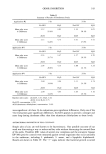
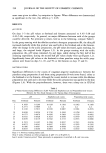
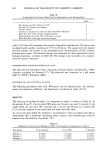
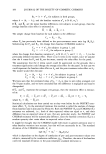
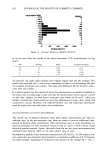
172 JOURNAL OF THE SOCIETY OF COSMETIC CHEMISTS If the ratio A/B is selected, then A appears inferior in efficacy to B but if the ratio B/A is selected, the reverse conclusion appears to be supported. In fact, from this limited data, most observers would conclude that the products were equivalent in efficacy. Post-treatment sweat response T/C ratios for each subject could also be adjusted by division by the corresponding pretreatment T/C ratios if the latter were available. Wooding and Finklestein (6) demonstrated that a logarithmic transformation of sweat rates resulted in normal distributions of the data and were valid for use in standard normal-theory hypothesis tests and confidence interval calculations. Wooding and Finklestein (6) were apparently the first writers to publish a mathematical model for the analysis of antiperspirancy data, which they called the "Sides Subjects Effects Model" (SSEM): Yjkm = •l• -3- 4)j -3- •k k -3- T m '-• Ejk m (our notation) where: Yjkrn is the logarithm of the sweat rate for axilla k of subject j, treated with treat- ment m, • is the log mean sweat rate over all subjects 4)j is the random effect of subject j, j = 1, . . . , n •k k is the fixed effect of sides (or laterality) k, k = 1,2 (left, right) q'm is the fixed effect of treatment m, m = 1,2 (control, test) {!jk m is the random effect of axilla k of subject j, treated with treatment m. subject to: ]E •kk= 0, • q'm = 0 k = 1,2 m = 1,2 4)i is N (0, tys=), independent, {jkm is N (0, ty=), independent, with qbj and •jkm mutually independent. NOTE: N (0, ty •) is statistical shorthand for the phrase: "Normally distributed with mean zero and variance ty 2." Wooding and Finklestein showed that this model removes the mean effects of sides and individual subjects from the error term. They recommended against the use of the simple baseline correction procedure. THE LOG TRANSFORM OF SWEAT MEASUREMENTS IS A NECESSITY The adoption of the logarithmic transformation of sweat rate was first proposed by Wooding (5) on the basis of his finding that the distribution of sweat rates was skewed, or asymmetrical, but became approximately symmetrical after log transformation. Fol- lowing computations in the log metric, the results could be back-transformed to the original metric. MacLennan and Whinney (10) have also confirmed the need for the log transform. Since Wooding's findings were based on relatively small data sets, we took our own 10ok at this question using close to 3000 baseline observations on 154 test subjects having ten or more baseline observations each. For each subject we calculated their average sweat rate and R/L ratios both in the original metric and the log metric.

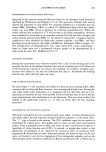
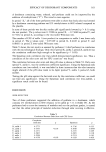
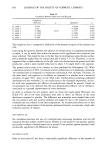
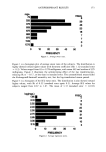
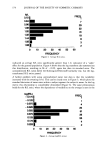
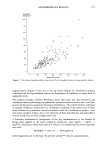
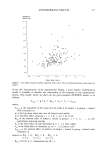
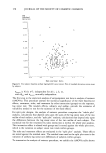
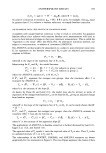
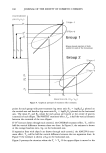
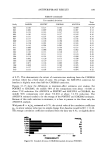
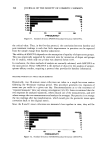
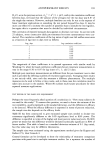
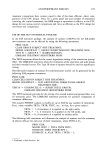
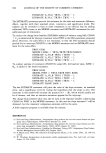
ANTIPERSPIRANT RESULTS 173 75 225 375 525 675 825 975 1125 1275 ! ......... ! ......... '! ......... i ......... i" ........ i lO 2o 3o 40 50 FREQUENCY Figure 1. Average sweat rates. 39 46 23 18 7 7 o 3 Figure 1 is a histogram plot of average sweat rates of the subjects. The distribution is highly skewed toward higher values with skewness coefficient (Sk) 1.12 (standard error = 0.2). Values ranged from 83 to 1278 milligrams, with mean 449 and median of 395 milligrams. Figure 2 illustrates the symmetrizing effect of the log transformation, reducing Sk to - 0.17, or less than its standard error. The untransformed means failed the Kolmogoroff-Smirnoff normality test, but the log-transformed means passed. Figure 3 is a histogram of the R/L sweat ratio. The distribution is also skewed toward higher values, with Sk of 0.52 (standard error again 0.2). Average R/L values for subjects ranged from 0.67 to 1.67. The mean of 1.13 (standard error = 0.013) 1.95 2.10 2.25 2.40 2.55 2.70 2.85 3.00 3.15 10 20 30 40 FREQUENCY Figure 2. Average log(sweat rates). FREQ. 2 6 13 25 39 31 22 10 3
Purchased for the exclusive use of nofirst nolast (unknown)
From: SCC Media Library & Resource Center (library.scconline.org)