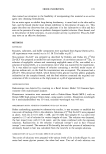
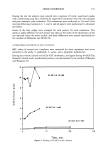
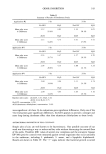
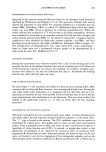
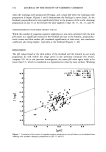
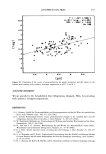
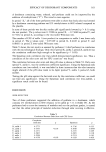
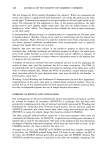
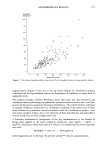
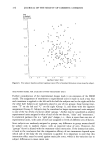
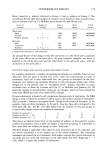
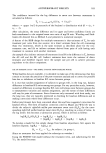
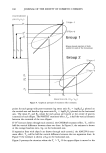
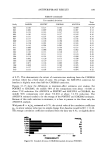
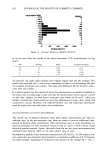
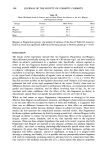
ODOR INHIBITION 137 During the test the subjects were entered into a regimen of timed, supervised washes with conditioning soap bars, followed by supervised treatments with the test solutions and post-treatment odor evaluation. The evaluations were conducted at 5-hr and 24-hr intervals following treatments 2, 3, and 4, and all aspects were randomized to eliminate any biases. Scores of the four judges were averaged for each person, for each evaluation. The axilla-to-axilla difference for each person was taken as the index of the deodorancy of the test material versus the water control, and these differences were treated statistically by the method of Hollander and Wolfe (8). ANTIMICROBIAL PROPERTIES OF ZINC GLYCINATE MIC values of several zinc complexes were measured for three organisms that occur naturally in the axilla: S. epidermidis, S. aureus, and a lipophilic diphtheroid. During an in-house clinical trial of Zn-GLY deodorancy, and again during the Hill Top Research clinical study, antibacterial potency was determined by the method of Marpies and Kligman (9). 12 10 0 0 Zn GLY at 10 rnM Zn GLY at 1 rnM Zn GLY 0.01 rnM 10 20 3O Time, min. Figure 2. Binding of Zn-GLY to hair, kinetics.

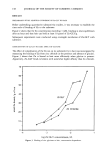
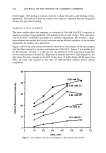
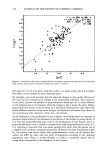
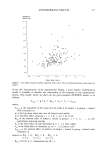
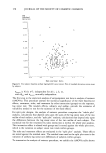
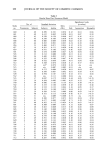
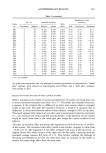
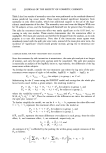
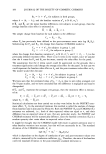
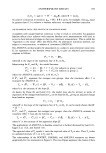
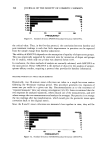
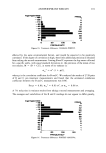
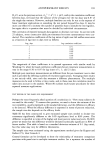
138 JOURNAL OF THE SOCIETY OF COSMETIC CHEMISTS RESULTS PRELIMINARY STUDY: KINETICS OF BINDING OF Zn-GLY TO HAIR Before undertaking quantitative substantivity studies, it was necessary to establish the time scale of binding of Zn to the substrate. Figure 2 shows that for Zn concentration exceeding 1 mM, binding is near equilibrium after an hour and that hair can hold at least 10 Ixmol of Zn-GLY/g. Subsequent experiments were conducted using overnight incubation of Zn-GLY with substrate. SUBSTANTIVITY OF Zn-GLY TO HAIR: EFFECT OF GLYCINE The effect of complexation of the Zn ion on its substantivity to hair was investigated by measuring the binding of Zn from zinc chloride in the presence and absence of glycine. Figure 3 shows that Zn is bound to hair more efficiently when glycine is present. Apparently, Zn-GLY binds to keratin with somewhat higher affinity than Zn chloride. 7O 6O 5O 4O 3O 2O 10 Zn GLY 0 1 -4 -3 -2 Zn Chloride log Zn GLY concentration, M. Figure 3. Binding of zinc glycinate to hair, concentration dependence.
Purchased for the exclusive use of nofirst nolast (unknown)
From: SCC Media Library & Resource Center (library.scconline.org)