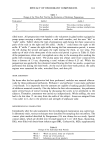
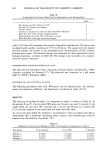
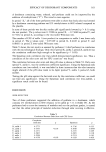
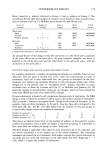
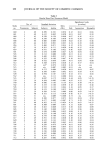
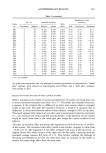
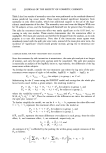
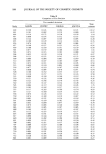
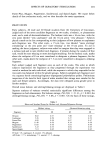
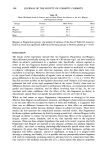
194 JOURNAL OF THE SOCIETY OF COSMETIC CHEMISTS Table III Panel Size: Required Number of Subjects in Panel for Detecting a True Difference in Percent Reduction at p = 0.05 With 80% Power and Standard Deviation of 0.1 Percent reduction Percent reduction Number of Number of Higher Lower subjects Higher Lower subjects 9O 85 6 45 25 9 85 8O 11 45 2O 6 85 75 4 40 35 130 80 75 17 40 30 36 80 70 6 40 25 17 75 70 26 40 20 11 75 65 8 40 15 7 75 60 4 35 30 152 70 65 36 35 25 41 70 60 11 35 20 20 70 55 6 35 15 12 70 50 4 35 10 8 65 60 47 30 25 175 65 55 14 30 20 47 65 50 7 30 15 23 65 45 5 30 10 14 60 55 60 30 5 9 60 50 17 30 0 7 60 45 9 25 20 200 60 40 6 25 15 54 55 50 75 25 10 26 55 45 21 25 5 15 55 40 11 25 0 11 55 35 7 20 15 227 55 30 5 20 10 60 50 45 92 20 5 29 50 40 26 20 0 17 50 35 13 15 10 255 50 30 8 15 5 68 50 25 6 15 0 32 45 40 110 10 5 285 45 35 30 10 0 75 45 30 15 5 0 317 panelists per group, and assume all groups have equal numbers of panelists. Then for the RRB design the total panel size N = nt(t - 1) and for the EVC design N = 2n(t - 1). Let 0 '2 be the variance of the log(R/L) responses. Then the variances for the relative treatment effects will be: 0.2/nt = (t - 1)0.2/N for RRB estimates 0.2/2n = (t -- 1)0.2/N for EVC direct estimates (test-versus-control) 0.2/n = 2(t - 1)0.2/N for EVC indirect estimates (test-versus-test) In the EVC design, the direct (test-versus-control) comparisons have variances half as large as those of the indirect (test-versus-test) comparisons and, therefore, require half the sample size to yield a given level of power. Comparisons requiring half the sample size to attain equivalent power are termed twice as "efficient." In the RRB design, all

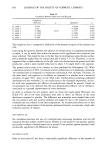
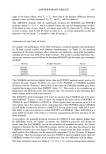
ANTIPERSPIRANT RESULTS 195 treatment comparisons have variance equal to that of the more efficient, direct com- parisons of the EVC design. Thus, for a given panel size and number of treatments (counting the control treatment), the RRB design is equivalent in efficacy to the EVC design for test-versus-control comparisons and twice as efficient as the EVC design for test-versus-test comparisons. USE OF THE SAS* STATISTICAL PACKAGE In the SAS statistical package, the analysis of variance (ANOVA) for the full-model two-treatment case can be effected by using the following statements: PROC GLM CLASS GROUP SUBJECT SIDE TREATMNT MODEL LOGSWEAT = GROUP SUBJECT(GROUP) TREATMNT SIDE TEST H = GROUP E = SUBJECT(GROUP) LSMEANS TREATMNT SIDE/STDERR PDIFF. The TEST statement allows for the correct hypothesis testing of the interaction (group) effect. The LSMEANS statement allows for estimation of the treatment and sides means and their standard errors. The Type III sums of squares should be used for significance testing. The full-model analysis of variance for multitreatment studies can be generated by the following SAS program statements: PROC GLM CLASS CELL GROUP SUBJECT SIDE TREATMNT MODEL LOGSWEAT = CELL GROUP(CELL) SUBJECT(CELL GROUP) TREATMNT SIDE TEST H = GROUP(CELL) E = SUBJECT(CELL GROUP) LSMEANS TREATMNT SIDE/STDERR PDIFF. The TEST statement provides for the testing of an overall interaction (group) effect over all treatment pairs. The LSMEANS statement provides for pairwise comparison of treatment differences. The simpler POSTRT analysis is readily set up in SAS for any number of treatments. First, create variables TRTA, TRTB,'TRTC, etc., so that, for a given subject: TRTA = 1, if treatment A is applied on the right axilla, TRTA = - 1, if treatment A is applied on the left axilla, and TRTA = 0, if treatment A is applied on neither axilla. The following SAS statements will illustrate the analysis of variance and the estimates of relative efficacy for each pair of three treatments, where POST is Pij: PROC GLM MODEL POST = TRTA TRTB TRTC ESTIMATE 'SIDES' INTERCEPT 1 ESTIMATE 'A_VS_B' TRTA 1 TRTB - 1 * Trademark of SAS Institute, Inc.
Purchased for the exclusive use of nofirst nolast (unknown)
From: SCC Media Library & Resource Center (library.scconline.org)