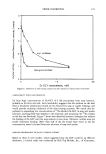
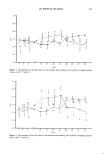
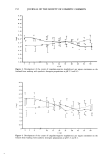
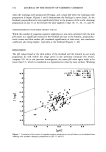
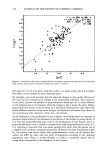
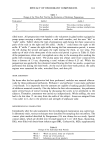
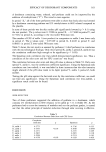
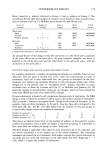
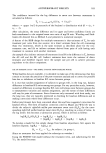
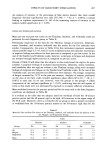
EFFECTS OF OLFACTORY STIMULATION 207 An analysis of variance of the percentage of false alarms showed that their overall frequency declined significantly over time [F(3,99) = 7.42 p ( 0.001], a typical finding in vigilance experiments (1). All of the remaining sources of variance in the analysis lacked significance (p) 0.05). STRESS AND WORKLOAD RATINGS Mean pre-test and post-test scores on the Thackray, Stanford, and Yoshitake scales are presented for each fragrance group in Table II. Preliminary inspection of the data for the Thackray ratings of attention, sleepiness, strain, boredom, and irritation indicated that the results for the five subscales were similar. Consequently, the scores in Table II for this instrument represent summated values (possible range is 5-45, with 25 as the midpoint) across the subscales. Increments in negative feelings are reflected in lower post-test as compared to pre-test scores. In the case of the Stanford and Yoshitake scales, however, increments in fatigue and sleepiness are revealed through higher post-test as compared to pre-test scores. Perusal of Table II will show that the subjects in this study found the vigil to be quite stressful. Composite feelings of increased inattentiveness, sleepiness, strain, boredom, and irritability after the vigil are evident in the Thackray ratings, along with increased feelings of sleepiness and fatigue on the Stanford and Yoshitake scales. In the case of the Yoshitake scale, pre-test and post-test differences were dramatic. On average, symptoms of fatigue increased by 257% in the post-test measure. Analyses of variance performed on the data of all three scales revealed significant phase effects [F(1,33) ) 48 p ( 0.001] in each case. In no case, however, were the groups or the groups X phase components of the analyses significant (p) 0.05), indicating that the self reports of stress in this study were not attenuated by exposure to accessory olfactory stimulation. Mean workload scores for the practice period and for the main task in the three fragrance conditions are displayed in Table III. It is evident in the table that the subjects rated the workload of both the 10-minute practice period and the 40-minute vigil to be high. All scores are in the upper range of the TLX scale. Moreover, there is a trend for the air group to show a greater increment in workload from the 10-minute practice session to the 40-minute vigil than for the Table II Mean Pre-Test and Post-Test Scores on the Thackray, Stanford, and Yoshitake Scales for Subjects in the Air, Muguet, and Peppermint Groups Scales Thackray Stanford Yoshitake Groups Pre Post Pre Post Pre Post Air 32.5 25.6 2.3 3.6 2.5 7.4 Muguet 33.6 25.1 2.4 3.8 3.3 7.1 Peppermint 34.2 25.7 2.2 3.3 2.7 7.2 Mean 33.4 25.5 2.3 3.6 2.8 7.2

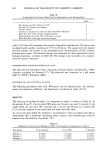
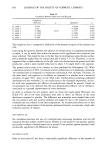
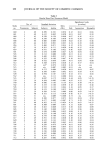
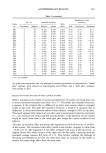
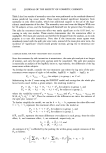
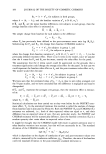
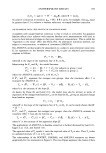
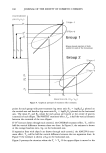
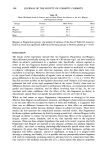
208 JOURNAL OF THE SOCIETY OF COSMETIC CHEMISTS Table III Mean Workload Scores in Practice and the Main Watch for Subjects in the Air, Muguet, and Peppermint Groups Groups Practice Main watch Mean Air 64.7 68.2 66.4 Muguet 69.4 68.0 68.7 Peppermint 63.6 62.3 63.0 Mean 65.9 66.2 Muguet or Peppermint groups. An analysis of variance of the data of Table III, however, failed to reveal any significant differences between groups or between phases (p 0.05). DISCUSSION The results of this experiment indicate that two fragrances, Peppermint and Muguet, when delivered periodically during the course of a 40-minute vigil, can have beneficial effects on subjects' performance in a vigilance task. Specifically, subjects exposed to either of the two fragrances showed greater overall sensitivity to signals than those receiving periodic whiffs of unscented air that result cannot be attributed to a change in subjects' willingness to emit detection responses, since the false alarm rates were equivalent in all groups. Moreover, the result cannot be due to differences among groups in the initial level of detectability of signals, since an analysis of variance revealed no group differences in hit rate during the practice task [F(2,33) = 2.16 p 0.05]. The data did not show an effect on the vigilance decrement itself: Subjects in all three groups performed less well as the vigil progressed than at the outset. Finally, there were no differences between men and women in performance efficiency, no interactions between gender and fragrance condition, and no effects involving time of day. So, we can conclude with some confidence that the effect of the two fragrances on ability to discriminate signals from non-signals has generality over sex and time of day. While we had reason to expect Peppermint (characterized as alerting) to be more effective than Muguet on performance measures, and Muguet (characterized as relaxing) to be the more effective on subjective reports of stress and workload, it is apparent that there was no difference between the two fragrances in their effect on performance efficiency and that neither had any dramatic impact on subjective reports. These latter results call into question the complicated scenario outlined earlier, that Peppermint facilitates vigilance performance by directly raising arousal level, whereas Muguet works through its ability to reduce the perceptually distracting effects of the symptoms of fatigue, tension, strain, headache, and so on, that typically arise in the vigilance situation. There are three simpler hypotheses that need to be tested: (a) given that both Peppermint and Muguet are assessed as very pleasant, perhaps any pleasant fragrance will suffice, and there is nothing physiologically/chemically special about these two fragrances (b) given that Peppermint and Muguet are both fragrances, perhaps any fragrance will suffice, pleasant, neutral or unpleasant, so long as it is judged either alerting or relaxing and finally, (c) it is possible that any perceptually salient fragrance will work by temporarily increasing subjects' alertness level via connections from olfac- tory centers to the midbrain reticular area (27), a brain region that plays an important
Purchased for the exclusive use of nofirst nolast (unknown)
From: SCC Media Library & Resource Center (library.scconline.org)