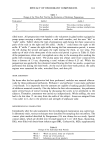
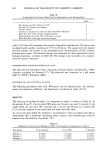
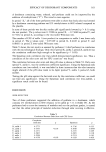
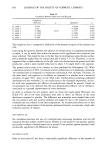
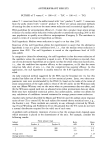
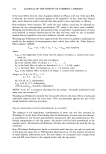
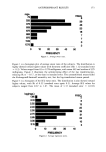
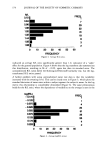
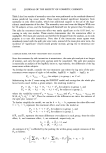
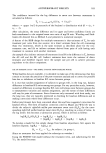
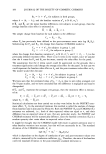
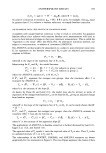
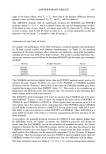
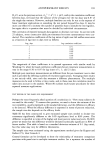
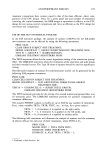
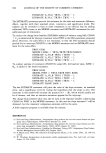
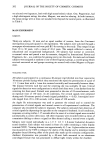
196 JOURNAL OF THE SOCIETY OF COSMETIC CHEMISTS ESTIMATE 'A_VS_C' TRTA 1 TRTC - 1 ESTIMATE 'B_VS_C' TRTB 1 TRTC - 1. The ESTIMATE statements provide the estimates for the sides and treatment difference effects, together with their standard errors, t-statistics, and significance levels. The analysis can be extended to four or more treatments in an obvious way by adding additional TRTn terms in the MODEL statement and ESTIMATE statements for each additional pair of treatments. To conduct the change from baseline (CHGBAS) analysis of variance using SAS, CHNG = Cii is substituted for the post-treatment value POST in the SAS statements presented above. However, the sides effect is not estimated, so that the SAS statements should provide for no intercept (NOINT) in the MODEL statement and no ESTIMATE state- ment for the sides effect. PROC GLM MODEL CHNG = TRTA TRTB TRTC/NOINT ESTIMATE 'A_VS_B' TRTA 1 TRTB - 1 ESTIMATE 'A_VS_C' TRTA 1 TRTC -1 ESTIMATE 'B_VS_C' TRTB 1 TRTC - 1. To conduct analysis of covariance (ANCOVA) using SAS, the baseline value, BASE = Bij , is added in the model statement. PROC GLM MODEL POST = TRTA TRTB TRTC BASE ESTIMATE 'A_VS_B' TRTA 1 TRTB -1 ESTIMATE 'A_VS_C' TRTA 1 TRTC - 1 ESTIMATE 'B_VS_C' TRTB 1 TRTC - 1 ESTIMATE 'SLOPE' BASE 1. The last ESTIMATE statement will print the value of the slope estimate, its standard error, and a significance level for testing the hypothesis that the slope is zero. The intercept in this model will estimate the quantity •(1 - [3), which would usually not be of interest, and thus no estimate statement appears for the int.,•ercept. The change from baseline value may also be used as the response variable, substituting CHNG for POST in the MODEL statement. In this case the slope estimate b' will be obtained, but the treatment comparison estimates will be the same. A SAS computer program is available from the authors. REFERENCES (1) Food and Drug Administration, Antiperspirant drug products for over-the-counter human use (pro- posed rule), Federal Register, 46693-46732 (October 10, 1978). (2) Food and Drug Administration, Antiperspirant drug products for over-the-counter human use (ten- tative final monograph), Federal Register, 36492-36505 (August 20, 1982). (3) Food and Drug Administration, Guidelines for Effectiveness Testing of OTC Antiperspirant Drug Products, Dockets Management Branch [HFA-305] (August 1982). (4) P. Majors and J. Wild, The evaluation of antiperspirant efficacy, J. Soc. Cosmet. Chem., 25, 139-152 (1974). (5) W. Wooding, Interpretation of gravimetric axillar antiperspirant data, Proc. Joint Conf. on Cosmet. Sciences, 91-105 (1968).

ANTIPERSPIRANT RESULTS 197 (6) (7) (8) (9) (lo) (11) (12) (13) (14) (15) w. Wooding and P. Finklestein, A critical comparison of two procedures for antiperspirant evalua- tion, J. Soc. Cosmet. Chem,, 26, 255-275 (1975). W. Cochran and G. Cox, Experimental Designs (John Wiley & Sons, New York, 1957). G. Milliken and D. Johnson, Analysis of Messy Data, Volume I: Designed Experiments (Lifetime Learning Publications, Belmont, CA, 1984). J. Fleiss, The Design and Analysis of Clinical Experiments (John Wiley & Sons, New York, 1986). A. I. MacLennan and K. A. Whinney, Hot-room testing of antiperspirant products, Chemistry and Industry, 13 (1987). N. Laird, Further comparative analyses of pretest~posttest research designs, The American Statistician, 37, 329-330 (1983). M. J. Egger, M. Coleman, J. Ward, J. Reading, and H. Williams, Uses and abuses of analysis of covariance in clinical trials, Controlled Clinical Trials, 6, 12-24 (1985). E. J. Stanek, Choosing a pretest-posttest analysis, The American Statistician, 42, 178-183 (1988). B. J. Winer, Statistical Principles in Experimental Design (McGraw-Hill, New York, 1971). L. Kupper and K. Hafner, How appropriate are popular sample size formulas? The American Statisti- cian, 43, 101-105 (1989).
Purchased for the exclusive use of nofirst nolast (unknown)
From: SCC Media Library & Resource Center (library.scconline.org)