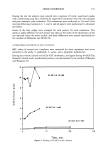
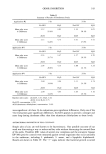
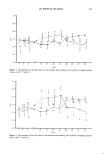
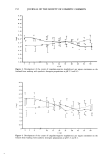
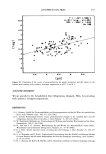
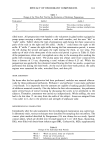
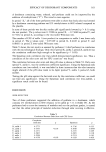
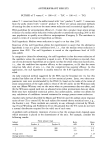
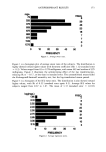
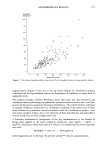
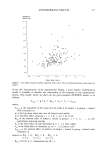
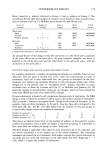
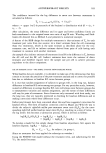
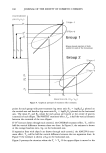
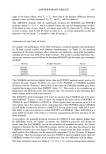
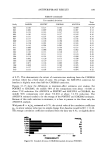
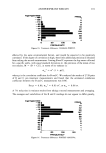
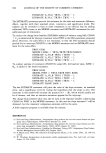
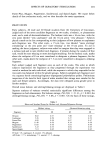
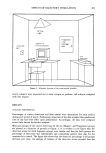
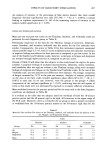
ANTIPERSPIRANT RESULTS 191 Iog(•)x1000 -- 113 1•) 37 I ß o 9 16 6'7' 1,4.,4. •)0 FREQUENCY Figure 13. Treatment differences: CHGBAS-POSTRT. affected by the same environmental factors, and would be expected to be positively correlated. If the degree of correlation is high, then little additional precision is obtained from taking the second measurement. Letting B and C represent the log sweat collected for a specific axilla, with equal standard deviations 0., the precision of the mean of two test results, M = (B 4- C)/2, in terms of its variance is: 0.m 2 = 0 '2 (1 + p)/2, where p is the correlation coefficient for B and C. We analyzed the results of 2728 pairs of B and C pre-treatment measurements and found that the estimated correlation coefficient between the B and C measurements was 0.86. 2 0.93 0.2 For p = 0.86, 0.m = , or 0.m = 0.96 0.. A 7% reduction in variance results from taking a second measurement and averaging. The averages and variabilities of the B and C readings do not appear to differ greatly, log (mgs)x1000 --48 --24 --12 0 0 FREQUENCY 14 42 147' 38 12 3 4 1 1 Figure 14. Treatment differences: POSTRT-ANCOVA.

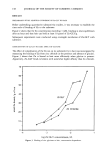
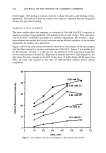
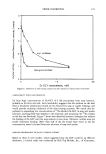
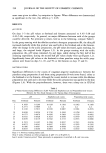
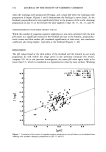
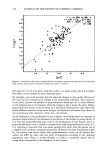
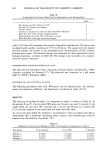
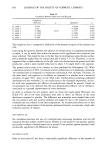
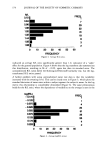
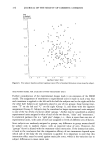
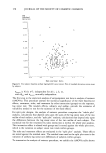
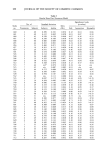
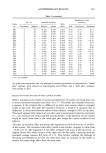
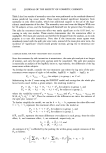
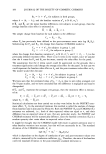
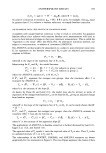
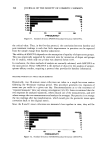
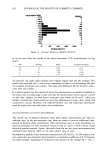
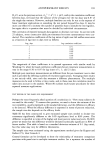
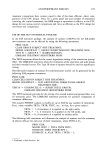
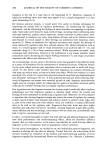
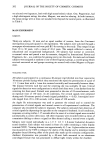
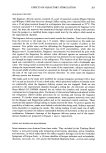
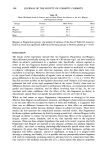
192 JOURNAL OF THE SOCIETY OF COSMETIC CHEMISTS --12 0 o FREQUENCY Figure 15. Treatment differences: CHGBAS-ANCOVA. 1 4, 174, •o 6 4, 1 2 as can be seen from the results of the above-mentioned 2728 measurements (in log units): Side Reading Mean Standard deviation R B 2.62 0.31 R C 2.64 0.27 L B 2.58 0.30 L C 2.61 0.28 As expected, the right axilla readings were slightly higher than the left readings. The results indicated that the C values were comparable in value to the B readings and that the standard deviations were similar. The right-left differences for the B and C collec- tions were also similar. It could be argued that the expense of the second measurement is minimal compared to the fixed costs of conducting a study and that the second result can be used as a check for bad data. Indeed, we have found occasional cases where the B and C collections yielded contradictory results and have used this information to reject data, using very conservative criteria. However, the tradeoff between cost and additional information must be resolved by the individual clinical laboratory. MULTIPLE BETWEEN-DAY SWEAT MEASUREMENTS The second case of repeated measures arises when repeat measurements are taken on multiple days. In the pre-treatment case, these are meant to provide additional infor- mation on baseline sweat performance. This information may, in some procedures, be used for adjustment of post-treatment values or may be used to check current versus historical panelist response. Again, the results from the two hot-room measurements are correlated since they are taken on the same subject close in time. Retrospective analysis of pre-treatment measurements, D• and D2, on 206 subjects over two consecutive pre-treatment days resulted in a correlation coefficient of 0.74 between the daily averages. Applying the formula for the variance of the average, M = (D1 q-
Purchased for the exclusive use of nofirst nolast (unknown)
From: SCC Media Library & Resource Center (library.scconline.org)