j. Soc. Cosmet. Chem., 45, 279-298 (November/December 1994) The kinetics of hair reduction TREFOR A. EVANS, TOMAS N. VENTURA, and AMY BETH WAYNE, Helene Curtis Inc., 4401 W. North Avenue, Chicago, IL 60639. Received February 17, 1994. Synopsis The single fiber tensile kinetic (SFTK) technique is established in the literature as a means of following the rate at which a reducing agent is able to break the keratin disulfide bonds during the permanent waving process. Here we present a slight modification to this method, as well as a means of further analyzing the data obtained from such experiments. As such, this work has allowed for the identification of a variety of kinetic behaviors. Fluorescence microscopy has also been used to try and characterize these various behav- iors. In addition, we have further used the method described to investigate the influence of factors such as pH, concentration, and hair type on the permanent waving process. Results have shown that the properties of the reducing agent solution and the influence of hair type can severely alter not only the reaction rate, but also the kinetic behavior. INTRODUCTION Although the permanent waving process has been around for many years, it is still perhaps somewhat remarkable that so little is known about the manner in which this procedure occurs. The overall mechanism is usually described in terms of breaking keratin disulfide bonds via nucleophilic attack with a thiolate ion. The pKa and chem- ical structure of the thiol, and the pH and concentration of the subsequent solution, all determine the efficiency with which this process can be performed. These disulfide bonds can then be reformed by treatment with an oxidizing agent, allowing the fibers to be held in their new configuration. However, this simplified explanation does not explain why various hair types can react with a given perm solution with varying degrees of success--a well known problem in the field. Additionally, it is also known that various reducing agents may not necessarily behave when reduced to practice in the manner predicted. For further investigation it is necessary to have a technique that would allow for the monitoring of the reaction progression under a variety of conditions. One such method that would seem to have promise is that of single fiber tensile kinetics. The term single fiber tensile kinetics (SFTK) was coined by Wickett (1), although the general technique can be dated back to the work of Reese and Eyring (2). This method involves following the progression of the reducing agent/hair reaction by monitoring the tensile properties of the fiber. The technique is based on imposing a 2% strain on a fiber 279

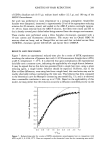
280 JOURNAL OF THE SOCIETY OF COSMETIC CHEMISTS and then monitoring the relaxation in stress that occurs as a result of the reducing agent breaking the disulfide bonds within the hair. Thus, by assuming that (i) each disulfide bond in the hair contributes equally to the overall tensile strength, and (ii) the 2% strain is within the linear region of the stress-strain curve, the stress decay data is used as an indication of the reaction progression. First, there may be some reservations about this initial claim regarding the contribution of each disulfide bond to the overall tensile properties. This is obviously the underlying assumption on which the success of the whole method depends however, there appears to be no evidence in the literature to either prove or disprove this presumption. Nevertheless, it is observed that the tech- nique has been sporadically used in the literature (3,4), with what appears to be a certain degree of success. Therefore, although the concerns are noted, it is still considered viable to use this method. Second, it should be pointed out that there is some question in the literature regarding the position of the Hookean region. Various reports have the Hookean region extending anywhere between approximately 1% to 2% strain, with some of this variability possibly being accounted for by the effect of the strain rate (5). In addition, Bendit (6) has claimed that because of the viscoelastic properties of keratin, hair fibers will not possess a Hookean region and that the linear region in the stress- strain curve is actually an inflection point caused by the viscoelastic curvature and experimental factors. The progression of the hair reduction process can have two limiting factors: the rate of the chemical reaction between the reducing agent and the disulfide bonds, and the ability of the reducing agent to diffuse into the fibers. Therefore, if diffusion is fast compared to the chemistry, then the overall rate is dictated by the chemical reaction (i.e., reaction-controlled). If diffusion is slow compared to the reaction rate, then the diffusion becomes the limiting step (diffusion-controlled) and the reaction progresses via the propagation of a well-defined reaction interface into the fibers. Mathematical expressions have been put forward to describe these two limiting cases in terms of the tensile properties. Reese and Eyring (2) postulated a first order expression to describe reaction-controlled processes: F(t) = F(0)exp(- kCot) (1) while Wickett (1) has derived a moving boundary model to describe diffusion-controlled processes: F(t)= F(0)exp[- (2• ka •ø)t 3/2] (2) where F(t) is the force at time t, F(0) is the initial force, C O is the initial concentration, k is the specific reaction rate constant, A is the cross-sectional area, and T is the temperature. It would seem then, that the single fiber tensile technique can quantitatively follow the reduction of hair fibers and that theoretical models already exist to which our data can be compared. However, it would be desirable to have a uniform data transformation technique that would allow for the comparison of experiments carried out under a variety of different conditions. To accomplish this, it appears possible that we can borrow some ideas from the analogous field of heterogeneous reaction kinetics.
Purchased for the exclusive use of nofirst nolast (unknown)
From: SCC Media Library & Resource Center (library.scconline.org)