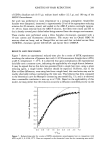
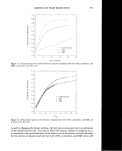
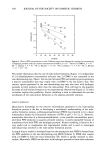
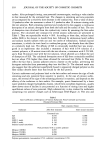
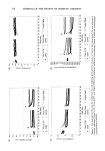
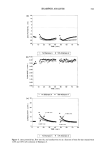
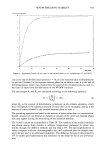
INDO-ANILINE DYE FORMATION 307 .Scheme II H202 RDS kl Intermediate (1) H202 ) Undesired Products (2') -I- • /C• I•1 • Oxidant ) 1(3 k:• H•N v v 'O Fast Intermediate-- (2" (3) lent since only one parameter (k2') is used to fit three sets of experimental data. The rate constant of the reaction between the intermediate formed in Scheme II and hydrogen peroxide (k 2' in Scheme II) is •300 times higher than the rate constant of the reaction between PBDI and hydrogen peroxide (k 2 in Scheme I). Therefore, reaction 2' is mainly responsible for the loss of reacted PPD to products other than the indo-aniline and is responsible for the observed decreases in indo-aniline formation at higher concentrations of hydrogen peroxide (shown in Figure 2). From Scheme II, it is clear that the conversion efficiency of PPD to the indo-aniline is essentially governed by the ratio of k2"/(k 2' [H202] ). At low [H202] , the rate of reaction 2' is less significant than that of reaction 2". Most of the reacted PPD are predominantly converted to the indo-aniline. As [H202] is increased, increasingly the reacted PPD is consumed through reaction 2', and the efficiency of PPD to the indo- aniline is decreased. In conclusion, the formation of a more reactive intermediate other than p-benzoquinone diimine is suggested in our kinetic modeling of the indo-aniline formation process in aqueous peroxide solution. The reduced conversion efficiency of PPD to indo-aniline at higher [H202] can be explained by an increasing consumption of the reactive interme- diate by hydrogen peroxide. ACKNOWLEDGMENTS We would like to thank Dr. K. Brown and Dr. J. F. Corbett for useful suggestions and

308 JOURNAL OF THE SOCIETY OF COSMETIC CHEMISTS discussions. Y. Feng would like to thank the Lawrence M. Gelb Research Foundation for providing financial support. REFERENCES (1) C. R. Robbins, The Chemical and Physical Behavior of Human Hair (Van Nostrand Reinhold, New York, 1979). (2) J. F. Corbett,J. Chem. Soc., B, 1418-1427 (1970). (3) J. F. Corbett, J. Soc. Cosmet. Chem. 20, 253-263 (1969). (4) J. F. Corbett, J. Chem. Soc., B, 207-212 (1969). (5) J. F. Corbett, J. Chem. Soc., B, 818-822 (1969). (6) J. F. Corbett, J. Soc. Cosmet. Chem. 23, 683-692 (1972). (7) J. F. Corbett, JSDC, 71-73 (February 1969). (8) N. Pekmez, K. Pekmez, and A. Yildiz,J. Electroanal. Chem., 348, 389-398 (1993). (9) U. Nickel, Y. H. Chen, S. Schneidner, M. I. Silva, H. D. Burrows, and S. J. Formosinho, J. Phys. Chem., 98, 2883-2888 (1994).
Purchased for the exclusive use of nofirst nolast (unknown)
From: SCC Media Library & Resource Center (library.scconline.org)