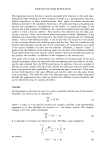
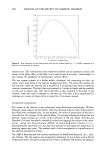
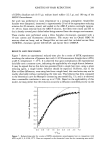
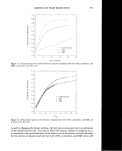
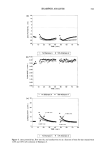
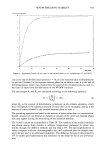
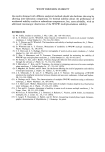
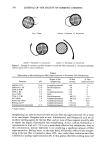
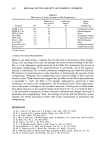
INDO-ANILINE DYE FORMATION 305 Scheme I PPD H202 RDS kl H202 PBDI Undesired Products (1) (2) +l• c• 2,6-DMP kt •. v v 'o I Fast • Indo-aniline (3) N...•% H•O• •. v T '0 k4 Decomposition (4) products. Although more chemical reactions may be involved in indo-aniline formation, this kinetic model includes only those reactions that are kinetically significant to affect the rates of the indo-aniline formation. All kinetic parameters included in Scheme I were obtained either experimentally in the present study or taken from the literature (2,3). Therefore, quantitative prediction of indo-aniline formation using this kinetic model is possible. The rate constant for reaction between PBDI and hydrogen peroxide (reaction 2) was obtained from conducting supplementary experiments to study kinetics of reac- tion between PBDI and hydrogen peroxide in pH = 9.2 borax buffer, using the spectrophotometer. PBDI was quantitatively synthesized by mixing one mole of PPD and two moles of K3Fe(CN) 6 (4). The coupling rate constant between PBDI and 2,6- DMP, k 3 (rate constant of second order reaction), in aqueous solution was obtained by J. F. Corbett (2). Figure 5a plots the calculated values of indo-aniline formation (lines) at three different [H202] using Scheme I and their corresponding experimental data (symbols). In gen- eral, predicted indo-aniline concentration using Scheme I is much higher than that of the corresponding experimental values. The differences between the calculated values of indo-aniline concentration and the experimental data increase as [H202] is increased. Clearly, reaction 2 in Scheme I is not sufficient to account for the loss of quantity of PPD consumed in the indo-aniline formation process.

306 JOURNAL OF THE SOCIETY OF COSMETIC CHEMISTS 0.5 5a Calculation using Scheme I 0.4- 0.3- 0.0 I I 0.30 0.25 0.20 0.15 0.10 0.05 0.00 5b, Calculations using Scheme II I 20 I I I 0 10 20 30 40 50 60 70 80 90 100 0 40 60 80 100 Time/min. Time/min. Figure 5. Comparison of calculated indo-aniline concentrations using Scheme I (Figure 5a) and Scheme II (Figure 5b), with the corresponding experimental data obtained using three set of concentrations of hydrogen peroxide. [PPD] = 1.9 X 10 -4 M [2,6-DMP] = 2.9 X 10 -4 M pH = 9.2 Experimental data: A, [H202] = 5.3 X 10 -3 M El, [H202] = 3.5 X 10 -2 M C), [H202] = 7.0 x 10 -2 M. Calculated values/Scheme I: A, ... - [q, ------' ¸, .. .. Calculated values/Scheme II: A, ........ I-1, '0 ..... During the PPD oxidation process, the reaction between PBDI and PPD is known to produce Bandrowski's base. The kinetics and mechanism of Bandrowski's base formation have been extensively studied by J. F. Corbett (5-7). However, including this reaction in our scheme (Scheme I) does not show any significant effect in reducing the difference between the experimental and calculation values shown in Figure 5a. In other words, self-reaction of PPD is insignificant under the experimental conditions used. Modification of Scheme I is made by assuming that a reactive intermediate instead of PBDI is formed in the rate determining-step (Scheme II). While this reactive interme- diate is reacting with hydrogen peroxide to form products other than the indo-aniline (reaction 2'), it is also rapidly converted to PBDI (reaction 2"). Once PBDI is formed, the dominant path will be the coupling reaction between PBDI and 2,6-DMP. The intermediate formed in Scheme II is likely to be a cationic radical formed by the loss of one electron from PPD. Although little is known about this cationic radical, there are reports that cationic radicals are formed from the oxidation of substituted PPDs in aqueous solution (8,9). Both rate constants of reaction 2', k2' , and of reaction 2", k2", are unknown. However, the value of k2" can be estimated from experimental data of indo-aniline formation obtained using low [H202] where reaction 2' is assumed to be negligible. Therefore, only the rate constant for reaction 2' is unknown and is used as an adjustable parameter in fitting experimental data. It is assumed that reaction 2' follows the same kinetic law as that of the reaction between PBDI and hydrogen peroxide. Simulations of indo-aniline formation with k 2' as fitting parameter are shown in Fig- ure 5b (lines) and are compared with the corresponding experimental data. Agree- ment between the predicted values (lines in Figure 5b) and our experimental observa- tions (symbols in Figure 5b), over tenfold variation of [8202] is considered excel-
Purchased for the exclusive use of nofirst nolast (unknown)
From: SCC Media Library & Resource Center (library.scconline.org)