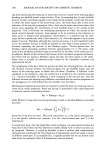
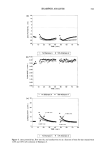
SHAMPOO ANALYSIS 325 disparity in such formulation variables as the concentration of a conditioning polymer (as well as its charge density, molecular weight, degree of alkoxylation, etc.) and the composition of a surfactant system. The drift of zeta potential toward less negative values during rinsing suggests an initial deposition of a surfactant-rich cationic poly- mer-anionic detergent complex, with subsequent desorption of the surfactant during rinsing. The sign of the zeta potential remains negative or close to zero even after extended rinsing with the test solution, which points to a neutralization effect of the strongly bound fraction of the anionic surfactant to the polymer. Note that the adsorp- tion of a polymer alone should lead to a reversal of the sign of the zeta potential of hair surface, as demonstrated by the data obtained for Jaguar C17 (Figure 2a-d). Similar trends were observed for other commercial cationic guar gums such as those known under the tradenames of Jaguar c13 and C14 manufactured by Rhone-Poulenc. A very significant reduction in plug permeability is also evident for shampoos C, D, and E after the first and the second treatment cycles. This sugg•sts the formation of deposits of the polymer-surfactant complex on hair, with the thickness ranging from 0.9 to 5.0 •m. It should be stressed that the calculated thickness of the conditioning layer refers to its wet, swollen state consisting of active components, thickeners, etc. Dry-state thickness is probably 2-3 orders of magnitude smaller, i.e., 0.05-0.005 •m. It is also noteworthy that the adsorption of cationic guar gum alone produces a significant de- crease in plug permeability even at very low polymer concentration (0.01%, Figure 2b). This property of cationic guar gum is probably related to the fact that the branched polymer forms turbid microdispersions, with micron-size swollen particles or microgels rather than true solutions in the aqueous medium. Because of the positive charge, the particles deposit or coagulate on hair with the retention of their extended conformation (shape), unlike linear cationic polymers, which spread into thin layers during the adsorption. The formation of thick polymer layers restricts the flow in plug microchan- nels, leading to a reduction in plug permeability. The conductivity data suggest a relatively fast removal of the excess ionic surfactants from the plug. In the first measurement cycle after the treatment, the conductivity readings were in the range from 5.5 to 7 •mhos/cm except for shampoos C and E. These two formulations produced the largest reduction in flow rates, which delayed the removal of the excess surfactant from the plug and resulted in high conductivity values in the first few cycles following the treatment. The small variation of conductivity with time (from the initial 5.5-7 •mho/cm to 5-5.5 •mho/cm after extended rinsing) for conditioning shampoos was nonexponential, and consequently the rate coefficients of desorption could not be calculated. In the case of nonconditioning shampoos based on anionic surfactants, the initial after-treatment reading was higher and ranged from 8 to 10 •mho/cm for the shampooings performed at 1%. Based on the initial values of conductivity after the treatment, one may conclude that the application of the systems depositing layers of cationic polymer on the hair surface leads to, alternatively, either less sorption of surfactants or their faster desorption from the polymer-surfactant com- plex formed on the fiber surface. These observations are consistent with the studies of SLS desorption discussed previously in the text of this paper, which showed 28% higher values of desorption rate coefficients from cationically modified hair. Further insight into the process of shampooing with a formulation based on cationic guar gum can be obtained by performing an experiment with four subsequent sham- pooings. Figure 7a-c presents the data obtained for a formulation similar (with a different polymer concentration) to that presented in Figure 6a-c (Shampoo C). Each

326 JOURNAL OF TIlE SOCIETY OF COSMETIC CHEMISTS (a) 20 (b) (c) 15- Zeta Potenbals After 7.5 Minute Rinsing 10 5- -2.94 mV -2.03, mV -1.44 mV -1.22 mV o -5- Shampoo-Shampoo Build-Up Coefficients -lo / 1-2 2-3 3-4 -200 • 1'0 1'5 2`0 2'5 3'0 3'5 4'0 4'5 5'0 5'5 6'0 6'5 7`0 7,5 8'0 8'5 90 TIME (MIN) 4.5- 3,5- n- 2- O u_ 1 0.5 o The thickness of deposited layer 1.80 IJm 2.34/am 2.93 pm Shampoo-Shampoo Build-Up Coefficients 1-2 2-3 3-4 0 • 1'0 1'5 2'0 2'5 3'0 3'5 4b 4'5 5'0 5'5 6'0 6'5 7'0 7'5 8'0 8'5 90 TIME (MIN) 2O 17.5- 15 12.5- 10- 7.5- 5- 2.5- Co • 10 1'5 2'0 2'5 3'0 3'5 4'0 4,5 5'0 5'5 6'0 6'5 7'0 7'5 8'0 8'5 90 TIME (MIN) Figure 7. Zeta potential (a), flow rate (b), and conductivity (c) as a function of time for hair treated with 1% solution of Shampoo C four times consecutively.
Purchased for the exclusive use of nofirst nolast (unknown)
From: SCC Media Library & Resource Center (library.scconline.org)