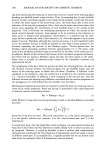
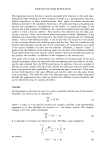
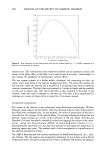
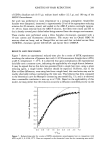
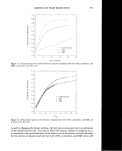
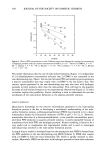
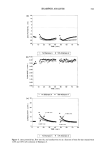
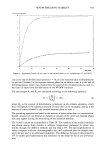
KINETICS OF HAIR REDUCTION 293 1.0 ..o 0.7 - / • 0.6 - • 0.5 - = / _o 0.4 / / ......•...•--"--"-- - • 0.5 - 0.2 -- cystearn•ne - ./ / -- - ATG 0.1 - ----- GMT - 0 5 10 15 20 25 time (mins) Figure 11. Fraction of reaction-vs-time data for the reduction of Japanese hair with ATG, cysteamine, and GMT, all at pH 9, 0.42 M, 25øC. 0.9 0.8 • v•v-v-v-- _ o :• 0.7 o o 0.6 - '• 0.5 • 0.4 • ff o Cysteamine • 0.3 • v ATG _ 0.2 • n GMT _ 0.1 0.0 0.0 0.5 1.0 1.5 2.0 2.5 3.0 5.5 4.0 t/to Figure 12. Reduced-time plots for the reduction of Japanese hair with ATG, cysteamine, and GMT, all at pH 9, 0.42 M, 25øC. As well as changing the kinetic pathway, the hair type can also give rise to an alteration in the overall reaction rate. The time at which the reaction reaches its midpoint (to. 5) is considered to be a good indication of the relative rate of the process, and the half times for the reaction of Japanese and fine hair with ATG, cysteamine, and GMT (all at pH

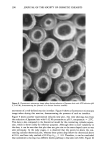
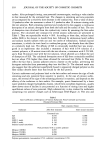
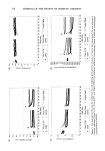
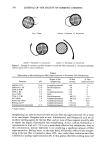
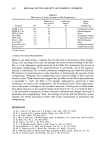
294 JOURNAL OF THE SOCIETY OF COSMETIC CHEMISTS 1.0 0.9 0.8 0.7 0.6 0.5 0.4. 0.3 0.2 0.1 0.0 0.0 ß ß ©© 0.5 1.0 1.5 2.0 2.5 5.0 t/t0. 5 Figure 13. Reduced-time plot obtained when using fine Caucasian hair in conjunction with ATG solution (pH 9, 0.42 M), demonstrating the presence of a strong sigmoidal behavior. Data are again compared to the contracting area model. Table II Difference in Reduction Times Between Japanese Hair and Fine Caucasian Hair for Some Common Reducing Agents (pH 9, 0.42 M, 25øC) Hair type ATG GMT Cysteamine Japanese hair 3.25 min 29.5 min 5.4 min Fine Caucasian hair 8.25 min 34.7 min 16.8 min 9, 0.42 M) are shown in Table II. It can be seen in each case that reaction with fine hair gives rise to considerably longer reaction times. Therefore, it may be concluded that one underlying reason for the poor reactivity of "difficult to perm" hair is probably the extra time that is required to break a suitable number of disulfide bonds in order to give a good curl strength. It is observed that changing the properties of the reducing solution can also change the kinetic behavior by which the reaction proceeds. Wickett (1) has described how reduc- tion with DTT (dithiothreitol) at pH 7 and 8 gives rise to a diffusion-controlled process, while at pH 10 and above the reduction is reaction-controlled. Figure 14 shows reduced- time data from the treatment of Japanese hair with 0.42 M cysteamine as a function of pH. It can be seen that from pH 6-9 we observe the same kinetic behavior as shown in Figure 9 however, at higher values we observe a change in the pathway to the type of behavior seen when using ATG as a reducing agent (Figure 7). Therefore, from the microscopy data we may postulate that here we are observing a change from reaction- controlled to diffusion-controlled conditions. Table III shows the average half times as a function of pH.
Purchased for the exclusive use of nofirst nolast (unknown)
From: SCC Media Library & Resource Center (library.scconline.org)