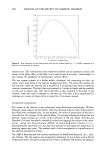
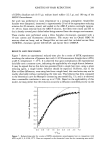
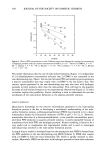
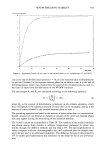
KINETICS OF HAIR REDUCTION 295 1.0 0.9 0.8 0.7 0.6 0.5 0.4 0.5 0.2 0.1 0.0 0.0 TYPE 1 • -- TYPE 2 •m- • - •/• - _ ø• 0 • _ t• o pH6 - a• © pH7 _ 2i•' v pH8 d• v pH9 _ r• u pill0 _ 0.5 1.0 1.5 2.0 2.5 3.0 5.5 4,0 t/to. 5 Figure 14. Reduced-time plots for Japanese hair treated with 0.42 M cysteamine as a function of pH. Table III Half Times for Reduction of Japanese Hair With 0.42 M cysteamine as a Function of pH pH of Reducing solution Half time (min) 6 63 7 37.5 8 29.5 9 7.6 10 4.9 Table IV Effect of Cysteamine Concentration on the Rate and Mechanism of Reaction When Treating Japanese Hair With Cysteamine at pH 9 Concentration Half time (to. 5) Kinetic behavior 0.3 M 10.5 min Reaction-controlled 0.42 M 5.4 min Reaction-controlled 0.6 M 5.5 min Diffusion-controlled Table IV shows results obtained from our laboratory, indicating the effect of varying cysteamine concentration when treating Japanese hair at pH 9. It is observed that at 0.3 M the reduction process is reaction-controlled, and as such an increase in concen- tration to 0.42 M results in shorter half times. However, further increasing the con- centration of the reducing solution does not result in any change in the half time, indicating that the process is no longer reaction-controlled. Performing the reduced- time analysis on the experimental data also confirms the presence of a change in kinetic behavior from the one shown previously for reaction with cysteamine to one that more resembles the diffusion-controlled behavior that was seen with ATG.

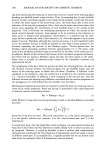
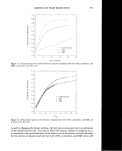
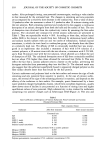
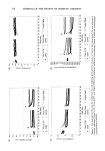
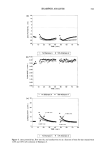
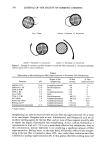
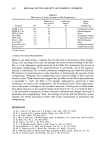
296 JOURNAL OF THE SOCIETY OF COSMETIC CHEMISTS Table V Smoothed Curves for the Various Experimental Reaction Behaviors That Have Been Observed Normalized time Type 1 Type 2 Type 3 Type 4 Type 5 0.1 0.08 0.08 0.04 0.02 0.05 0.2 0.15 0.13 0.06 0.04 0.09 0.3 0.21 0.18 0.10 0.06 0.13 0.4 0.26 0.23 0.14 0.09 0.18 0.5 0.31 0.28 0.19 0.13 0.23 0.6 0.36 0.33 0.24 0.18 0.29 0.7 0.40 0.38 0.30 0.25 0.34 0.8 0.44 0.42 0.36 0.32 0.40 0.9 0.47 0.46 0.43 0.40 0.45 1.0 0.50 0.50 0.49 0.49 0.49 1.1 0.53 0.54 0.55 0.57 0.53 1.2 0.55 0.58 0.61 0.64 0.56 1.3 0.57 0.61 0.66 0.70 0.59 1.4 0.59 0.64 0.70 0.75 0.61 1.5 0.61 0.67 0.74 0.78 0.63 1.6 0.63 0.69 0.77 0.81 0.64 1.7 0.64 0.72 0.79 0.83 0.65 1.8 0.65 0.74 0.81 0.84 0.66 1.9 0.66 0.76 0.83 0.85 0.67 2.0 0.67 0.77 0.84 0.86 0.67 2.1 0.68 0.79 0.85 0.86 0.67 2.2 0.69 0.80 0.86 0.87 0.68 2.3 0.69 0.81 0.86 0.87 0.68 2.4 0.70 0.82 0.87 0.87 0.68 2.5 0.70 0.83 0.87 0.87 0.68 3.0 0.73 0.85 0.88 0.87 0.69 3.5 0.75 0.86 0.88 0.87 0.69 4.0 0.77 0.88 0.88 0.87 0.69 During our studies, we have so far been able to identify the presence of five regularly occurring kinetic pathways based on the shapes of the reduced-time plots. These are shown in Table V and also pictorially in Figure 15. The two experimental behaviors that were obtained with the Japanese hair at pH 9 using cysteamine and ATG have been termed Type 1 and Type 2. It is also observed that there is more than one type of sigmoidal mechanism that can be obtained. The behavior shown in Figure 13 is termed Type 3 meanwhile, another sigmoidal behavior has also been obtained when using ATG, termed Type 4. This second type of sigmoidal mechanism has also been obtained when using cysteine as a reducing agent, and can be approximated quite well by Wickett's moving boundary mechanism up to ot•0.85 (Figure 16). A weaker sigmoidal behavior has also been obtained when using cysteamine as a reducing agent, and this behavior is termed Type 5. Again it is noted that with the exception of the contracting cylinder mechanism, none of the models shown in Table I are found to be applicable to the reduction of hair. CONCLUSIONS Although, in general, the heterogeneous kinetic models do not seem to be appropriate to hair/reducing agent interactions, the reduced-time technique is very useful in allow-
Purchased for the exclusive use of nofirst nolast (unknown)
From: SCC Media Library & Resource Center (library.scconline.org)