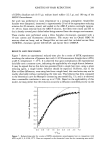
j. Soc. Cosmet. Chem., 45, 299-308 (November/December 1994) Kinetics and mechanism of indo-aniline dye formation in aqueous peroxide solution YAN FENG and ALEXANDER CHAN, Clairol R&D Research Laboratories, 2 Blachley Road, Stamford, CT, 06922. Received August 5, 1994. Synopsis Oxidation of a mixture of para-phenylenediamine (PPD) and phenols generates indo-aniline dyes. The process is of special interest with hydrogen peroxide (H202) , which is used commercially to induce permanent hair coloring formation. Although limited reports can be found to discuss the mechanism of indo-aniline formation by other oxidants, e.g., K3Fe(CN)6 and 02, little is known about the mechanism of indo-aniline formation in aqueous peroxide solution. Kinetic studies of indo-aniline formation by H20 2, recently carried out in our laboratories, indicate that indo-aniline is formed through a multiple-step scheme. The rate of indo-aniline formation was limited by PPD consumption, a kinetically slow step. Both promotion and inhibition of H202 on indo-aniline formation were observed and were accounted for by a mechanism developed based on kinetic modeling. INTRODUCTION Indo-anilines (I) are a series of colored compounds. These compounds, formed by the peroxide oxidation of a mixture of p-phenylenediamine and phenols, have been found to be very useful for hair coloring (1). Understanding the mechanism of indo-aniline formation is of interest to the hair coloring industry because of its particular values in the development of permanent hair coloring products. A detailed mechanistic study of indo-aniline dye formation was reported by J. F. Corbett (2-4) in the early 70s, using ferricyanide as the oxidizing agent. He reported stoichiometrical conversion of PPD to indo-aniline at pH 8.5 in excess of phenols. The kinetics of indo-aniline formation in the presence of ferricyanide is fast, and the indo-aniline formation is instant after the reactants are mixed. On the contrary, forma- tion of indooaniline under similar conditions, except for the use of hydrogen peroxide as the oxidant, was found to be a very slow process. Our studies indicate that multiple steps are responsible for indo-aniline formation in the hydrogen peroxide system. The efficiency of converting PPD to indo-aniline, which is defined as the ratio of the amount Address correspondence to Yan Feng at 4020 Yorktown Dr. #5, Fairfax, VA 22030. Alexander Chan's current address: Helene Curtis, Inc., R&D Dept., 4401 W. North Ave., Chicago, IL 60639. 299

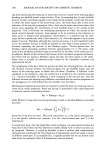
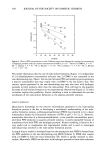
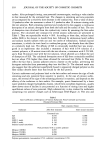
300 JOURNAL OF THE SOCIETY OF COSMETIC CHEMISTS H• O (i) R and R'=H,OH,NH2,NHR, alkyl, alkoxy. of indo-aniline formed to that of the PPD consumed, depends on the concentration of hydrogen peroxide used. Kinetic modeling is employed to explore the mechanistic steps responsible for the indo-aniline formation. EXPERIMENTS All experiments were performed in a pH = 9.2 borax buffer solution at room temper- ature. To maintain quantitative measurement of the rates of the indo-aniline formation and to minimize H202 decomposition, all reaction solutions were prepared in either Teflon or glass containers. The solution was then transferred by a plastic pipette into cuvettes for spectroscopic measurements. p-Phenylenediamine (PPD, 99%) and 2,6-dimethylphenol (2,6-DMP, 99.8%) were chosen as the primary reactants. They were obtained from Aldrich and were used directly as received. The hydrogen peroxide used as oxidizing agent was obtained from Clairol (6% Clairoxide). Reactant concentrations varied from 5 X 10 -5 to 1 X 10⁻³ M for both PPD and 2,6-DMP and from 5 X 10⁻³ to 2 X 10- • M for hydrogen peroxide. The lowest reactant concentration that can be used was limited by the experimental techniques used. The highest limits of reactant concentrations of PPD and 2,6-DMP were selected to assure that only primary reactions responsible for indo-aniline formation were studied. The hydrogen peroxide concentration is controlled to be less than 0.2 M under the experimental conditions used, in order to maintain the pH of the buffer solution. The rate of indo-aniline dye formation was obtained from the initial slope of indo-aniline concentration profiles, which were obtained by monitoring the optical density of indo- aniline formed at maximum absorption wavelength using a UV/VIS spectrophotometer (Lambda 6, Perkin Elmer). The PPD disappearance rate was determined by monitoring the PPD consumption as a function of time. At a given time, the PPD concentration was determined by adding sufficient ferricyanide salt to a reaction mixture to convert all the unreacted PPD rapidly to the corresponding indo-aniline of known extinction coefficient (1 X 10 -4 M/O.D. for 2,6-dimethyl-indo-aniline) (2). Effects of reactant concentrations on the rates of indo-aniline formation were studied by varying one reactant concentration at a time while others were kept constant at fixed pH. All kinetic data were collected at the time when the amount of indo-aniline (product) formed accounted for •5% of the initial PPD concentration. All kinetic modeling described below was performed using "scientist" software from Micromath, Inc.
Purchased for the exclusive use of nofirst nolast (unknown)
From: SCC Media Library & Resource Center (library.scconline.org)