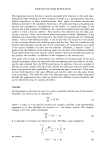
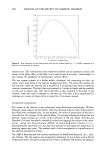
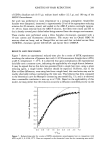
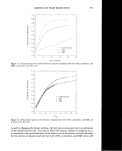
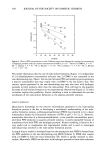
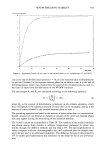
KINETICS OF HAIR REDUCTION 287 '• 0.7 • 0.• • 0.5 / // - / • 0.3 /•// -- -moving boundary - 0.2 // -- -first order - / -contracting area 0.1 - 0.0 I • 0 5 10 15 20 t/t0.1 Figure 5. Theoretical reduced-time plots for the first order, moving bounda•, and contracting area expressions, normalizing at • = 0.1. [-ln(1 - o0] ¾2 = kt (20) This theoretical model also produces a sigmoidal reaction profile, as shown in Figure 6. EXPERIMENTAL TENSILE TESTING The tensile testing was carried on an Instron Model 1122. The hair samples included unaltered European hair from a single donor (supplied by DeMeo), Japanese hair (ob- tained from Helene Curtis Inc., Japan), or hair collected from internal donors. Our testing method differs from Wickett's in that as opposed to conventional stress relaxation, we use a 2% intermittent stress relaxation. As such, our experiment involves imparting a 2% strain on the fiber, measuring the stress, and then removing the strain. This process is repeated every 30 seconds at a rate of 0.5 inches/rain, allowing the progression of the reaction to be mapped via the decrease in the stress. This intermittent approach is assumed to be more appropriate for following changes during a chemical reaction than the existing dynamic method, for the following reason. During a static stress-relaxation experiment, the hair fiber is under strain at all times and because of its viscoelastic properties, it will constantly be trying to relax the stress. Superimposed over this mechanical stress relaxation is the chemically induced change in modulus that is caused by the breaking of the disulfide bonds. Therefore, these two factors are convo- lured. As long as the mechanical relaxation is considered to be faster than the chemically induced change, the experiment can be concluded to be measuring the resultant effect of the reducing agent. However, should the chemically induced relaxation be faster than the mechanical relaxation, then the data that is produced is not a true reflection of the

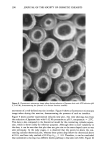
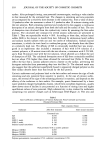
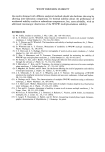
288 JOURNAL OF THE SOCIETY OF COSMETIC CHEMISTS 0.7 0.2- 0.1 - 0.0 0.1 0.2 0.3 0.4 0.5 0.6 0.7 0.8 0.9 .0 Fraction of Reaction Figure 6. First derivative of the reduced-time plot for the Avrami-Erofeev n = 2 model, expressed as a function of the fraction of reaction. reaction rate. The intermittent stress relaxation method can be assumed to reduce the extent of the above effect as the fiber is not under strain at all times. Additionally, it also reduces the possibility of mechanically induced effects. The test system consists of a double-walled cylindrical cell containing an inlet, an outlet, and a hook fitted to the base for engaging the fiber. The inner cell contains the test solution, while the external cell is attached to a circulating water bath to maintain constant temperature. The hair fibers are trimmed to 2 inches in length and are attached at each end to plastic tabs. One end of the fiber is then attached to the hook in the cylinder, while the other is clamped to the load cell. The fiber is first equilibrated by carrying out a series of strain cycles in water for a five-minute period. FLUORESCENCE MICROSCOPY The nature of the reaction is also monitored using fluorescence microscopy. Wickett obtained visual support for his kinetic results by staining thick sections of the reduced hair fibers with methylene blue. In this method, the extent of penetration of the dye is controlled by the porosity of the reduced fibers, the guiding assumption being that the porosity would increase as a result of the reduction of the hair fibers. Toy'oka and Kazuhiro (10) have described a method for selectively tagging the reduced sites them- selves, using the fluorochrome ABD-F [4-(aminosulfonyl)-7-fluoro-2, 1,3,- benzoxadiazole], and Evans (11) has used this material to investigate the penetration of reducing agents into wool. The method used in this investigation is a modification of the method described by Evans. The ABD-F fluorochrome was custom synthesized by MediChem Research, Inc., Lem- ont, Illinois. The test solution was prepared by dissolving 12.4 g of boric acid in 80 ml ofdeionized water. The pH was adjusted to 8 with 2 N NaOH, followed by the addition
Purchased for the exclusive use of nofirst nolast (unknown)
From: SCC Media Library & Resource Center (library.scconline.org)