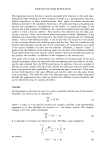
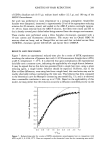
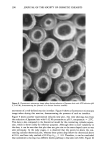
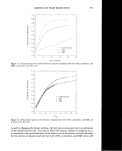
KINETICS OF HAIR REDUCTION 281 Heterogeneous reaction kinetics is usually associated with reactions in the solid state, particularly those involving the heat treatment of solids (e.g., decomposition reactions, volatile evaporation, or phase transformations). Here, again, the relative reaction and diffusion rates have to be considered. Reactions in the solid state begin at localized sites (nuclei) that correspond to imperfections on the surface, or corners and edges. If the reaction rate is fast compared to diffusion, then these nuclei spread across the surface and coalesce to form a reaction interface. This interface then advances into the solid, pro- ducing a reaction "front" with reactant ahead and product behind. Meanwhile, if the diffusion rate is faster than the reaction rate, the overall reaction proceeds via "branching chains," with no well-defined interface. It can be seen that this situation is very similar to that occurring between the reducing agent and the hair. Here the nucleation step between reducing agent and the hair can be considered to be instantaneous, as a result of the contact between the fiber and the solution. Therefore, a reaction "front" is produced by the diffusion of the reducing agent into the hair, with unbroken disulfide bonds ahead of the front and reduced cystine behind. Reaction-controlled processes do not produce this interface, as diffusion is fast compared to the reaction rate. This paper will attempt to demonstrate the usefulness of utilizing some of the data analysis techniques, which are associated with heterogeneous reaction kinetics, in treat- ing the data obtained from the SFTK experiments. In addition, there are a number of theoretical kinetic models that have been derived for solid-state reactions which have been investigated for their applicability in hair/reducing agent interactions. These mod- els have been based not only upon diffusion and reaction order, but also upon factors such as geometry. The work will show that although none of these models adequately describe the experimental data, there are distinctively different reaction behaviors that can be identified using the analysis described. THEORY In heterogeneous reactions the term ot is used to symbolize the fraction of the reaction. Therefore, the reaction rate is expressed as dot - kf (ot) (3) dt where t is time, k is the specific reaction rate constant, and f(ot) is the mathematical expression in ot that describes the reaction (i.e., the kinetic model). The simplest example is the first order relationship: dot - k(1 - ot) (4) dt It is desirable to eliminate the derivative term. Therefore, upon integration: we obtain o•=o• • t=t ' or=0 t=0 at (5) -ln(1 - ot) = kt (6)

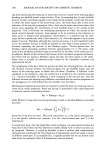
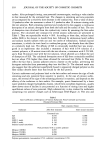
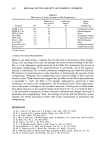
282 JOURNAL OF THE SOCIETY OF COSMETIC CHEMISTS or in a more general form: where g(•) = kt (7) g(c) = f f(c) (8) As outlined earlier, a number of kinetic models have been derived that have subse- quently been found to apply to many solid-state reactions. A summary of the most common expressions is shown in Table I, with both the integral and differential form of the various equations being given. It is not intended to give lengthy proofs or descriptions of the various models in this publication however, should they be required, an excellent summary (with a full set of references) is given in reference 7. It can be seen that the models in Table I are grouped into three main categories: acceleratory, decel- eratory, and sigmoidal. These classifications are the first step in differentiating between the applicability of various expressions at the experimental level. An acceleratory reac- tion is one in which the maximum rate of reaction is in the later stages therefore, the rate is increasing over the majority of the reaction. Similarly, a deceleratory reaction is one in which the maximum rate is in the early stages of the reaction, meaning that the rate is decreasing over the majority of the reaction. Finally, a sigmoidal reaction is one in which the maximum rate is near the middle of the reaction. (It should be pointed out Table I Broad Classification of Solid-State Expressions Acceleratory or-time curves g(ot) = kt f(ot) = 1/k(dot/dt) P 1 Power law O/. 1/n n(o0(n -- 1)/n E 1 Exponential law In ot ot Sigmoidal or-time curves A2 Avrami-Erofeev [-ln(1 - ot)] •/2 2(1 - ot)(-ln(1 - or)) •/2 A3 Avrami-Erofeev [-ln(1 - ot)] v3 3(1 - ot)(-ln(1 - or)) 2/3 A4 Avrami-Erofeev I-In(1 - or)] v4 4(1 - ot)(-ln(1 - or)) 3/4 B 1 Prout-Tompkins ln[ot/(1 - or)] or(1 - or) Deceleratory or-time curves Based on geometrical models R2 Contracting area 1 - (1 - o0 ¾2 2(1 - or) v2 R3 Contracting volume 1 - (1 - or) •/3 3(1 - o0 2/3 Based on diffusion mechanisms D 1 One-dimensional ot 2 1/2or D2 Two-dimensional (1 - ot)ln(1 - or) + ot (-ln(1 - ot))-• D3 Three-dimensional [1 - (1 - ot)•/3] 2 3/2(1 -- 0/.) 2/3 (1 -- (1 -- O/.)1/3) --1 D4 Ginstling-Brounshtein (1 - 2ot/3) - (1 - o0 2/3 3/2((1 - or) -•/3 - 1) -• Based on "order" of reaction F ! First order - In(1 - or) 1 - ot F2 Second order 1/(1 - or) (1 - or) 2 F3 Third order [1/(1 - ot)] • 0.5(1 - o0 3
Purchased for the exclusive use of nofirst nolast (unknown)
From: SCC Media Library & Resource Center (library.scconline.org)